
 Add as a preferred source on Google
Google’s Willow Magic-State Error Is One Million Times Above RSA Benchmark
The processor reached 99.99% fidelity and retained 8% of attempts after error checks; the experiment did not factor an RSA key.

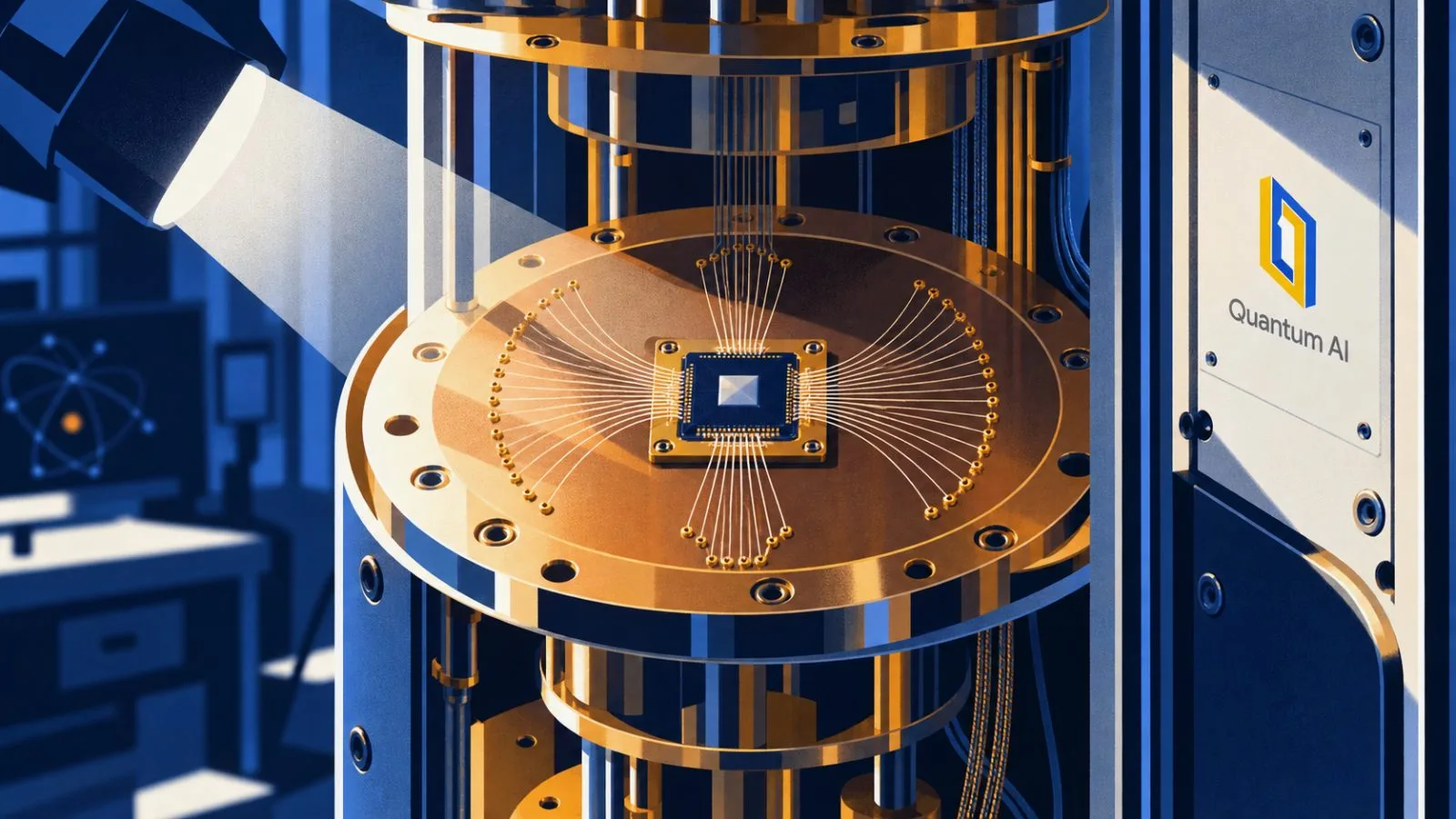
Google’s Willow processor lowered magic-state errors about 40-fold, but its roughly 10⁻⁴ error rate remains about one million times above a design benchmark associated with factoring RSA-2048.
Google Quantum AI announced the result Thursday, Oct. 15. The experiment measured fidelity of 99.99% and retained 8% of attempts after error checks. It prepared quantum states; it did not factor an RSA key.
Magic states enable non-Clifford operations used in universal, fault-tolerant quantum computing. Willow has 105 tunable transmon qubits. Researchers transferred a cultivated state from a distance-3 color code to a distance-5 surface code, demonstrating the process across two types of error-correction codes.
The million-fold comparison uses a roughly 10⁻¹⁰ magic-state infidelity associated with one RSA-2048 design. That figure is not a universal raw-state cutoff for factoring a key. A separate resource estimate uses cultivated T states with a target logical error of 10⁻⁷, followed by an 8T-to-CCZ distillation step estimated to reduce output error below 10⁻¹². These numbers describe different stages of a fault-tolerant computing design.
That separate estimate projects factoring a 2,048-bit RSA integer in less than a week with fewer than 1 million noisy qubits. Its assumptions include a square nearest-neighbor grid, 0.1% gate error, a 1-microsecond surface-code cycle and a 10-microsecond control reaction time. The Willow experiment does not demonstrate a system operating at that scale.
Google Quantum AI Research Scientist Emma Rosenfeld and Quantum Software Engineer Craig Gidney wrote that researchers “still need to demonstrate magic state cultivation at a larger scale to make it realistic for practical quantum computing.”
Simon Yoon
ReporterSimon Yoon reports on blockchain technology for TokenPost. Send corrections or tips to info@tokenpost.com.