
 Add as a preferred source on Google
RoboScript Achieves 83.4% Mean Success Rate Across 50 Bimanual RoboTwin 2.0 Tasks
A frozen foundation model practices a demonstrated task in simulation, then carries task knowledge in a Task Memory into new scenes.

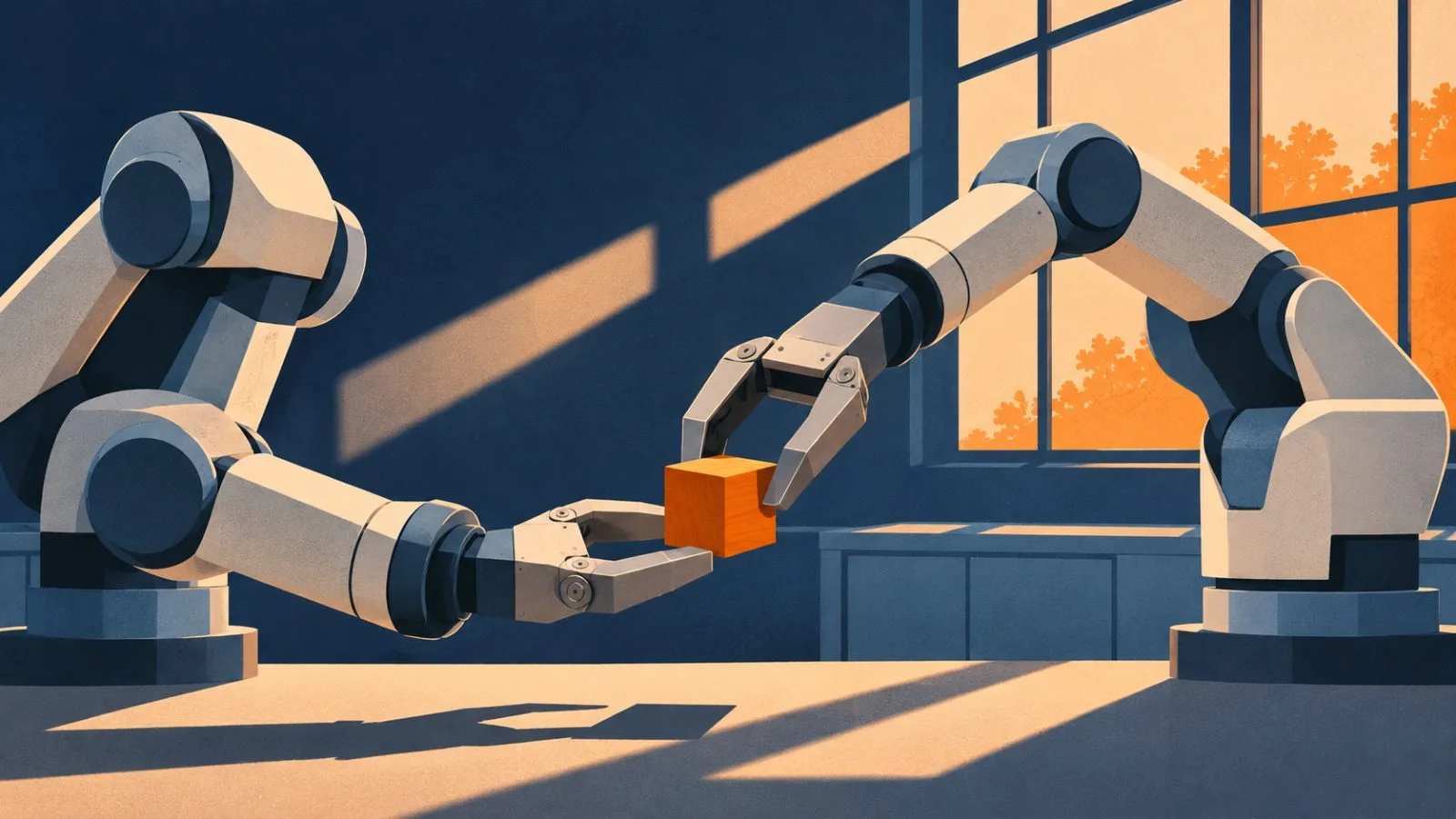
Researchers from Huazhong University of Science and Technology and ArcheOne AI developed RoboScript, which achieved an 83.4% mean success rate across 50 bimanual RoboTwin 2.0 tasks using one demonstration per task and no gradient updates.
RoboScript uses World In-Context Learning (WICL). A frozen foundation model rehearses a demonstrated task in simulation, then stores task knowledge in a Task Memory for use in new scenes.
The success rate was 83.6% in clean scenes and 83.2% in randomized scenes. That was more than 20 percentage points above the strongest trained action policy. Traditional approaches encode manipulation skills in model weights, which can limit adaptability to new environments.
RoboScript also transferred learned tasks to physical dual-arm robots. Its implementation is open source under Apache License 2.0. The study was published Nov. 11 on arXiv, and further validation on other benchmarks and real-world scenarios is anticipated.
Simon Yoon
ReporterSimon Yoon reports on blockchain technology for TokenPost. Send corrections or tips to info@tokenpost.com.