
 Add as a preferred source on Google
Claude-Assisted Robot Programs Completed 92.1% of Physical Trials
A dual-arm platform completed 221 of 240 runs across eight tasks. Claude Opus 5.5 helped develop the programs but was absent during evaluation.

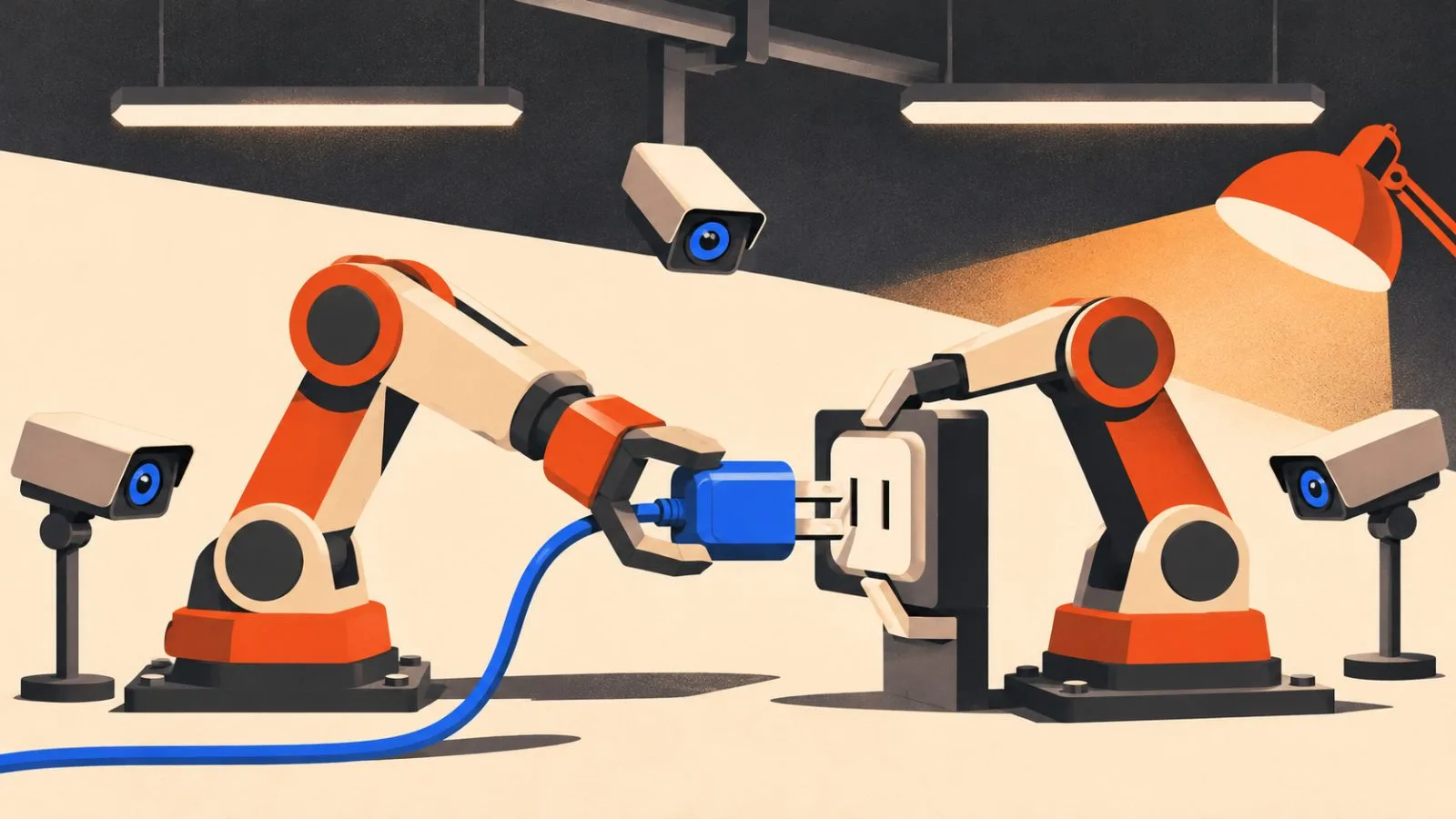
Programs developed with Anthropic’s Claude Opus 5.5 completed 221 of 240 physical robot trials, a 92.1% success rate across eight manipulation tasks. The ACE-CaP-0 study tested whether a coding agent could create task-specific programs that continued to work after development ended.
The ACE-CaP Team submitted its preprint Nov. 12. The test platform used two Agilex PIPERX arms and three Orbbec DaBai DC1 cameras. Each task program ran 30 physical trials without code updates, and neither people nor the coding agent were in the execution loop.
The programs’ decision rules stayed fixed, while live observations could still change the values and actions those rules produced. This separated the agent’s coding work from trial-by-trial control while keeping the robot responsive to new observations.
Tasks included charger insertion, bread packing, bottle uncapping, cup nesting, flower insertion, chicken plating, parcel reorientation and shoe packing. Charger insertion succeeded in all 30 trials, while bread packing had the lowest result at 25 of 30. Bottle uncapping, flower insertion and shoe packing each had 27 successes; cup nesting and parcel reorientation had 28 each, and chicken plating had 29.
Mean execution times ranged from 0.97 minutes for parcel reorientation to 2.27 minutes for shoe packing. The experiment measured task times but did not compare the system with live-model control, so it does not establish a speed advantage over that approach.
People took part during development. Developers could provide written guidance and physical demonstrations, and the coding agent could test revisions in simulation. The process allowed up to 10 human-assisted scene resets per task; resets for collecting demonstrations were excluded from that limit.
ACE-CaP-0 uses a Code-as-Policies design, combining task instructions with robot perception and control functions in executable programs. The results cover eight tasks on a dual-arm platform and do not establish performance in industrial settings or under new conditions. The team also wrote that “consistency across independent development runs remains to be established.”
Simon Yoon
ReporterSimon Yoon reports on blockchain technology for TokenPost. Send corrections or tips to info@tokenpost.com.