
 Add as a preferred source on Google
NVIDIA's Daviator Targets K-Point Bottlenecks in VASP GPU Runs
NVIDIA's OMat24-scale performance and cost figures are projections extrapolated from 13 sample inputs, not a run of the full dataset.

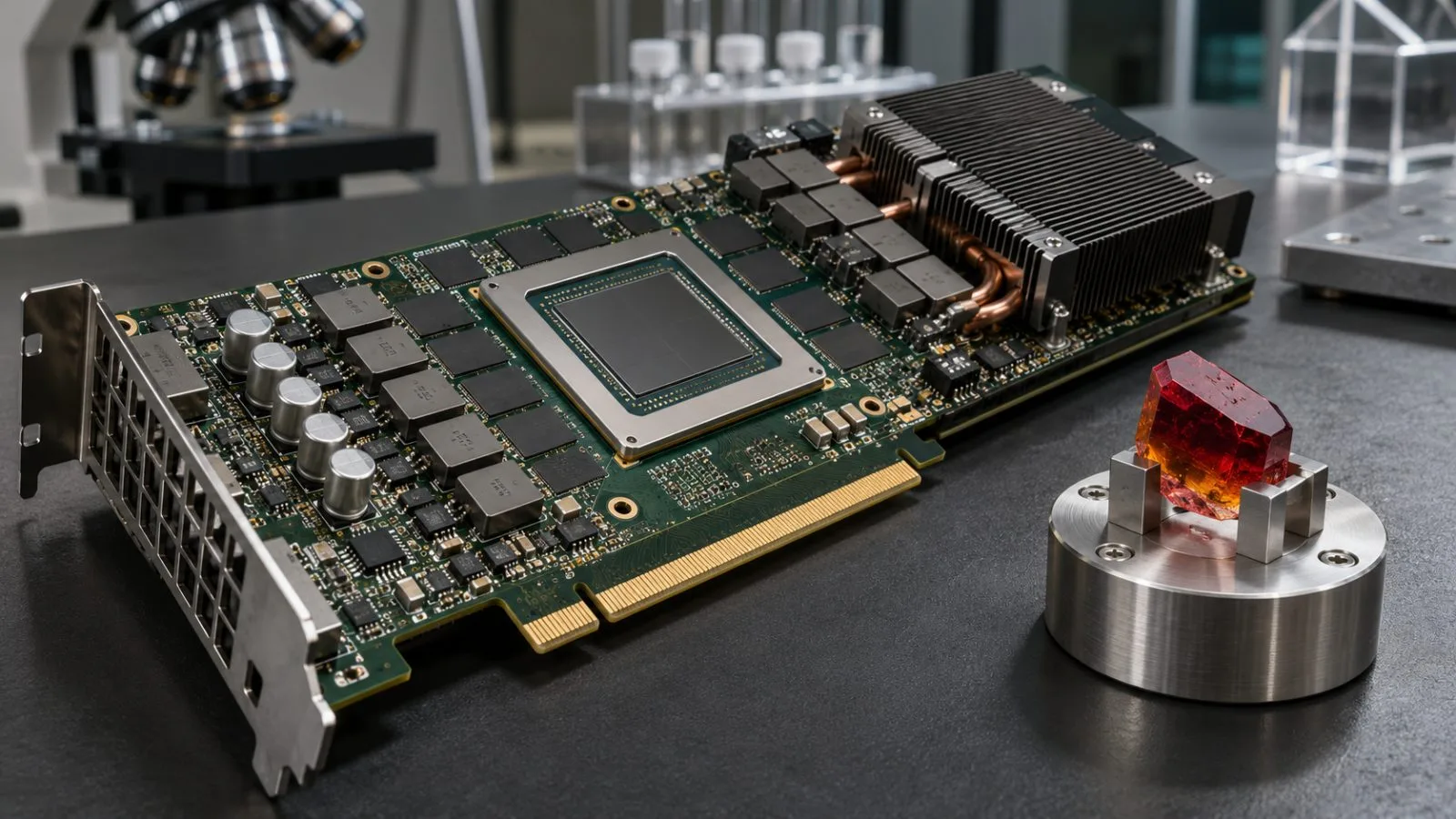
NVIDIA introduced Daviator on Nov. 18 to batch work across k-points in VASP, aiming to keep GPUs busier during materials simulations that can leave accelerators underused.
The Vienna Ab initio Simulation Package (VASP) runs plane-wave density functional theory (DFT), a method used to calculate material properties. DFT calculations can produce energies, forces and stresses used to train machine-learning interatomic potentials. NVIDIA says those models can require tens to hundreds of millions of calculations.
Daviator batches GPU operations across k-points, including through a batched Davidson eigensolver. NVIDIA says the approach reduces sequential processing and kernel launches while keeping data on the GPU.
In comparisons involving VASP 6.6.0 CPU and OpenACC baselines and H100, H200 and B200 GPUs, NVIDIA reported more than twice the speed of a CPU baseline for a single-iron-atom calculation. A 64-atom Bi-doped GaAs case had more than 85% lower execution time. Separately, the Davidson solver ran 22 times faster in a LiFePO₄ test using the r²SCAN functional.
The larger figures are projections for a workflow scaled to the Open Materials 2024 (OMat24) dataset, which contains more than 110 million DFT calculations. NVIDIA estimates VASP with Daviator could run up to 22 times faster than VASP on CPU nodes and up to seven times faster than VASP on GPUs without Daviator, using the same number of cloud instances. It projects costs 60% to 75% below CPU costs, or about $5 million to $6 million in savings.
Those estimates extrapolate from 13 representative inputs, rather than a run of the entire dataset. The benchmark inputs used reciprocal-space projectors, while OMat24 was generated with real-space projectors.
A separate mixed-precision option selectively uses FP32 while retaining FP64 for calculations that need greater accuracy. NVIDIA reported roughly twice the end-to-end acceleration against FP64 on RTX PRO 6000-class hardware, with only marginal end-to-end gains on H100 and H200 GPUs.
NVIDIA plans to offer Daviator through its ALCHEMI VASP microservice, which requires a VASP user license. The current implementation runs on a single node; NVIDIA expects multi-node support later but has not given a release date.
Simon Yoon
ReporterSimon Yoon reports on blockchain technology for TokenPost. Send corrections or tips to info@tokenpost.com.