
 Add as a preferred source on Google
OpenMind’s Iris Uses Living Human Neurons in Its Decision Loop
The humanoid sends camera footage online to neural cultures in Australia and Switzerland, then receives signals based on the cells’ activity.

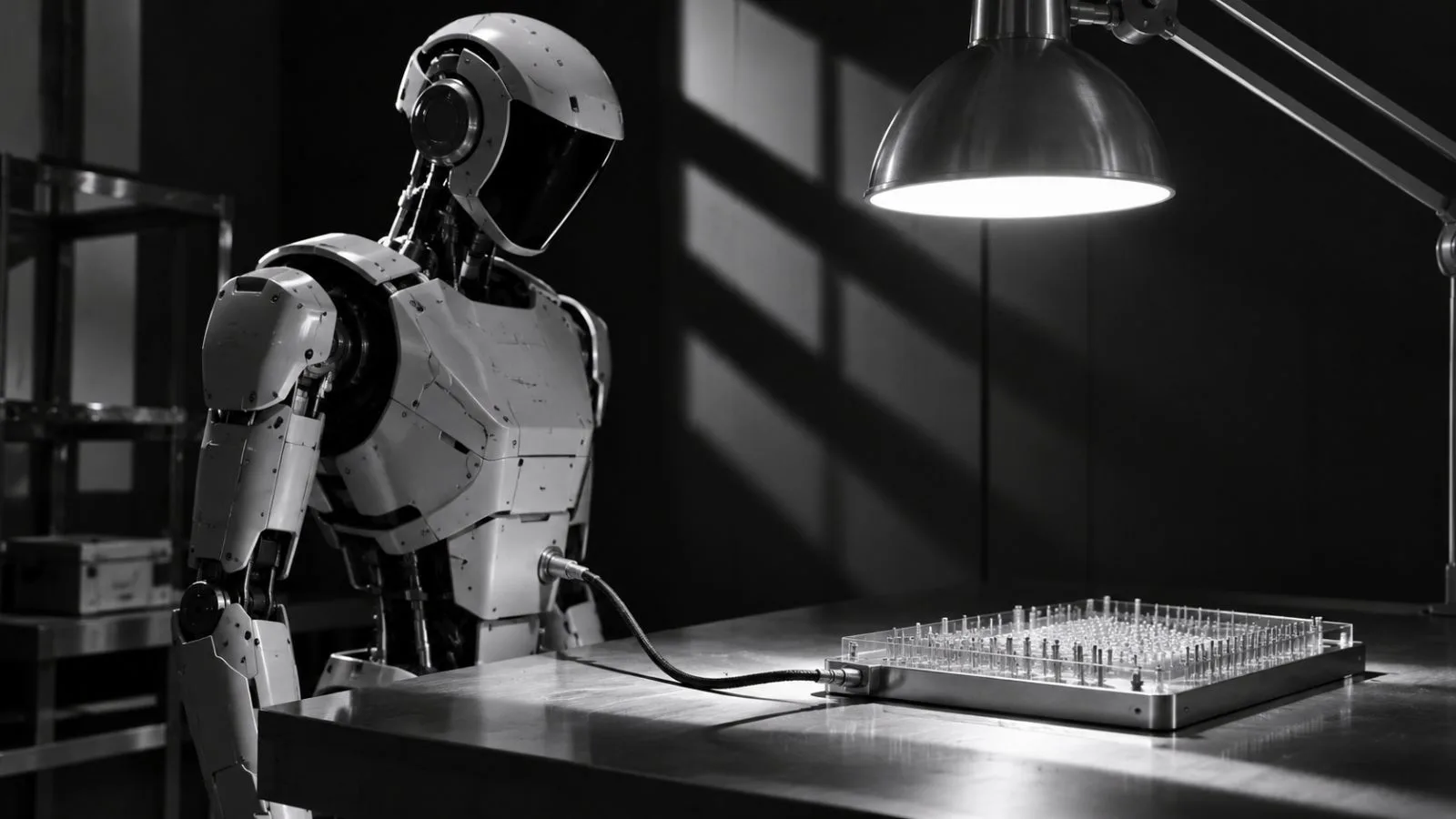
OpenMind unveiled Iris, a humanoid robot that uses lab-grown human neurons in part of its decision loop, connecting living-cell activity to how the robot responds to people.
The work was led by Jan Liphardt, OpenMind’s founder and a Stanford bioengineer. Camera footage from Iris is sent online to neural cultures in Australian and Swiss labs. Electrodes stimulate the cells and record their activity; that activity is translated into signals sent back to Iris.
The cultures are made from stem cells grown into thin layers on plates lined with tiny electrodes. OpenMind rents access to the cultures. Its best-performing cultures responded in about a quarter of a second and remained alive for more than 100 days. Across nearly 500 stimulations, the cultures decoded signals with up to 94% accuracy.
Iris runs on OM1, OpenMind’s operating system for robots. The company’s software also supports Claude as a reasoning model for humanoids. Iris moves part of its decision loop off silicon chips, using living neurons to provide some of the judgment involved in interpreting the people around it.
Simon Yoon
ReporterSimon Yoon reports on blockchain technology for TokenPost. Send corrections or tips to info@tokenpost.com.