

 News
News  Coin Information
  About us
  Customer Service


 Add as a preferred source on Google

Ripple’s XRP Ledger-based payments stack is back in focus after a Japanese cross-border settlement pilot found that Ripple’s ‘On-Demand Liquidity’ (ODL) model cut transaction costs by nearly 60% versus traditional SWIFT rails while shortening settlement times by one to three days—renewing debate over whether blockchain-based infrastructure can meaningfully compete with legacy banking networks.
The results, disclosed from a recent proof-of-concept involving Japan’s financial sector, indicate that ODL—Ripple’s product that uses XRP as a ‘bridge asset’ to source liquidity between currencies—can reduce the frictions typically associated with correspondent banking. In conventional international transfers, funds often pass through multiple intermediaries, adding fees and extending settlement into multi-day windows. By contrast, ODL is designed to convert funds into XRP and out again on demand, reducing the need for pre-funded accounts and compressing processing time closer to real-time settlement.
The Japan test is notable because it moves the discussion beyond theory and into operational conditions within a major payments market. Supporters argue the pilot underscores Ripple’s long-standing claim that XRP’s core utility lies in ‘cost efficiency’ and faster cross-border movement of value, particularly in corridors where FX conversion introduces layered charges. In this framework, XRP acts as a temporary settlement instrument rather than a long-term store of value.
Still, market participants say the harder question is not technical feasibility but ‘adoption’. Replacing or materially disintermediating SWIFT-centric workflows would require regulatory comfort, institutional risk approvals, integration with incumbents’ compliance tooling, and confidence that liquidity can scale reliably across currency corridors. Analysts note that even when pilots succeed, the path from test environments to production use is often slowed by procurement cycles, operational risk reviews, and the need to demonstrate resilience under peak volumes.
Ripple’s supporters point to interoperability efforts as a differentiator. The company is widely cited as one of the blockchain-focused networks aligned with ISO 20022, the global financial messaging standard that many banks are adopting to modernize data-rich payments. Compliance with ISO 20022 does not guarantee enterprise rollout, but it can reduce integration friction and improve the ability to fit blockchain settlement into existing banking back offices.
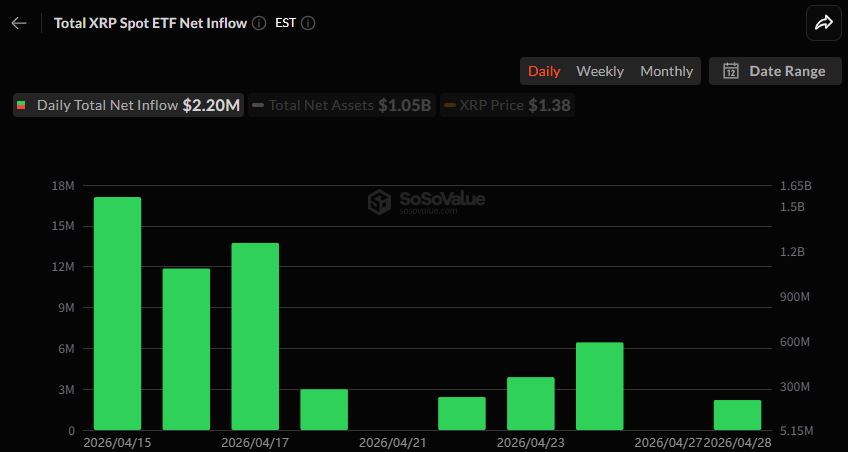
In the market, XRP’s price action has not yet reflected the upbeat tone of the pilot results. As of April 29, 2026 UTC, XRP was trading at $1.3556, down 1.84% over 24 hours and off 6.50% over seven days, according to CoinMarketCap data cited in the report. The token remained up 2.32% over 30 days, suggesting some medium-term support despite near-term retracement.
XRP’s market capitalization stood at roughly $83.62 billion, giving it about 3.32% of the total crypto market and placing it fourth by market value. Trading activity accelerated, with 24-hour volume estimated at $2.26 billion—up 25.46% day over day—driven overwhelmingly by centralized exchanges (CEXs), a pattern typically associated with short-term positioning and heightened volatility around macro events.
Supply metrics continue to matter for longer-term valuation debates. Circulating supply was reported at about 61.68 billion XRP—around 61.7% of the 100 billion maximum—implying additional tokens could enter the market over time. Fully diluted valuation (FDV) was estimated near $135.5 billion in the data cited.
While the 30-day performance remained positive, XRP was still down 24.14% on a 90-day basis, reflecting the broader cool-down that followed earlier-year rallies and a risk-off posture tied to macro uncertainty. Traders have also been cautious across major tokens ahead of the U.S. Federal Open Market Committee (FOMC) rate decision, with liquidity expectations and policy guidance seen as key drivers for crypto beta in the short term.
Looking ahead, the Japan pilot adds tangible evidence that XRP-based settlement can reduce costs and time in real-world conditions, but the market’s next focus is whether similar deployments expand across Asia and beyond. For XRP, the central question remains whether demonstrated technical advantages can translate into sustained institutional usage—an outcome that would hinge less on benchmarks and more on regulatory alignment, operational integration, and scalable liquidity across payment corridors.
🔎 Market Interpretation
- Japan pilot validates efficiency claims: A cross-border settlement proof-of-concept in Japan reported Ripple’s On-Demand Liquidity (ODL) cut transfer costs by ~60% versus traditional SWIFT-based rails and improved settlement speed by 1–3 days, strengthening the case that blockchain settlement can be operationally competitive.
- XRP’s role framed as “utility,” not storage: The pilot reinforces the narrative that XRP functions primarily as a bridge/temporary settlement asset to source liquidity between fiat currencies, rather than as a long-term store of value.
- Adoption remains the true bottleneck: Even with strong pilot metrics, scaling into production depends on regulatory clarity, bank risk approvals, compliance integration, and corridor-level liquidity depth—factors that often slow the transition from test to live deployment.
- ISO 20022 alignment may reduce integration friction: Ripple’s association with ISO 20022 is positioned as a practical advantage because banks upgrading messaging standards may find it easier to integrate data-rich payment workflows with new settlement rails.
- Market pricing not yet reflecting pilot optimism: Despite favorable operational results, XRP traded at $1.3556 (Apr 29, 2026 UTC), down 1.84% daily and 6.50% weekly, though still up 2.32% over 30 days; the disconnect suggests traders are prioritizing macro and near-term risk conditions over pilot headlines.
- Liquidity is concentrated on CEXs: 24-hour volume rose to ~$2.26B (+25.46% DoD), largely driven by centralized exchanges—often indicative of short-term positioning and increased volatility sensitivity around macro events (e.g., upcoming FOMC decision).
- Supply/valuation overhang stays in view: With ~61.68B XRP circulating (~61.7% of max 100B) and FDV near $135.5B, investors continue to weigh potential future supply release against demand growth from real payment usage.
💡 Strategic Points
- Watch for “pilot-to-production” signals: The key catalyst is not another proof-of-concept, but evidence of repeatable, live corridor expansion (new bank/PSP integrations, sustained volumes, and multi-jurisdiction regulatory sign-off).
- Gauge corridor liquidity and slippage: ODL’s viability at scale depends on reliable XRP liquidity across currency pairs; monitor whether liquidity can support peak volumes without material FX slippage or spread widening.
- Track compliance and operational integration: Material adoption requires fit with existing AML/KYC, sanctions screening, reconciliation, auditing, and reporting systems—areas where implementation timelines can exceed technical build timelines.
- Macro events still dominate short-term price: Near-term XRP and broader crypto beta may remain tethered to liquidity expectations and policy guidance (e.g., FOMC), even if settlement utility narratives improve.
- Differentiate “messaging” vs “settlement” upgrades: ISO 20022 improves payment data richness and interoperability, but it does not automatically replace settlement rails; the commercial win is proving ODL can sit inside bank workflows without increasing operational risk.
- Key metrics to monitor next: (1) Number of active ODL corridors, (2) institutional counterparties onboarded, (3) sustained transaction volumes, (4) average cost/time improvements in production, (5) regulatory/licensing milestones in Asia.
📘 Glossary
- XRP Ledger (XRPL): A blockchain network designed for fast, low-cost transactions; the infrastructure underpinning XRP transfers and certain Ripple payment solutions.
- On-Demand Liquidity (ODL): Ripple’s cross-border payments approach that uses XRP as an intermediary asset to source liquidity between two fiat currencies, aiming to avoid pre-funded accounts.
- Bridge Asset: An intermediary asset used temporarily to exchange value between two currencies when direct liquidity is limited or costly.
- SWIFT / SWIFT rails: The dominant global bank messaging network used to coordinate cross-border transfers, commonly relying on correspondent banking chains for settlement.
- Correspondent Banking: A system where banks route international payments through intermediary banks, often increasing fees, complexity, and settlement time.
- Settlement Time: The time required for a transaction to be finalized and funds to be considered transferred and available.
- ISO 20022: A global financial messaging standard enabling richer payment data and improved interoperability across banks and payment systems.
- CEX (Centralized Exchange): A custodial crypto exchange where trades occur via an intermediary platform, often associated with higher short-term speculative volume.
- Market Capitalization: Token price multiplied by circulating supply; a snapshot measure of total market value.
- Circulating Supply: The amount of tokens currently available in the market (excluding locked or unreleased amounts).
- Fully Diluted Valuation (FDV): Market cap assuming the maximum token supply is in circulation, used to assess potential dilution impact.
- FOMC: The U.S. Federal Open Market Committee, whose rate decisions influence global liquidity conditions and risk asset sentiment, including crypto.
















Comment 0