
IREN Shifts From Bitcoin Mining to AI Cloud With $3.7 Billion Revenue Target
IREN is pivoting from Bitcoin mining to AI cloud infrastructure backed by major deals with Nvidia and Microsoft while targeting $3.7 billion in annual revenue.


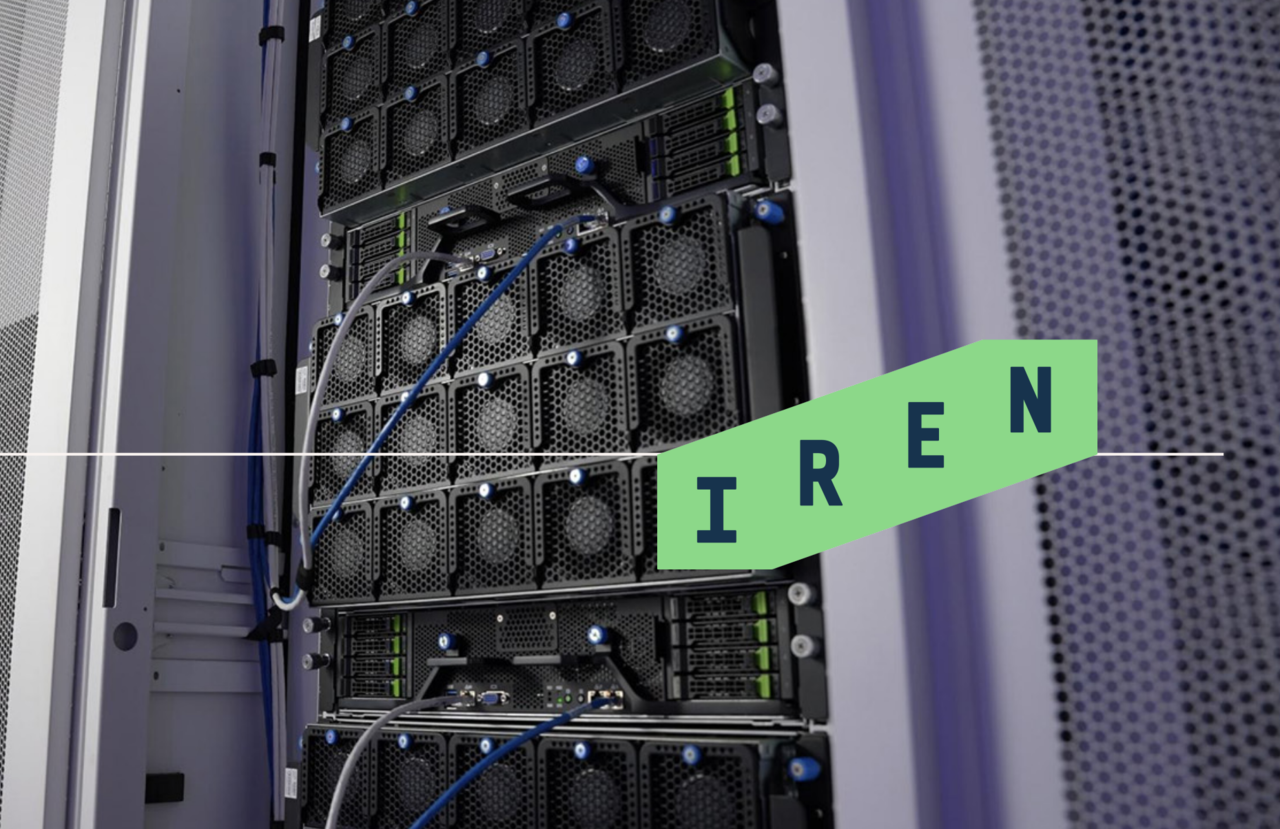
IREN ($IREN), formerly known as Iris Energy, is accelerating a strategic pivot away from Bitcoin (BTC) mining as it seeks to reposition itself as an AI cloud and high-performance computing (HPC) infrastructure provider—a shift that underscores how compute demand and power access are becoming the new battlegrounds for energy-intensive digital businesses.
The company said it expects its ongoing build-out to support roughly $3.7 billion in annualized AI cloud revenue once key projects are completed. Management’s near-term target is to have 480 megawatts (MW) of AI cloud capacity operational by year-end, equivalent to about 150,000 GPUs. Longer-term, IREN is aiming to assemble a 5 gigawatt (GW) global power portfolio to support what it describes as an energy-dense computing platform spanning multiple regions.
Big Tech partnerships anchor the AI transition
IREN’s roadmap is being underwritten by a series of large commercial arrangements with major technology firms. The company disclosed a five-year, $3.4 billion AI cloud services agreement with Nvidia ($NVDA). Nvidia also holds an option to purchase up to $2.1 billion of IREN equity at $70 per share, a feature that investors have interpreted as both a strategic endorsement and a potential source of future dilution.
Separately, IREN has signed a 750MW capacity supply agreement with Microsoft ($MSFT), which the company values at approximately $9.7 billion in total contract value. It is also pursuing a roughly $3.5 billion procurement arrangement with Dell Technologies ($DELL) for GPUs and related infrastructure.
While the company did not provide detailed margin assumptions for each contract, the scale of the deals signals that IREN is attempting to move up the value chain from commodity-like mining economics toward more predictable, contracted data center revenue—an increasingly common thesis among listed miners seeking to reduce reliance on cyclical crypto prices.
Sweetwater, Texas emerges as the flagship site
Central to IREN’s plan is the Sweetwater 1 data center project in Texas, designed for 1.4GW and expected to accommodate more than 700,000 GPUs. The company is positioning Sweetwater 1 as a key hub to execute its commitments to Nvidia and Microsoft, placing the project at the heart of its near- and mid-term commercialization strategy.
IREN also outlined a development pipeline that includes the Horizon projects 1 through 4, intended to secure the initial 480MW of AI capacity by 2026, and the Childress Horizons 5 and 6 projects, aimed at lifting active capacity to 1,210MW by 2027. In British Columbia, the company said air-cooled GPU installations are already underway, with additional shipments planned for the second half of 2026.
Europe expansion via Spain acquisition
As part of its global expansion, IREN agreed to acquire Spanish data center developer Ingenostrum, a deal it says will bring a 50-person local team and 490MW of grid connection capacity in Spain. Executives framed Spain’s renewable energy build-out and regulatory environment as favorable conditions for large-scale AI data center deployment, and said the acquisition supports the company’s broader goal of building a 5GW global power pipeline.
$3 billion convertible offering boosts firepower—while raising dilution questions
To finance the capital-intensive build-out, IREN recently issued $3 billion in convertible senior notes, upsized from an initial $2 billion target on what it described as strong demand. The notes carry a 1% coupon and mature in 2033, with a conversion premium of 32.5% based on a reference share price of $55.15.
Net proceeds were approximately $2.96 billion after fees, with about $201 million allocated to capped call transactions designed to reduce dilution if the notes convert. The remaining proceeds are expected to be deployed toward construction and expansion efforts, including Sweetwater and Horizon.
Still, the financing structure reinforces a persistent investor concern around share count expansion. The company’s outstanding shares have increased by roughly 50% over the past year, and additional dilution could occur through both convertible note conversion and Nvidia’s equity option if exercised.
Mixed quarterly picture as AI ramps and mining winds down
In its most recent third-quarter results, IREN reported revenue of $144.8 million, below analyst expectations. However, AI cloud revenue rose 94.2% quarter-on-quarter to $33.6 million, a jump that management and bullish analysts cite as evidence that the transition is gaining momentum.
Bitcoin mining revenue, by contrast, has been deliberately reduced as the company retires older hardware and reallocates power and capital toward AI and HPC. Some analysts are projecting roughly 66% revenue growth in fiscal 2026 and more than 235% in fiscal 2027, maintaining overweight-style ratings tied to IREN’s self-controlled power pipeline as a perceived competitive moat. More cautious voices point to execution risk on mega-project timelines, supply constraints for high-end Nvidia GPUs, and the complexity that comes with running a hybrid portfolio during the transition phase.
Volatility remains elevated as the stock cools after a steep run
IREN shares closed at $52.94 on Thursday ET, May 15, down $5.46 (9.35%) on the Nasdaq, and slipped a further 0.62% in after-hours trading to $52.61. The company’s Europe-listed shares fell 8.47% intraday to €45.63 and were down roughly 12% on the week.
Despite the pullback, the stock remains up more than 100% year-to-date and roughly sixfold over the past 12 months. It continues to trade well above its 200-day moving average, and earlier in May a 50-day moving average crossed above the 200-day mark—a so-called 'golden cross' that many technical traders interpret as a bullish signal. At the same time, annualized 30-day volatility remains above 120%, highlighting how sensitive the name is to sentiment shifts around AI infrastructure, funding, and project milestones.
MarketBeat data showed short interest of 58.36 million shares as of April 30, representing 18.49% of the public float, down slightly by 1.31% from the prior report. Based on average daily volume of 51.56 million shares, days to cover was estimated at 1.6—figures that suggest skepticism and hedging demand remain meaningful even after the rally.
Reframing IREN for crypto-native investors
Once widely viewed as a pure-play Bitcoin mining stock, IREN is increasingly signaling that it does not want to be defined by mining. With BTC exposure being intentionally reduced, the company’s valuation narrative is shifting toward 'AI infrastructure,' data centers, and energy access—where long-duration power contracts and GPU supply relationships can matter more than block rewards and hash rate.
If IREN can deliver on its capacity targets while managing dilution and execution risk, its business model may ultimately resemble a power-backed compute platform more than a crypto cycle proxy—an evolution that reflects the broader convergence between digital infrastructure, energy markets, and AI-driven demand.