
METACON 2026 Opens in Seoul, Signals Shift From AI Hype to Deployment
METACON 2026 opened in Seoul with government and industry leaders emphasizing a shift toward real-world AI deployment and builder-driven innovation.

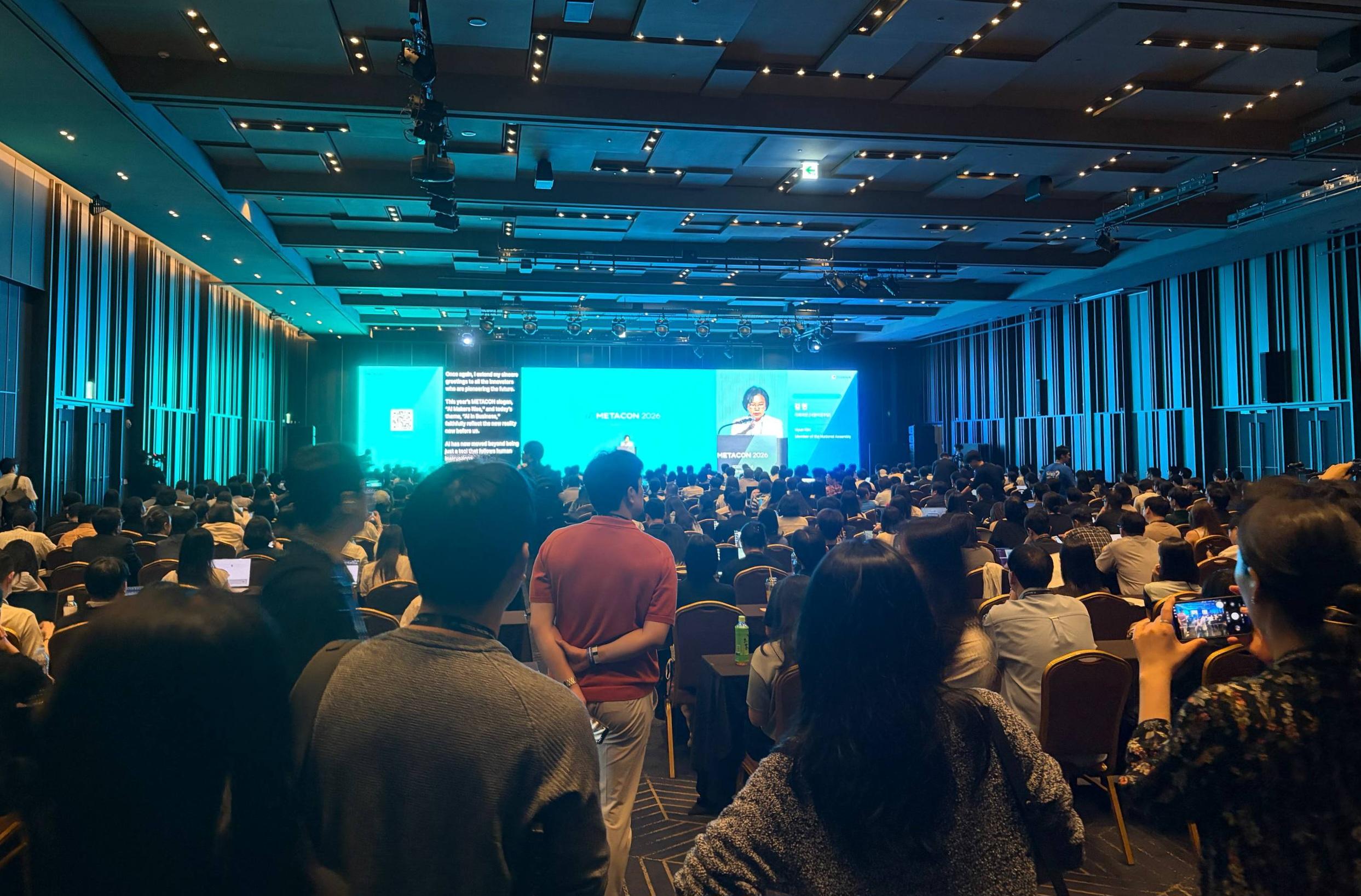
METACON 2026 opened in Seoul on Thursday ET, signaling what organizers called a shift from merely “talking about AI” to building tangible value with it—an inflection point as businesses and governments race to turn rapid model advances into productivity gains and new products.
The sixth edition of the AI and technology business conference, co-hosted by TokenPost, is being held July 3–4 ET at COEX in Seoul’s Samseong-dong district. This year’s theme, ‘AI Makers Rise’, frames the event around the emergence of ‘AI makers’—developers, enterprises, and public-sector teams moving beyond adoption to the hands-on creation and industrial deployment of AI systems.
In opening remarks, Seoul Mayor Oh Se-hoon positioned the theme as a statement about where competitiveness will be decided. “Those who turn technology into reality create new value and open the future,” he said, adding that the main actors will be companies and builders “constantly challenging themselves on the ground.” Oh pledged city support for experimentation and growth, arguing that successful commercialization of AI will translate into safer and more convenient daily life for residents.
Oh also reiterated Seoul’s earlier vision of becoming a leading city for ‘physical AI’—a term increasingly used to describe AI integrated with robots, mobility, sensors, and other systems that operate in the real world. The city, he said, is opening Seoul as a large-scale ‘testbed’ so innovations can move from the lab into operational urban environments. He highlighted plans to strengthen growth infrastructure ranging from GPU support to assistance with global expansion as competition for compute and talent intensifies across Asia.
Lawmakers from across South Korea’s political spectrum used the stage to underline both the opportunity and the governance challenges posed by the next phase of AI. A Democratic Party member of the National Assembly said the topic “AI in Business” reflects an already-arrived reality, arguing that AI is moving from instruction-following tools toward ‘AI agents’ that can plan, reason, and execute tasks more autonomously. He warned that if negative side effects are not managed proactively, long-term industrial growth could be constrained.
He pointed to proposed revisions to South Korea’s framework AI law—described as an “AI agent safety” initiative—as an attempt to build institutional foundations for trustworthy adoption. The goal, he said, is to create an environment where companies can innovate safely while citizens use AI with confidence, and to prioritize “policy bridges” over heavy-handed regulation.
A People Power Party lawmaker echoed the view that AI is boosting national competitiveness, including in semiconductors, but urged a broader measure of success: whether productivity gains actually make citizens happier. He called the early achievements of the new National Assembly session the creation of a baseline AI law and AI budgeting, alongside a strategy to push South Korea toward “AI G3” status with a focus on ‘physical AI.’ While acknowledging the difficulty of obtaining global leadership in large language models, he argued that physical AI is an area where South Korea’s manufacturing strength could translate into an edge. He added that AI policy should support balanced regional development, not only capital-area concentration.
Reform Party leader Lee Jun-seok said the past year has seen substantial effort to elevate South Korea’s AI standing, but argued it is time to scrutinize whether the country is heading in the right direction. The central challenge, he said, is no longer curiosity about AI but how to apply it inside real workflows. Lee emphasized that competitiveness will be determined less by the raw technology than by job- and industry-specific capability to use it, citing the late President Roh Moo-hyun’s reported habit of building software to manage his schedule and network as an example of problem-solving through automation.
The agenda reflects this “execution” emphasis. Day one is themed ‘AI in Business. Already Happened’, focusing on enterprise AI strategy and corporate transformation. Day two shifts to ‘Your AI Transformation. Now Begins’, centering on individual developers and creators with sessions on ‘vibe coding,’ agentic engineering, and builder-oriented use cases.
Speakers include Hyundai Motor Group in the opening keynote, with additional sessions led by experts from organizations such as LG CNS, KT, Upstage, Salesforce, SAP, and Deloitte, alongside academic voices including KAIST emeritus professor Maeng Seong-hyeon. Organizers said the program will cover generative AI deployment, industry-by-industry transformation, and practical implementation lessons.
Side events are also designed to connect the emerging AI builder economy with capital and go-to-market expertise. The AI Marketing Summit on day one focuses on branding and marketing tactics in the generative AI era, while day two’s AI InvestCon centers on investment strategy, market outlooks, and case studies of promising companies and startups. Exhibitions, networking programs, and hands-on showcases run throughout, underscoring METACON’s broader message: the next stage of AI will be defined by ‘builders’ who can turn models into measurable outcomes at scale.