
 Add as a preferred source on Google
USDC Sees $333 Million Outflow as Ethereum, Solana جذب Inflows
USDC recorded $333 million in outflows while Ethereum and Solana led inflows, signaling a selective rotation in crypto market positioning.







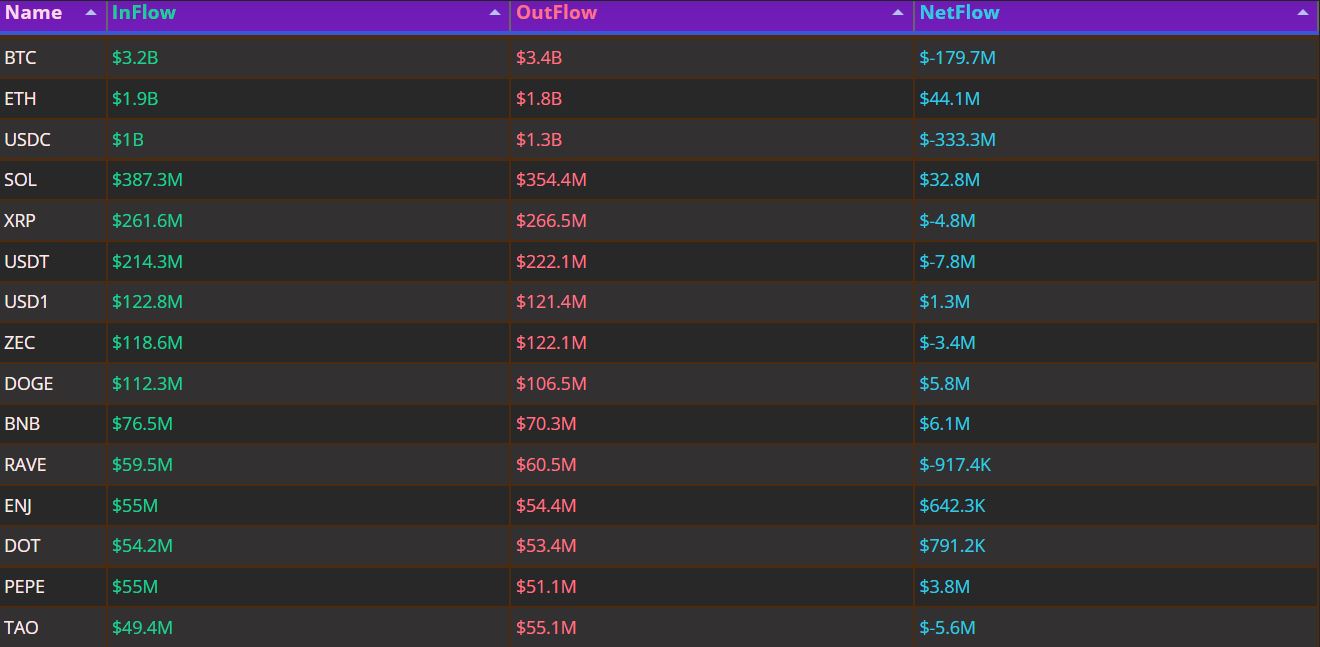
Crypto market flows shifted noticeably over the past 24 hours, with heavy outflows from stablecoins—particularly USD Coin (USDC)—and Bitcoin (BTC), while Ethereum (ETH) and Solana (SOL) attracted fresh inflows, signaling a more selective rotation rather than a broad risk-off exit.
As of 11:00 a.m. Tuesday in Seoul (2:00 a.m. UTC), data from Cryptometer showed Bitcoin (BTC) posting roughly $179.7 million in net outflows over the prior day, making it the second-largest outflow among tracked assets. In contrast, Ethereum (ETH) led all assets with about $44.1 million in net inflows, followed by Solana (SOL) at approximately $32.8 million.
Beyond the two major smart-contract networks, smaller but notable inflows pointed to targeted demand. PAX Gold (PAXG)—a gold-backed token often used as a defensive allocation—saw around $22.2 million in net inflows. Tron (TRX) added roughly $10.0 million, while FDUSD recorded about $8.0 million. The mix suggests traders were not simply moving to cash, but reallocating across distinct themes such as on-chain activity, network-specific momentum, and alternative hedges.
The most striking move came from stablecoins. USD Coin (USDC) registered about $333.3 million in net outflows, the largest outflow of any asset in the dataset, while Tether (USDT) saw a smaller net outflow of about $7.8 million. Large stablecoin outflows can reflect several dynamics—conversion into other cryptoassets, transfers off exchanges, or temporary declines in on-exchange liquidity—though the simultaneous inflows into ETH and SOL point to at least part of the move being redeployed into higher-beta exposures.
Several other assets also recorded net outflows, underscoring uneven sentiment across the market. BASED saw about $23.9 million in outflows, U about $15.5 million, Bittensor (TAO) roughly $5.6 million, and Zcash (ZEC) about $3.4 million. Overall, the pattern suggests investors are narrowing exposure rather than broadly adding risk across the board.
In aggregate, Tuesday’s flow data highlights a market leaning into 'selective buying'—with Ethereum (ETH) and Solana (SOL) capturing incremental allocations—while stablecoin liquidity and Bitcoin (BTC) positioning loosened. If the trend persists, it could reinforce near-term leadership from smart-contract ecosystems even as reduced stablecoin balances hint at a tighter liquidity backdrop for the broader market.
Article Summary by TokenPost.ai
🔎 Market Interpretation
Selective rotation, not broad derisking: Capital moved out of Bitcoin (BTC) and stablecoins—especially USDC—while rotating into Ethereum (ETH) and Solana (SOL), implying targeted risk-taking rather than a full market exit.
BTC positioning softened: BTC posted approximately $179.7M in net outflows, suggesting reduced exposure or reallocations away from BTC in the near term.
Smart-contract leaders attracted fresh demand: ETH led inflows at roughly $44.1M; SOL followed with about $32.8M, pointing to renewed appetite for higher-beta network plays and ecosystem momentum.
Stablecoin liquidity declined on-exchange: USDC saw around $333.3M in net outflows (largest of all assets), while USDT outflows were smaller (~$7.8M). This can indicate redeployment into crypto assets, off-exchange transfers, or reduced on-exchange liquidity.
Hedging and theme-based allocations appeared: PAXG inflows (~$22.2M) suggest some investors simultaneously added defensive exposure while seeking growth via ETH/SOL.
Uneven sentiment across altcoins: Net outflows in assets like BASED (~$23.9M), U (~$15.5M), TAO (~$5.6M), and ZEC (~$3.4M) reinforce that flows are narrowing into preferred narratives rather than lifting the whole market.
💡 Strategic Points
Watch ETH/SOL leadership signals: Continued inflows can translate into relative strength versus BTC, especially if ecosystem activity, staking demand, or sector catalysts persist.
Monitor stablecoin balances as a liquidity gauge: Large USDC outflows may tighten immediate exchange-side liquidity; if sustained, it can increase volatility and make broad rallies harder without fresh stablecoin inflows.
Interpret USDC outflows carefully: The move may reflect (1) conversion into ETH/SOL, (2) funds moving off exchanges into self-custody/DeFi, or (3) temporary venue-specific rebalancing—each has different implications for risk appetite.
Barbell behavior is emerging: Simultaneous inflows into high-beta assets (ETH/SOL) and defensive PAXG suggest a mixed posture—seeking upside while maintaining hedges.
Risk management implication: With BTC and stablecoins both seeing outflows, short-term market depth could be thinner; traders may prefer staged entries, tighter sizing, and awareness of slippage around catalysts.
📘 Glossary
Net inflows / net outflows: The net amount of capital entering or leaving an asset over a period (inflows minus outflows), often used to infer demand and positioning.
Stablecoin: A crypto asset designed to track a reference value (commonly USD). Examples: USDC and USDT.
On-exchange liquidity: Available balances and depth on trading venues; higher liquidity generally supports smoother price discovery and larger trades with less impact.
Higher-beta exposure: Assets that typically move more than the broader market (higher volatility), often sought when investors are taking on more risk.
Smart-contract network: A blockchain that supports programmable applications (dApps). Examples: Ethereum (ETH) and Solana (SOL).
PAX Gold (PAXG): A token backed by physical gold, often used as a defensive or diversification tool within crypto portfolios.