
 Add as a preferred source on Google
Stablecoin Inflows Top $35 Million as Crypto Markets Signal Risk-Off Shift
Traders moved over $35 million into stablecoins led by USDT as Bitcoin and Ethereum saw outflows, signaling rising short-term risk aversion in crypto markets.







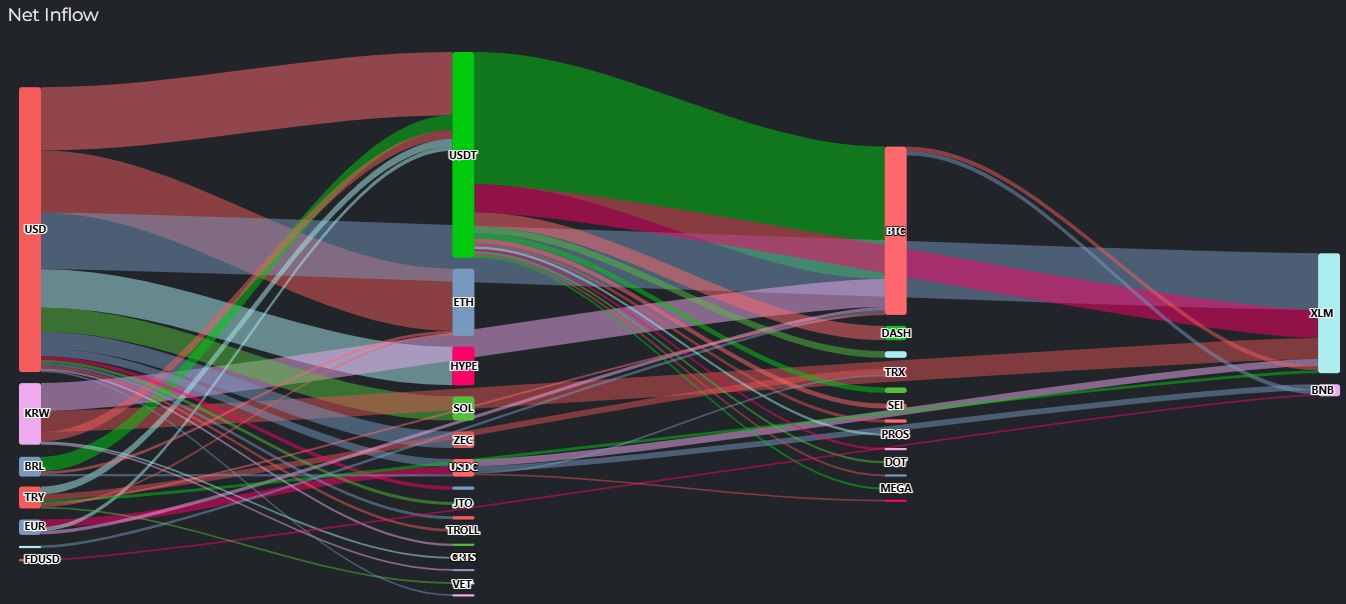
Crypto markets showed signs of near-term risk aversion on Wednesday ET, as capital rotated out of major assets such as Bitcoin (BTC) and Ethereum (ETH) while a larger pool moved into stablecoins—especially Tether (USDT)—pointing to a growing ‘wait-and-see’ stance among traders.
Data compiled by Cryptometer at 10:15 p.m. Tuesday ET (02:15 UTC Wednesday) showed that over the prior five hours, fiat inflows into the crypto market totaled roughly $18.45 million, led by the U.S. dollar at $14.37 million. Additional inflows came from the Korean won ($3.14 million), the Turkish lira ($1.15 million), and the Brazilian real (about $0.97 million).
The dollar-denominated inflow was spread across multiple tokens, with allocations flowing into USDT and a mix of large- and mid-cap assets including Ethereum (ETH), Stellar (XLM), Hyperliquid (HYPE), and Solana (SOL). Won-based inflows tilted more heavily toward Bitcoin (BTC) and Stellar (XLM), suggesting localized demand for higher-liquidity pairs.
Stablecoin flows were active on both sides of the ledger. During the same window, USDT posted about $10.48 million in outward distribution into various cryptoassets, while USD Coin (USDC) dispersed about $0.87 million. More than half of the USDT outflow moved into Bitcoin (BTC), with Stellar (XLM) also drawing a notable share—an indication that some traders were selectively redeploying stablecoin liquidity into liquid majors and high-turnover alternatives rather than broadly re-risking across the market.
On the inflow leaderboard, Bitcoin (BTC) led with approximately $8.58 million, followed by Stellar (XLM) at $6.14 million and Ethereum (ETH) at $3.37 million. Hyperliquid (HYPE) recorded around $1.93 million, Solana (SOL) about $1.22 million, and Zcash (ZEC) roughly $0.81 million.
Despite those pockets of buying, the dominant theme was outflows from key cryptoassets into cash-like instruments. Cryptometer’s outflow snapshot over the last five hours showed Ethereum (ETH) with roughly $8.88 million in net outflows, Solana (SOL) $5.23 million, XRP (XRP) $5.00 million, Bitcoin (BTC) $4.50 million, Zcash (ZEC) $4.14 million, and NEAR Protocol (NEAR) $4.03 million.
The destination of that risk-off rotation was clear: about $35.35 million flowed into USDT and $6.86 million into USDC. In addition, a ‘cash-out’ pattern to traditional currencies was recorded, including around $3.32 million into U.S. dollars and $2.41 million into Korean won.
Market participants often interpret heavy stablecoin accumulation as a signal of reduced conviction and heightened sensitivity to short-term macro or market catalysts. While stablecoin inflows can later serve as ‘dry powder’ for renewed buying, the scale of rotation into USDT in this snapshot suggests traders are prioritizing liquidity and optionality until a clearer directional trigger emerges.
Article Summary by TokenPost.ai
🔎 Market Interpretation
Near-term risk-off positioning: Traders rotated out of major cryptoassets (BTC, ETH, SOL, XRP) and into stablecoins, led by USDT, reflecting a defensive “wait-and-see” posture.
Stablecoins as the primary shelter: Net destinations show $35.35M into USDT and $6.86M into USDC over the observed window, signaling a preference for liquidity and reduced volatility exposure.
Mixed tape under the hood: Even with risk aversion, some capital selectively redeployed from USDT into BTC and XLM, implying tactical buying in liquid names rather than broad market risk-taking.
Fiat on-ramps remain active but cautious: Roughly $18.45M of fiat inflows (mainly USD $14.37M) entered the market, yet the dominant flow pattern still points to capital preservation.
Macro/catalyst sensitivity: The magnitude of stablecoin accumulation is commonly read as elevated sensitivity to upcoming triggers (macro data, policy signals, or market structure events), with participants preferring optionality.
💡 Strategic Points
Watch stablecoin dominance for timing signals: Continued USDT/USDC accumulation often indicates traders are sidelining; a downturn in stablecoin inflows paired with rising spot buys can hint at renewed risk-on behavior.
Focus on “selective bid” leaders: In this snapshot, BTC and XLM attracted notable inflows, suggesting they may act as early beneficiaries if risk appetite returns.
Identify stress via major-asset outflows: Reported net outflows were heaviest in ETH (~$8.88M), SOL (~$5.23M), XRP (~$5.00M), and BTC (~$4.50M); persistent outflows can precede volatility spikes or downside continuation.
Use “dry powder” framing carefully: Stablecoin inflows can later fuel rallies, but only once a directional catalyst appears; until then, the market may remain range-bound with sharper intraday swings.
Monitor fiat ‘cash-out’ alongside stablecoin flows: The presence of conversions back to USD (~$3.32M) and KRW (~$2.41M) reinforces that some participants are reducing crypto exposure outright, not merely reallocating internally.
📘 Glossary
Risk aversion (risk-off): A market regime where investors reduce exposure to volatile assets and shift toward safer or more liquid holdings.
Stablecoin: A cryptoasset designed to track a stable value (typically 1:1 with a fiat currency). Examples: USDT, USDC.
Net outflow / inflow: The balance of funds leaving vs. entering an asset over a period; net outflow implies more selling/exit than buying/entry.
Dry powder: Capital held in cash or stablecoins ready to deploy quickly when a favorable opportunity or catalyst appears.
Liquidity: The ability to buy/sell an asset with minimal price impact; higher liquidity assets (e.g., BTC, ETH) often attract capital during uncertainty.
On-ramp (fiat inflow): Conversion of traditional currency (USD, KRW, etc.) into cryptoassets.
Optionality: Maintaining flexibility to act later; in markets, this often means holding cash/stablecoins while awaiting clearer signals.