
Institutional Holdings Reach 4.16 Million BTC as Supply Tightens
Institutional investors including ETFs, corporations, and governments now hold 4.16 million BTC, signaling tightening market supply and a structural shift in ownership.


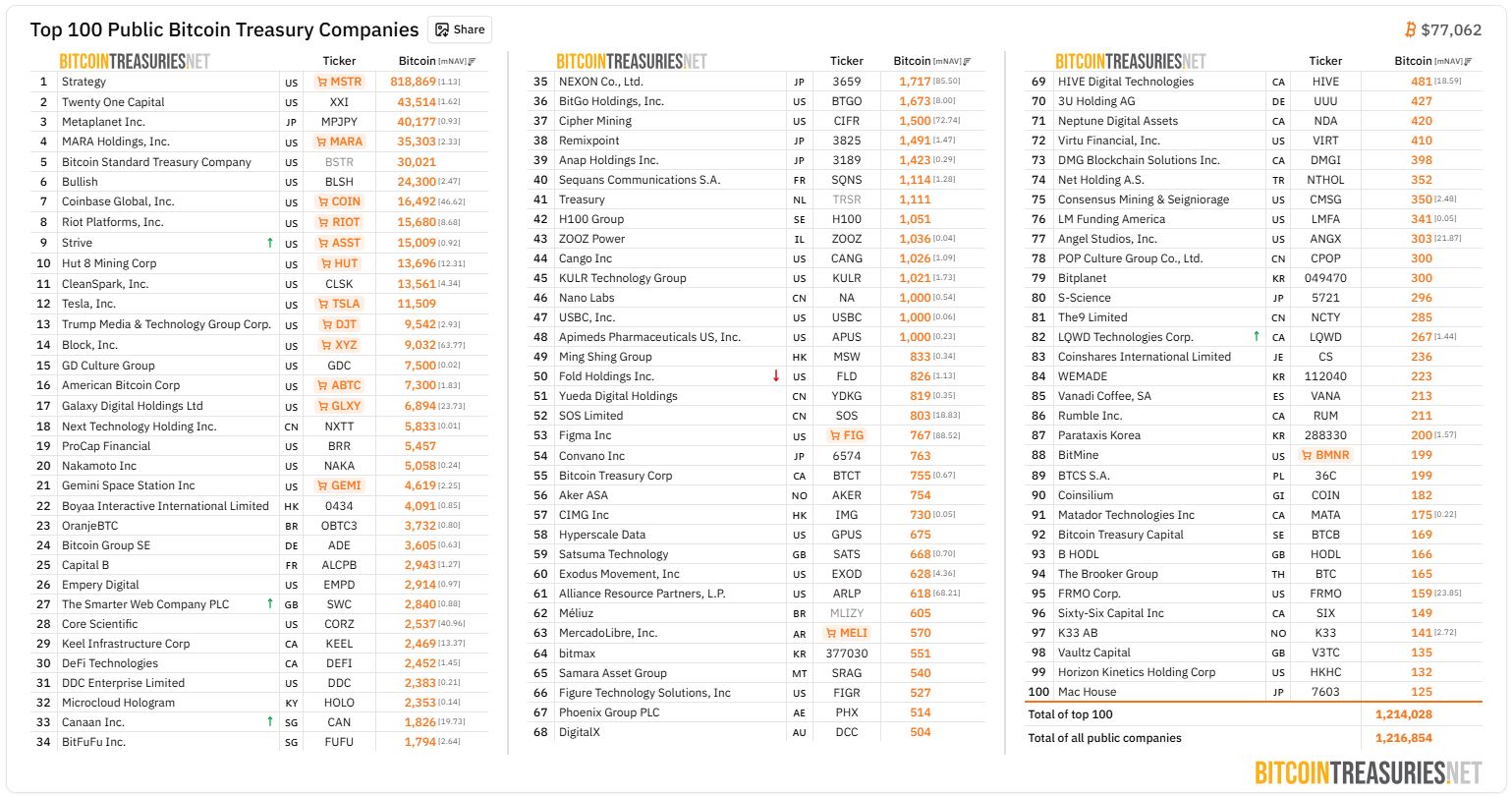
Institutional Bitcoin (BTC) holdings have climbed to an estimated 4.16479 million BTC, underscoring how quickly 'long-term holders'—from listed companies to ETF issuers and governments—are absorbing a meaningful share of circulating supply.
According to data compiled by BitcoinTreasuries as of May 18 (UTC), 345 institutions collectively hold 4,164,790 BTC. The holdings are distributed across several categories: publicly listed companies (196 entities) hold 1,216,854 BTC, ETFs and other funds (44 entities) hold 1,515,075 BTC, governments (13 entities) hold 649,903 BTC, private companies (72 entities) hold 289,395 BTC, DeFi and smart-contract systems (16 entities) hold 379,341 BTC, and exchanges and custodians (4 entities) hold 114,222 BTC.
Market watchers typically interpret the trend as a structural shift in Bitcoin ownership. As more BTC sits in corporate treasuries, regulated fund vehicles, and state wallets, the 'liquid float' available to trade may tighten—an effect that can influence volatility and price formation over time, especially during demand spikes.
Public companies: Strategy remains the dominant corporate holder
Among listed companies, total holdings stand at 1,216,854 BTC—valued at roughly $93.75 billion—equivalent to about 5.795% of Bitcoin’s total supply. Strategy ($MSTR) continues to rank as the single largest institutional holder, with 818,334 BTC, representing about 3.899% of supply.
Strategy added 535 BTC on May 11 (UTC), extending its ongoing accumulation pattern. In contrast, MARA Holdings ($MARA) sold 3,386 BTC the same day, returning to a disposal posture last seen on March 26 (when it reduced holdings by 15,133 BTC). Coinbase Global ($COIN) also stood out, purchasing 1,103 BTC on May 7 (UTC), resuming net buying after about three months. Strive ($ASST) added 443 BTC on May 1 (UTC) and another 9 BTC on May 24 (UTC), continuing incremental accumulation.
Based on the dataset, the leading listed-company holders include: Strategy ($MSTR) with 818,869 BTC; Twenty One Capital ($XXI) with 43,514 BTC; Metaplanet (MPJPY) with 40,177 BTC; MARA Holdings ($MARA) with 35,303 BTC; and Bitcoin Standard Treasury Company (BSTR) with 30,021 BTC. They are followed by Bullish (BLSH) with 24,300 BTC, Coinbase Global ($COIN) with 16,492 BTC, Riot Platforms ($RIOT) with 15,680 BTC, Strive ($ASST) with 15,009 BTC, and Hut 8 Mining ($HUT) with 13,696 BTC.
In South Korea, five listed companies are recorded as holding Bitcoin, with Bitmax (377030) at 551 BTC, Bitplanet (049470) at 300 BTC, Wemade (112040) at 223 BTC, Parataxis Korea (288330) at 200 BTC, and Neowiz Holdings (042420) at 104 BTC.
Private companies: Block.one and Tether remain major holders
Private companies collectively hold 289,395 BTC—about $22.315 billion—roughly 1.378% of total supply. Block.one leads with 164,000 BTC, followed by Tether Holdings with 97,141 BTC. Other notable holders include Stone Ridge Holdings Group with 10,000 BTC, SpaceX with 8,285 BTC, and the Tezos Foundation with 2,903 BTC.
Governments: holdings largely steady as El Salvador continues small purchases
Government-held Bitcoin totals 649,887 BTC—about $50.127 billion—roughly 3.095% of supply. The U.S. is listed with 328,372 BTC, China with 190,000 BTC, the U.K. with 61,245 BTC, Ukraine with 46,351 BTC, and El Salvador with 7,655 BTC. The United Arab Emirates (6,420 BTC) and Bhutan (4,973 BTC) follow.
While most major sovereign holders appear to be maintaining existing balances, El Salvador continues a pattern of small, periodic buys—often daily or every other day—supporting the view that some state participants are positioning BTC as a strategic reserve asset over time. Analysts often note that sustained sovereign participation can bolster perceptions of 'institutional legitimacy,' even when the absolute volumes are modest compared with ETF flows.
ETFs and funds: BlackRock’s IBIT leads overall fund custody
ETFs and other funds account for 1,629,279 BTC—about $125.63 billion—roughly 7.758% of supply, highlighting the role of regulated wrappers in channeling demand. BlackRock’s iShares Bitcoin Trust (IBIT) holds 818,147 BTC, or about 3.896% of total supply, making it the largest among ETF and fund vehicles.
IBIT reduced holdings by 1,949 BTC at the end of last month, but later added 7,820 BTC on May 5 (UTC), reflecting the ebb and flow of creations and redemptions tied to investor demand. Other large vehicles include Fidelity’s FBTC with 185,798 BTC, Grayscale’s GBTC with 150,744 BTC, Grayscale Bitcoin Mini Trust with 53,002 BTC, and Xapo with 38,931 BTC.
DeFi and smart contracts: tokenized BTC remains a meaningful pool
DeFi and smart-contract systems hold 379,341 BTC—about $29.235 billion—roughly 1.806% of supply. Wrapped Bitcoin (WBTC) leads with 125,330 BTC, followed by cbBTC with 87,668 BTC, BTCB with 65,301 BTC, Casascius coin holdings at 34,808 BTC, and Lombard Protocol (LBTC) with 11,780 BTC.
Market participants generally view these categories as reflecting different motivations for accumulation: corporate, private, and government buyers often frame BTC as an 'inflation hedge' or long-term store of value, while ETFs, custodians, exchanges, and tokenized BTC structures respond more directly to investor access, liquidity, and settlement needs.
Overall, the steady rise in institutional and government holdings reinforces a narrative of tightening supply dynamics—one that could shape medium- to long-term market structure as more Bitcoin moves into balance sheets and regulated vehicles, reducing the portion readily available for trading in spot markets.
Article Summary by TokenPost.ai
🔎 Market Interpretation
Institutional absorption is accelerating: 345 tracked institutions hold an estimated 4,164,790 BTC, indicating a growing share of supply migrating into long-duration hands (corporate treasuries, ETFs/funds, and government wallets).
Supply tightness narrative strengthens: As BTC moves into balance sheets and regulated wrappers, the liquid float available for spot trading can shrink—potentially amplifying price moves during demand surges and changing volatility dynamics.
ETFs are now a central demand conduit: Funds/ETFs collectively hold ~1.63M BTC, reinforcing that regulated access vehicles are a primary channel for incremental buying and selling via creation/redemption flows.
Ownership is concentrating in “mega-holders”: Strategy and BlackRock’s IBIT each sit near ~818k BTC, meaning a small number of entities can materially influence perceived market tightness through steady accumulation or distribution.
Sovereign holdings add legitimacy, not necessarily volume: Government balances appear mostly stable; recurring small purchases (e.g., El Salvador) are framed as symbolic/strategic reserve behavior despite ETF flows dominating marginal demand.
💡 Strategic Points
Watch liquidity, not just price: If institutional BTC continues to rise, traders should monitor metrics tied to tradable supply (exchange balances, ETF flows, corporate treasury changes) as leading indicators for volatility regimes.
ETF flow days can override broader trends: IBIT’s reported reductions and subsequent additions illustrate how creations/redemptions can cause short-term swings in custodial holdings even within a longer-term accumulation thesis.
Corporate actions are heterogeneous: Strategy’s persistent accumulation contrasts with miners’ periodic selling (e.g., MARA), implying that “institutions” are not uniformly bullish—cash-flow needs and capital structure matter.
Concentration risk and headline sensitivity: Large-holder disclosures (buy/sell updates) may increasingly drive market reactions, as their position sizes represent meaningful portions of circulating supply.
Tokenized BTC is a distinct liquidity layer: DeFi/smart-contract BTC (e.g., WBTC, cbBTC, BTCB) reflects demand for settlement, collateral, and cross-chain access—useful for on-chain liquidity but also sensitive to bridge/custody risk perceptions.
Medium/long-term implication: Continued migration of BTC into treasuries, ETFs, and state wallets supports a structurally tighter market where supply shocks can be more impactful—especially if demand accelerates during macro or risk-on periods.
📘 Glossary
Institutional holdings: Bitcoin held by organizations such as public/private companies, ETFs/funds, governments, exchanges/custodians, and DeFi/smart-contract systems.
Long-term holders: Entities or investors that tend to hold BTC for extended periods, reducing near-term selling pressure.
Circulating supply: BTC currently available in the market (excluding coins provably lost or not in circulation, depending on methodology).
Liquid float: The portion of BTC realistically available for trading (often approximated by coins held on exchanges and other readily sellable positions).
ETF (Exchange-Traded Fund): A regulated investment vehicle that trades on exchanges and can hold BTC via a custodian (e.g., spot Bitcoin ETFs).
Creations/Redemptions: The mechanism by which ETF shares are issued or removed, typically driving the fund’s BTC holdings up or down based on investor demand.
Corporate treasury BTC: Bitcoin held on a company’s balance sheet as a reserve/asset allocation choice.
Tokenized BTC: Blockchain representations of BTC (e.g., WBTC) used in DeFi for trading, lending, collateral, or settlement across chains.
Custodian: A regulated entity that safeguards BTC on behalf of funds, institutions, or clients.
Volatility: The magnitude of price fluctuations; can increase when tradable supply is thin and market demand shifts quickly.