

 News
News  Coin Information
  About us
  Customer Service


 Add as a preferred source on Google

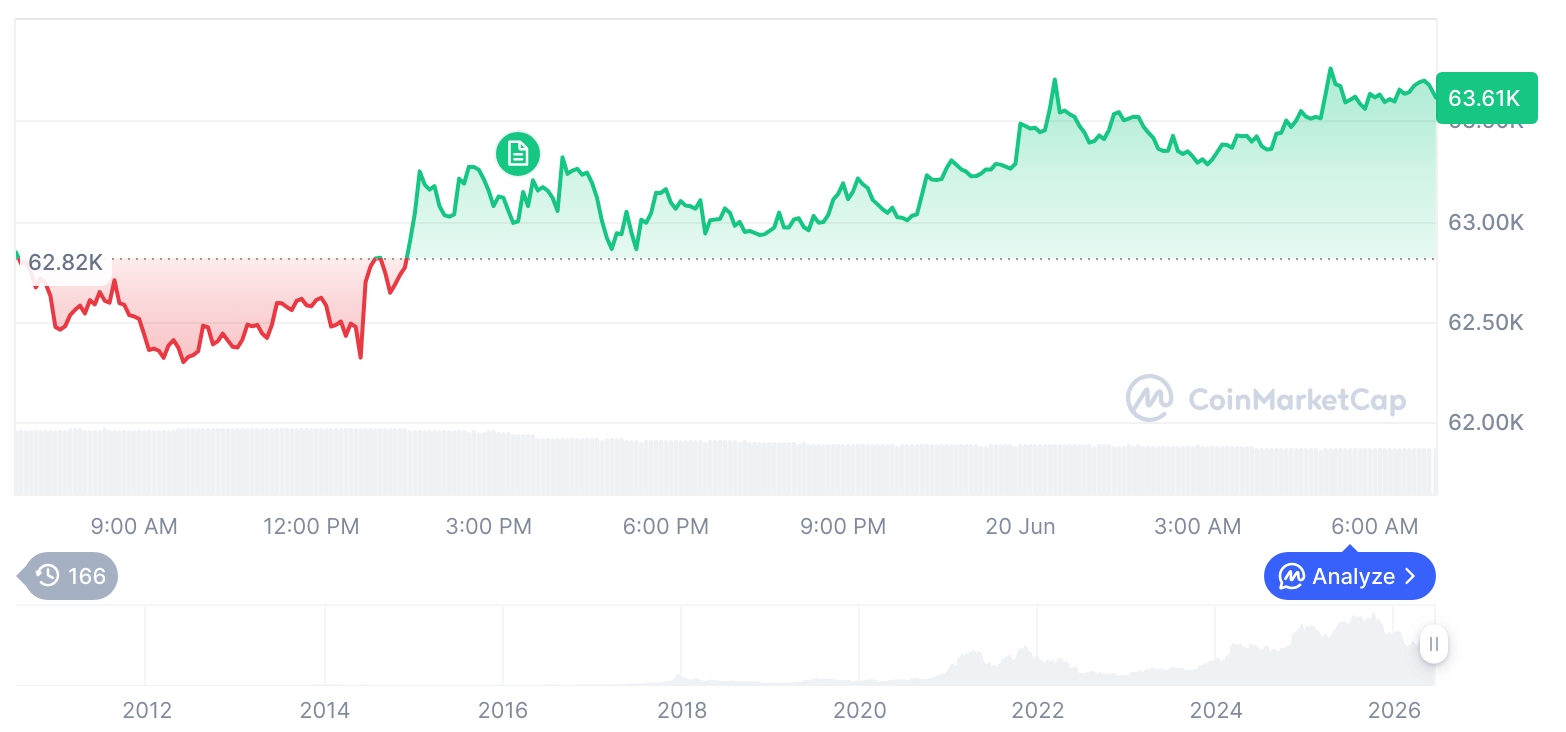
Bitcoin (BTC) has struggled to regain momentum in the low-to-mid $60,000 range, leaving it roughly 40% below levels seen around a year ago and even further from its peak. For a market that has already absorbed spot ETF approval, a wave of Wall Street participation, and an unusually supportive posture from Washington, the inability to sustain a six-figure price has forced a broader question: whether the next major risk for digital assets is not technological or macroeconomic, but political.
In recent years, crypto has drifted from being framed primarily as financial technology toward becoming a marker of political identity. Republicans have increasingly positioned digital assets as a symbol of innovation, economic liberty, and resistance to heavy-handed state control. Democrats, meanwhile, have tended to approach the sector through the lens of consumer protection, market oversight, and financial stability. Divergent policy instincts are normal in democratic systems, but the market impact intensifies when those differences harden into a partisan frontline.
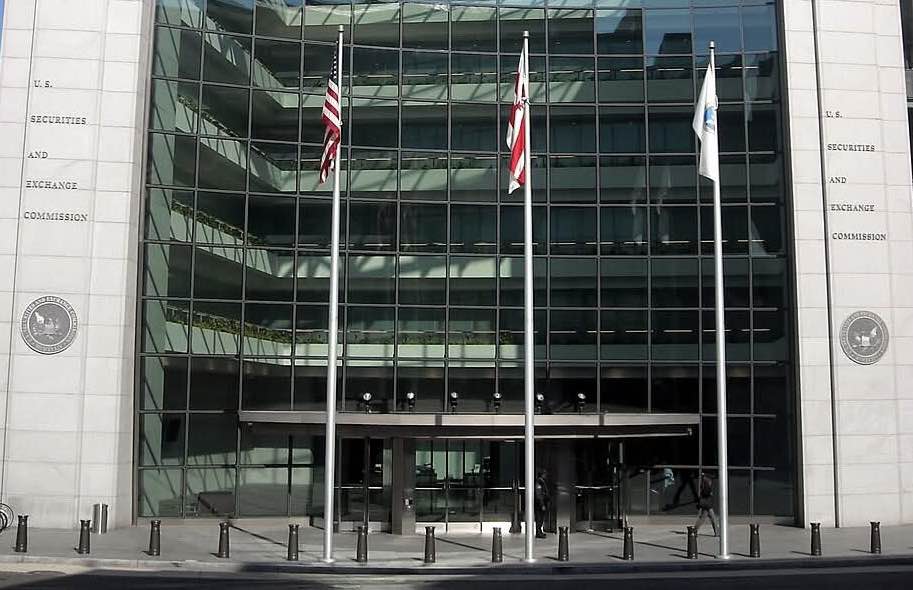
A recent clash in U.S. capital markets underscored that shifting terrain. SpaceX—while not a crypto company—made a high-profile Nasdaq debut on June 12 UTC, in a blockbuster transaction that targeted a valuation around $1.75 trillion and raised roughly $75 billion at a fixed offering price of $135 per share. In the run-up, Senator Elizabeth Warren pressed SEC Chair Paul Atkins to delay the listing, and on the day of the debut she sharply criticized the Trump administration’s SEC for what she characterized as an improper approval. Her objections centered on governance concerns tied to Elon Musk’s voting control and the possibility that index inclusion could increase exposure for retirement savers.
The episode mattered less for SpaceX itself than for what it revealed about the political map surrounding market regulation. On one side sits a bloc associated with Musk, President Trump, and a deregulatory approach to capital markets; on the other is a faction, personified by Warren, prioritizing tighter oversight and investor protection. Increasingly, Bitcoin is perceived—fairly or not—as aligned with one side of that divide. That is a dangerous evolution for an asset class that argues it is neutral infrastructure rather than a partisan vehicle.
From a market perspective, the immediate concern is what happens after the industry has already “spent” much of its most bullish narrative. Spot Bitcoin ETFs have been live. Traditional finance has entered. The White House and SEC have taken a more crypto-friendly stance than in prior years. Congress has advanced major legislation, including the GENIUS Act, a stablecoin bill passed in July 2025, and the CLARITY Act, a market structure proposal that has cleared the House and moved to the Senate Banking Committee. Yet despite those tailwinds, BTC has not held six figures.
That dynamic pushes the underlying wager beyond charts and into the realm of governance. Buying Bitcoin today arguably carries an implicit bet that a supportive SEC, a supportive White House, and a supportive congressional balance will remain in place long enough for policy clarity to become durable. If that political premise weakens, outcomes may hinge less on adoption curves or monetary conditions and more on election returns.
And that premise is already being tested. Prediction markets have increasingly reflected higher odds of Democrats retaking the House in the 2026 midterms, and some measures of President Trump’s approval—particularly around the economy—have shown less stability than markets typically prefer. Cost-of-living pressures remain a central voter issue. Some investment banks have also signaled that the CLARITY Act’s path could slip until after the midterms, with speculation that lawmakers may slow-roll contentious votes while awaiting a potential shift in congressional control.
Even under divided government, the executive branch retains meaningful levers—executive actions, appointments, budget priorities, and the tone of supervision. But that is precisely the vulnerability, critics argue: an asset class whose regulatory posture depends heavily on the preferences of a single administration can become fragile when the political cycle turns. In that scenario, the sector’s risk premium rises—not because of a new protocol exploit or a surprise inflation print, but because the policy foundation has not been fully embedded in stable institutions.
The column’s warning extends beyond the U.S. to South Korea, where digital asset policy is also becoming increasingly politicized. The Lee Jae-myung administration has signaled a pro-crypto agenda that includes allowing spot crypto ETFs, exploring a won-denominated stablecoin, advancing tokenized securities legislation, introducing a comprehensive digital asset framework act, and creating a presidential digital asset committee. Market participants largely see these initiatives as supportive, but the same dependence on political momentum can also become a structural weakness if reforms are perceived as the project of a single government rather than a bipartisan institutional settlement.
Several fault lines illustrate that fragility: disagreements within financial authorities over who should be permitted to issue a won stablecoin, the Bank of Korea’s caution regarding monetary stability, and delays in the next phase of crypto legislation that suggest social and institutional consensus remains incomplete. In a market dominated by retail activity and reliant on centralized exchanges—while corporate participation is still constrained—policy signals can quickly translate into price signals. A presidential pledge becomes a 'trading theme'; a regulator’s warning becomes a sell cue.
The broader implication is that crypto markets mature not by finding the most enthusiastic government, but by building rules that are difficult to reverse. A presidential committee can provide speed, but it can also carry a strong political imprint that fades with a change in leadership. By contrast, durable institutional arrangements—clear statutory conditions for ETF approvals and stablecoin issuance, standardized exchange listing and disclosure requirements, responsible pathways for corporate and institutional participation, and a baseline cross-party agreement on market integrity—reduce the risk that the sector becomes a form of 'political ticker.'
Ultimately, the argument is that digital assets face their deepest vulnerability when they are treated as symbols in a partisan contest. The market often debates headline risks—quantum computing, long-dormant wallets, or the next macro data release—but a more consequential uncertainty may lie in Washington’s shifting power balance. In that light, Bitcoin’s next major inflection point may be less about the chart and more about whether the regulatory trajectory becomes institutionalized—or remains contingent on election cycles.



















Comment 0