
 Add as a preferred source on Google
$410 Million Crypto Liquidations Signal Renewed Volatility Across Bitcoin, Ethereum Markets
$410 million in crypto liquidations hit leveraged traders across major exchanges as Bitcoin and Ethereum led losses, highlighting renewed market volatility.






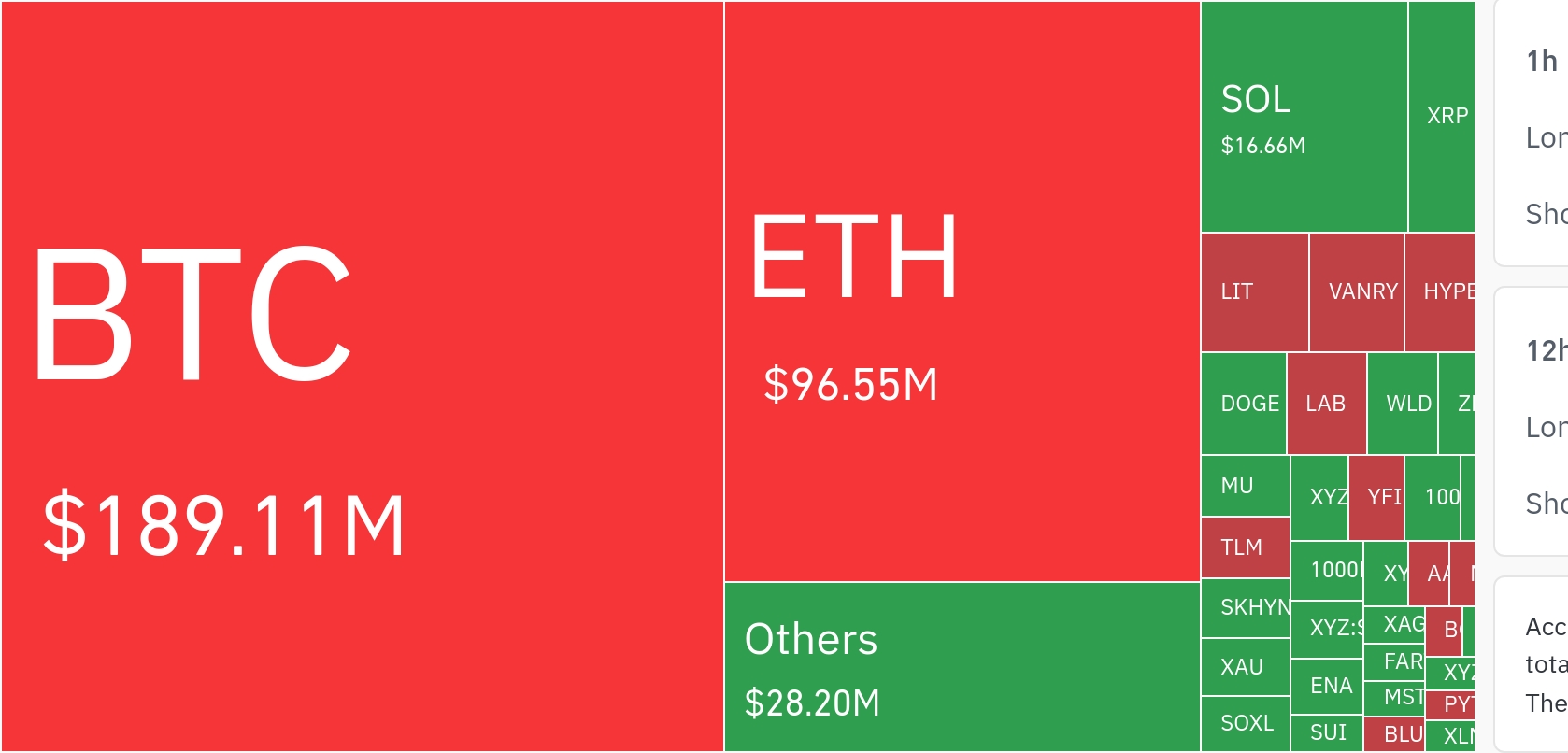
Roughly $410.13 million in leveraged crypto positions were liquidated over the past 24 hours, underscoring a renewed bout of volatility that has whipsawed both directional bulls and bears across major venues.
Data compiled from CoinGlass showed long liquidations reached about $257.72 million, accounting for 62.79% of the total, while short liquidations came in at $152.41 million, or 37.21%. The imbalance suggests the day’s sharp moves ultimately punished traders positioned for continued upside, even as pockets of short squeezes emerged on specific exchanges.
Over the most recent four-hour window, Binance led all venues in liquidations, logging about $20.97 million—46.31% of the total tracked across exchanges in that period. Notably, shorts represented $13.98 million of that figure (66.65%), indicating a localized burst of upward price pressure that forced bearish positions to close. Bybit ranked second with $6.21 million in liquidations (13.72%), with shorts making up an even larger share at $5.15 million (82.97%). OKX followed with approximately $5.65 million (12.48%), where shorts accounted for 60.24%.
Hyperliquid stood out as an exception, with long liquidations slightly outweighing shorts; longs represented 54.08% of liquidation volume on the venue during the same snapshot, pointing to more pronounced downside pressure for traders positioned on the long side in that market.
By asset, Bitcoin (BTC) saw the largest wave of forced unwinds. BTC-linked liquidations totaled about $189.11 million over 24 hours, with a peak of roughly $5.83 million over the last four hours. Ethereum (ETH) followed with around $96.55 million in liquidations over 24 hours, including a four-hour high near $7.90 million. Among major altcoins, Solana (SOL) recorded about $16.66 million, while XRP (XRP) and Dogecoin (DOGE) posted sizable figures as well—approximately $23.09 million and $10.44 million, respectively.
The liquidation activity extended into high-beta meme tokens, with PEPE also seeing notable forced closes even as its price rose by about 4.20% over the period—an outcome consistent with crowded, highly leveraged positioning that can unwind quickly in both directions.
In crypto derivatives markets, a 'liquidation' occurs when a leveraged trader can no longer meet margin requirements and the exchange forcibly closes the position. Large liquidation clusters typically coincide with sudden spikes in volatility, rapid price gaps, or cascading stop-outs as reduced collateral amplifies losses.
While the 24-hour breakdown shows longs bore the brunt overall, the exchange-by-exchange skew toward short liquidations in the latest four-hour window suggests intraday reversals have been sharp enough to trigger both downside cascades and brief upward squeezes. The latest figures highlight a market still sensitive to leverage, where price swings can quickly translate into forced deleveraging across major tokens and venues.
Article Summary by TokenPost.ai
🔎 Market Interpretation
Leverage-driven volatility: About $410.13M in crypto derivatives positions were liquidated in 24 hours, signaling sharp, fast reversals rather than a clean trend.
Longs hit harder overall: $257.72M longs (≈62.79%) vs $152.41M shorts (≈37.21%), implying the broader move ultimately punished traders positioned for continued upside.
Intraday squeeze dynamics: In the last 4 hours, major venues showed a short-heavy liquidation skew (e.g., Binance and Bybit), consistent with brief upward bursts that forced bears to cover.
Exchange dispersion matters: Binance led 4-hour liquidations (~$20.97M, ~46.31% share), suggesting activity concentration and potential liquidity/positioning hotspots at specific venues.
Asset impact concentrated in majors: BTC (~$189.11M) and ETH (~$96.55M) dominated forced unwinds, showing that even benchmark assets are experiencing leverage stress.
Risk spilling into high-beta names: Liquidations extended to altcoins and meme tokens (e.g., PEPE) where crowded leverage can unwind quickly even during price gains.
💡 Strategic Points
Expect two-sided pain in choppy regimes: With longs dominating the 24h totals but shorts dominating the most recent 4h window on key venues, the market is exhibiting rapid reversal risk (downside cascades followed by short squeezes).
Use liquidation skews as a positioning signal:
Long-heavy liquidations (24h): can indicate the market flushed optimistic leverage, sometimes stabilizing after forced selling.
Short-heavy liquidations (recent hours): can point to spot-driven pops or forced buy-backs that may fade once covering pressure ends.
Venue-specific risk management: High liquidation share on a single exchange (e.g., Binance in the 4h snapshot) suggests traders should watch order-book depth, funding shifts, and per-venue premiums for early warning of cascades.
Majors lead, alts amplify: BTC/ETH liquidations set the tone, while SOL/XRP/DOGE and memes can show higher convexity—bigger percentage swings and faster liquidation loops when leverage is crowded.
Practical takeaways for leveraged traders:
Reduce position size or leverage during whipsaw conditions; widen liquidation distance via lower leverage.
Prefer predefined invalidation levels and avoid stacking entries near obvious liquidity zones.
Monitor 4h vs 24h liquidation imbalance to detect regime shifts (trend vs chop).
📘 Glossary
Liquidation: Forced closure of a leveraged position when margin requirements can’t be met, typically executed by the exchange to prevent further losses.
Long liquidation: A forced sell of a long position after price drops enough to exhaust margin.
Short liquidation: A forced buy-to-close of a short position after price rises enough to exhaust margin.
Margin: Collateral posted to open or maintain a leveraged derivatives position.
Leverage: Borrowed exposure that magnifies gains and losses; higher leverage reduces the price move required to trigger liquidation.
Short squeeze: Rapid price rise that forces short sellers to buy back positions, accelerating upside pressure.
Stop-out / Cascade: A chain reaction where liquidations trigger further price movement, causing additional liquidations.
High-beta asset: A token that typically moves more than the broader market, often amplifying volatility.
Funding (derivatives): Periodic payments between longs and shorts in perpetual futures that reflect positioning bias and can influence leverage behavior.