
Ethereum Options Skew Bullish as Call Dominance Holds Despite OI Dip
Ethereum options data shows call-heavy positioning despite a slight drop in open interest, highlighting continued bullish sentiment with hedging activity across key strike levels.


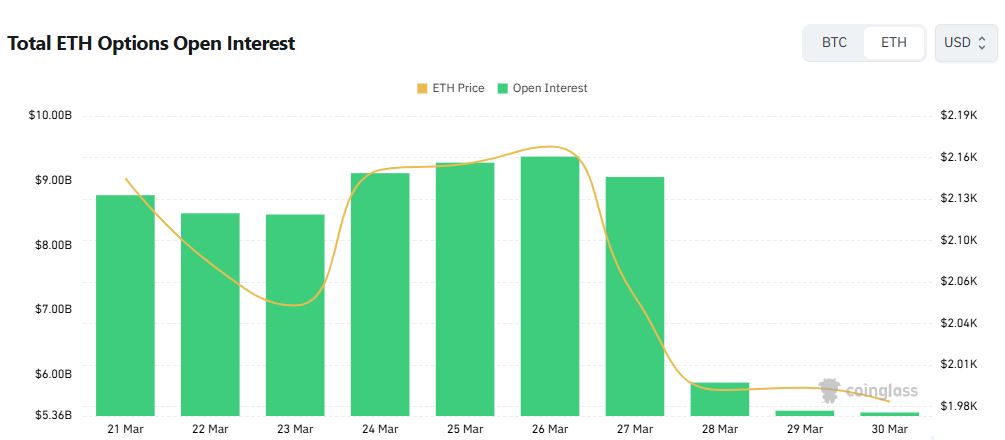
Ethereum (ETH) options positioning continued to skew bullish on Monday, even as overall open interest dipped slightly—an indication that traders are still leaning toward upside scenarios while selectively concentrating activity around specific strike levels.
As of 12:00 a.m. ET on March 30, data compiled by CoinGlass showed total Ethereum options open interest (OI) at $5.42 billion, down about 0.55% from $5.45 billion a day earlier. Despite the modest decline, the market’s structure remained call-heavy: calls accounted for 62.65% of open interest versus 37.35% for puts, reinforcing the view that the broader derivatives complex is still positioned for potential upside.
Notional options trading volume over the past 24 hours totaled roughly $526 million. By venue, activity was led by Bybit at $245 million, followed by Deribit at $116 million, Binance at $86 million, OKX at $68 million, and CME at $11 million. On a 24-hour basis, calls also dominated flow, representing 60.84% of volume compared with 39.16% for puts.
In terms of longer-dated positioning, the largest concentrations of open interest were clustered in call contracts on Deribit: the $3,200 call expiring Dec. 25, 2026 ranked first, followed by the $2,500 call and the $2,000 call—both expiring June 26, 2026. The distribution suggests traders are maintaining exposure to higher price targets over an extended horizon, even as aggregate OI edges lower.
Shorter-term trading, however, showed a sharper focus on specific strikes. The most active contract by 24-hour volume was the $2,750 call expiring April 3, 2026 on Bybit, highlighting concentrated interest around that level. Other high-volume contracts included the $8,400 call expiring June 26, 2026, and the $1,900 put expiring March 30, 2026—also on Bybit—pointing to simultaneous demand for upside participation and downside protection across different timeframes.
Options are derivatives that allow investors to take leveraged views on an underlying asset’s price or hedge existing exposure. A ‘call option’ confers the right to buy at a preset price—typically associated with bullish positioning—while a ‘put option’ confers the right to sell, often used to express downside expectations or manage drawdown risk. ‘Open interest’ measures the total number of outstanding contracts and is commonly interpreted as a proxy for accumulated positioning, while changes in OI and the call/put mix can help distinguish between longer-term positioning and shorter-term tactical trades.
The latest figures underscore a market still structurally tilted toward calls, though the slight pullback in open interest and the presence of actively traded put exposure suggest traders may be balancing bullish conviction with hedging demand as they navigate shifting volatility and liquidity conditions.