
 Add as a preferred source on Google
Bitcoin Options Flow Clusters at $75,000 Strike as Calls Dominate Open Interest
Bitcoin options data shows call-heavy positioning with traders concentrating short-term activity around the $75,000 strike while maintaining downside hedges.


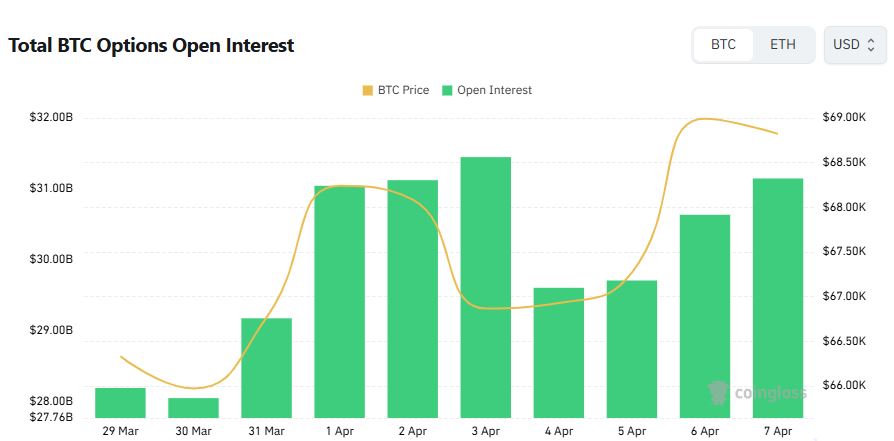
Bitcoin (BTC) options positioning remained skewed toward calls on Monday, but the market’s freshest activity clustered around a $75,000 strike—an indication that short-term flows are concentrating around a key upside level even as traders continue to hedge near-term volatility.
As of Monday at 00:00 UTC, data compiled by Coinglass showed total Bitcoin options 'open interest' (OI) at $31.15 billion, up 1.7% from $30.63 billion a day earlier. By contract mix, calls accounted for 56.59% of OI versus 43.41% for puts, keeping the broader structure in 'call-dominant' territory.
Trading activity, however, painted a more nuanced picture. Total options volume over the past 24 hours was approximately $3.26 billion. Deribit led with $1.87 billion, followed by Bybit at $619 million, Binance at $430 million, OKX at $337 million, and CME at roughly $2.41 million. Despite call-heavy OI, 24-hour volume leaned slightly defensive: calls made up 45.77% of turnover while puts represented 54.23%.
The largest OI concentrations were found in longer-dated, high-conviction strikes on Deribit, led by the $120,000 call expiring Dec. 25, followed by the $80,000 call expiring May 29 and the $60,000 put expiring Dec. 25. The mix suggests a market simultaneously warehousing asymmetric upside exposure into year-end while keeping meaningful downside protection in place.
In contrast, the most actively traded contracts over the last day reflected near-term tactical positioning. The top contract by volume was the $75,000 call on Binance expiring April 7, followed by the $69,000 put expiring April 24 on Deribit and the $68,000 call expiring June 26 on Deribit. Heavy flow into the $75,000 call underscores how traders are gravitating toward a clear reference point—often a sign that spot price action and dealer hedging can become more sensitive around that strike into expiry windows.
Options are commonly used to express leveraged directional views or to hedge an existing spot or futures position. A 'call option' gives the right to buy the underlying asset at a predefined price at or before expiration, while a 'put option' gives the right to sell. OI tracks the total number of outstanding contracts and is widely monitored as a proxy for the build-up of positioning over time.
Monday’s data set highlights a familiar split in crypto derivatives: structurally bullish positioning in outstanding contracts, paired with brisk put demand in daily flow. In practice, that combination can signal that traders are maintaining upside exposure while paying for protection against a pullback—an environment that tends to keep implied volatility supported and can amplify price moves around heavily trafficked strikes such as $75,000.
Article Summary by TokenPost.ai
🔎 Market Interpretation
{
"positioning_snapshot": [
{
"theme": "Call-dominant structure in outstanding positions",
"details": "Total BTC options open interest (OI) rose to $31.15B (+1.7% day-over-day). Calls represent 56.59% of OI vs. puts at 43.41%, indicating a structurally bullish options stack."
},
{
"theme": "Near-term trading flow is more defensive than the OI suggests",
"details": "Despite call-heavy OI, the last 24h volume skewed toward puts (puts 54.23% vs. calls 45.77%), implying fresh demand for downside hedges or short-term protection."
},
{
"theme": "Key upside magnet forming at $75,000 strike",
"details": "The most traded contract was the $75,000 call (Binance, Apr 7 expiry), signaling that short-dated flows and hedging pressure may cluster around this level—often increasing price sensitivity into nearby expirations."
},
{
"theme": "Long-dated convictions point to asymmetrical upside into year-end with protection",
"details": "Largest OI concentrations include the $120,000 call (Dec 25), $80,000 call (May 29), and $60,000 put (Dec 25) on Deribit—consistent with upside participation paired with meaningful tail-risk hedging."
},
{
"theme": "Liquidity and venue distribution",
"details": "Deribit leads options volume ($1.87B/24h), followed by Bybit ($619M), Binance ($430M), OKX ($337M), and CME (~$2.41M), underscoring that crypto-native venues dominate price discovery in BTC options."
}
],
"what_it_could_mean": [
{
"signal": "Bullish core + protective flow",
"interpretation": "A market can remain net bullish in its standing inventory (OI) while actively buying puts intraday to hedge drawdowns—often supportive of implied volatility and prone to sharper spot reactions on catalysts."
},
{
"signal": "$75,000 as a reference/inflection zone",
"interpretation": "Heavy activity at a single strike can create a localized 'pin' or 'accelerant' effect as dealer hedging adjusts with spot moves, particularly into short expiries."
}
]
}
💡 Strategic Points
{
"actionable_takeaways": [
{
"point": "Watch $75,000 for gamma/hedging-driven moves",
"why": "Concentrated volume in a near-dated $75,000 call can increase hedging flows around that level, making spot more reactive near expiry windows."
},
{
"point": "Do not equate call-heavy OI with near-term bullish flow",
"why": "OI is a stock variable (accumulated positions), while volume is a flow variable (new activity). Here, volume skewed put-heavy, suggesting short-term caution even with bullish longer-term structures."
},
{
"point": "Interpret long-dated $120k call OI as convex upside demand",
"why": "Large OI in far-out calls often reflects structured exposure to upside tail outcomes into year-end, rather than an immediate directional bet."
},
{
"point": "Downside protection remains priced-in/desired",
"why": "Meaningful OI in the $60,000 Dec put and higher put share in daily volume indicate ongoing hedging demand, which can keep implied volatility supported."
},
{
"point": "Use venue mix to gauge where risk is being expressed",
"why": "Deribit dominance suggests the most informative positioning may sit there, while Binance flow (top-volume $75k call) highlights where short-dated, tactical trading is concentrated."
}
],
"levels_and_contracts_mentioned": [
{
"strike": "75,000",
"type": "Call",
"venue": "Binance",
"expiry": "Apr 7",
"role": "Top 24h traded contract; potential near-term focal point"
},
{
"strike": "69,000",
"type": "Put",
"venue": "Deribit",
"expiry": "Apr 24",
"role": "High-volume defensive positioning"
},
{
"strike": "68,000",
"type": "Call",
"venue": "Deribit",
"expiry": "Jun 26",
"role": "Active mid-dated upside interest"
},
{
"strike": "120,000",
"type": "Call",
"venue": "Deribit",
"expiry": "Dec 25",
"role": "Largest OI; long-dated upside convexity"
},
{
"strike": "80,000",
"type": "Call",
"venue": "Deribit",
"expiry": "May 29",
"role": "Large OI; medium-dated bullish structure"
},
{
"strike": "60,000",
"type": "Put",
"venue": "Deribit",
"expiry": "Dec 25",
"role": "Large OI; year-end downside hedge"
}
]
}
📘 Glossary
{
"terms": [
{
"term": "Options Open Interest (OI)",
"definition": "The total number of outstanding (not yet closed) option contracts. Often used to gauge how much positioning has accumulated in the market.",
"why_it_matters_here": "OI increased to $31.15B and remains call-dominant, framing the market as structurally bullish despite defensive daily flow."
},
{
"term": "Call Option",
"definition": "Gives the holder the right (not obligation) to buy the underlying asset at a specified strike price by (or at) expiration.",
"why_it_matters_here": "Calls comprise 56.59% of OI, and the most traded contract was a $75,000 call, highlighting upside focus at a key level."
},
{
"term": "Put Option",
"definition": "Gives the holder the right (not obligation) to sell the underlying asset at a specified strike price by (or at) expiration.",
"why_it_matters_here": "Puts dominated 24h volume (54.23%), suggesting active hedging or downside positioning."
},
{
"term": "Strike Price",
"definition": "The predefined price at which an option can be exercised (buy for calls, sell for puts).",
"why_it_matters_here": "The $75,000 strike is drawing the most activity, making it a likely short-term market reference point."
},
{
"term": "Expiration",
"definition": "The date when an option contract ends and can no longer be exercised.",
"why_it_matters_here": "Short-dated expiries (e.g., Apr 7) can concentrate hedging flows and increase sensitivity near key strikes."
},
{
"term": "Implied Volatility (IV)",
"definition": "The volatility level implied by option prices; a proxy for expected future price swings.",
"why_it_matters_here": "The mix of bullish OI with ongoing put-buying can keep IV supported and amplify moves around crowded strikes."
},
{
"term": "Dealer Hedging / Gamma Effects",
"definition": "Market-makers adjust hedges (often in spot/perps) as option exposure changes with price; this can dampen or amplify moves depending on positioning.",
"why_it_matters_here": "Heavy flow at the $75,000 call strike can increase hedge adjustments as BTC approaches that level."
}
]
}