
 Add as a preferred source on Google
Ethereum ETFs Extend Inflow Streak to Nine Days, Surpass $12 Billion Total
U.S. spot Ethereum ETFs recorded a ninth straight day of inflows, pushing cumulative totals above $12 billion amid sustained institutional demand led by BlackRock funds.


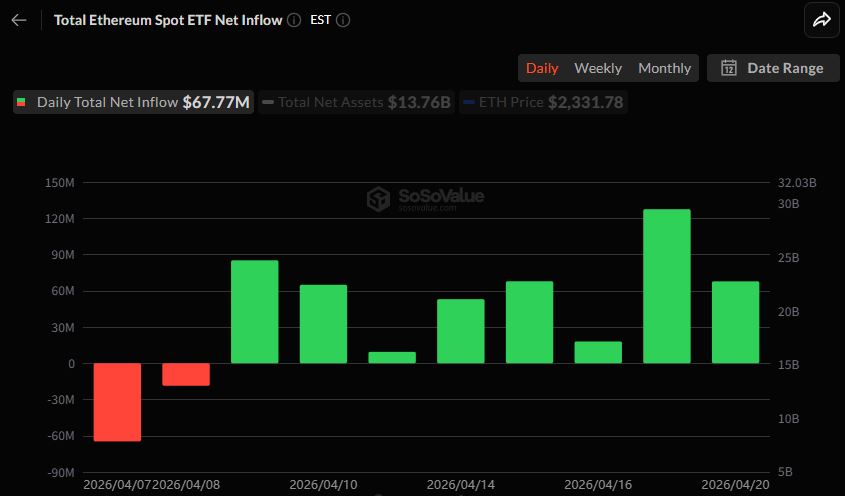
U.S. spot Ethereum (ETH) ETFs extended their steady streak of inflows, logging a ninth consecutive positive session and pushing cumulative net inflows above $12 billion—another signal that 'institutional demand' for ETH exposure remains resilient despite recent market volatility.
According to data compiled by SosoValue, U.S.-listed spot Ethereum ETFs recorded $67.77 million in net inflows on April 20 U.S. Eastern Time (ET). Over the eight prior trading sessions leading into April 20, the category maintained a consistent inflow trend, lifting total cumulative net inflows to $12.01 billion.
Flows were concentrated in a handful of products. BlackRock’s iShares Ethereum Trust ($ETHA) led the group with $76.05 million of net inflows, followed by BlackRock’s iShares Ethereum Staking ETF ($ETHB) with $13.19 million and Invesco’s QETH ($QETH) with $1.16 million. Offsetting some of those additions, Grayscale’s Ethereum Trust ($ETHE) posted $17.05 million in net outflows, Grayscale’s Mini Ethereum Trust ($ETH) saw $4.43 million in redemptions, and Fidelity’s Ethereum Fund ($FETH) recorded $1.16 million in outflows. The remaining ETFs were flat on the day.
Trading activity remained robust. Total turnover across spot Ethereum ETFs reached $745.07 million, led by $500.1 million in volume for BlackRock’s $ETHA. Grayscale’s Mini Ethereum Trust ($ETH) followed with $86.55 million, while Grayscale’s $ETHE posted $50.54 million.
The category’s total net assets climbed to $13.76 billion, equivalent to roughly 4.88% of Ethereum’s total market capitalization. By assets under management, BlackRock’s $ETHA remained the largest vehicle at $7.34 billion, followed by Grayscale’s $ETH at $2.08 billion and Grayscale’s $ETHE at $1.95 billion.
Market watchers are increasingly treating sustained flows into spot ETH ETFs as a barometer for 'liquidity inflow' into large-cap crypto exposure, especially as investors weigh the relative appeal of regulated products versus direct on-chain holdings. If inflows persist while turnover stays elevated, ETF demand could continue to play an outsized role in shaping short-term price discovery for Ethereum across U.S. trading hours.
Article Summary by TokenPost.ai
🔎 Market Interpretation
Persistent institutional bid: U.S. spot Ethereum ETFs logged a 9th straight inflow day, bringing cumulative net inflows to $12.01B, suggesting demand for regulated ETH exposure remains firm despite volatility.
Flow leadership is concentrated: Net buying was driven primarily by BlackRock products (ETHA and ETHB), while Grayscale vehicles and Fidelity saw outflows—indicating rotation within the ETF complex rather than broad-based selling.
High activity supports price discovery: With $745.07M in daily turnover (dominated by ETHA), ETFs continue to be an active venue that can influence short-term ETH price action during U.S. hours.
Meaningful footprint vs. ETH market cap: Spot ETH ETF net assets rose to $13.76B, about 4.88% of Ethereum’s market capitalization—large enough to matter for marginal demand/liquidity.
💡 Strategic Points
Watch flow persistence as a sentiment gauge: Continued multi-day inflows often signal risk-on positioning by institutions; a break in the streak may mark weakening demand or reallocations.
Monitor concentration risk: Since ETHA ($76.05M) was the key contributor while some peers had redemptions, overall category inflows may be fragile if leadership softens.
Volume + inflows interaction: If inflows stay positive while turnover remains elevated, ETFs can amplify moves via creation activity; if volume stays high but flows flip negative, it may indicate distribution/hedging.
AUM ranking matters for impact: Largest AUM vehicles—ETHA ($7.34B), Grayscale’s ETH ($2.08B), ETHE ($1.95B)—are most likely to drive headline flow/volume and influence market narrative.
Regulated vs. on-chain exposure tradeoff: The article frames ETFs as a preferred path for some investors versus direct holdings, implying ETFs may increasingly act as a liquidity gateway to ETH.
📘 Glossary
Spot Ethereum ETF: An exchange-traded fund designed to track ETH’s price using spot-market exposure (rather than futures), enabling regulated access through brokerage accounts.
Net inflow/outflow: The day’s capital moving into or out of ETFs, typically reflecting creations (inflows) or redemptions (outflows) of ETF shares.
Cumulative net inflows: Total net inflows since the products launched—used as a long-run measure of category demand.
Turnover / trading volume: Dollar value of ETF shares traded in a session; high volume can improve liquidity but may also reflect short-term speculation.
Net assets (AUM): Total value of assets held by an ETF; higher AUM generally implies greater market relevance and tighter execution for large orders.
Price discovery: The process by which markets incorporate new information into prices; active ETF trading can influence how ETH prices adjust during U.S. market hours.