

 News
News  Coin Information
  About us
  Customer Service


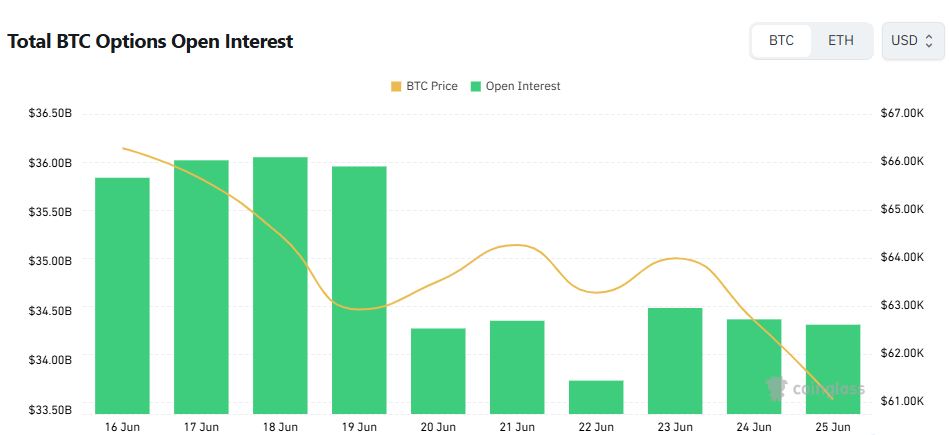
Bitcoin (BTC) options open interest edged slightly lower, but short-term flow shifted toward downside protection, with the most actively traded contract over the past day concentrated in a $60,000 put. The positioning highlights a market that remains structurally tilted bullish in outstanding exposure while actively hedging near-term volatility.
As of Wednesday 01:00 UTC, data compiled by CoinGlass showed total Bitcoin options 'open interest' (OI) at $34.37 billion, down 0.15% from $34.42 billion a day earlier. Calls accounted for 59.77% of total OI, while puts made up 40.23%, indicating that longer-dated positioning still leans toward upside scenarios.
Trading activity, however, told a different story. Aggregate options volume over the past 24 hours reached roughly $5.69 billion, with puts taking the lead at 52.76% versus calls at 47.24%—a split often associated with increased demand for hedges or tactical bearish bets during periods of uncertainty.
By venue, Deribit dominated turnover at $3.26 billion, followed by Bybit at $1.09 billion, Binance at $722 million, OKX at $571 million, and CME at $47 million. The distribution underscores the continued role of offshore crypto-native derivatives venues in driving the bulk of options activity, while CME’s smaller share reflects a more selective cadence from institutional participants on regulated rails.
In terms of where traders are positioned, the largest concentrations of outstanding contracts were clustered at higher strike calls on Deribit: the $120,000 call expiring Dec. 25, 2026 led open interest, followed by $80,000 calls expiring July 31, 2026 and Dec. 25, 2026. Such strikes are typically interpreted as longer-horizon upside exposure or structured positioning tied to volatility strategies.
Short-term trading was more defensive. The most heavily traded contract over the past 24 hours was the $60,000 put expiring June 26, 2026 on Deribit, followed by a $58,000 put expiring July 31, 2026 and a $70,000 call with the same July 31, 2026 expiry. The prominence of sub-spot put strikes suggests a focus on protecting against pullbacks or monetizing volatility, even as the broader OI mix remains call-heavy.
Options are derivatives that allow investors to express leveraged views on price direction or hedge existing exposure. A 'call option' grants the right, but not the obligation, to buy an asset at a predetermined price in the future, while a 'put option' grants the right to sell. 'Open interest' reflects the total number of outstanding contracts and is commonly used as a gauge of how much positioning is being carried forward rather than traded intraday.
The latest data points to a familiar tension in crypto derivatives: longer-dated positioning skewed toward upside, paired with near-term put demand that can signal caution, hedging activity, or preparation for higher volatility. How that balance evolves—particularly whether rising put volume coincides with renewed OI growth—could help clarify whether traders are building fresh bearish exposure or simply insuring portfolios against a choppier market regime.
🔎 Market Interpretation
- Open interest slightly eased, but positioning remains structurally bullish: Total BTC options OI dipped to $34.37B (-0.15% day/day), with calls at 59.77% vs puts at 40.23%, suggesting longer-dated exposure still favors upside scenarios.
- Short-term flow turned defensive: In the last 24h, options volume reached $5.69B with puts leading (52.76%) over calls (47.24%), a pattern commonly linked to hedging demand or tactical downside speculation.
- Key signal: active downside protection despite call-heavy OI: The most traded contract was a $60,000 put (Deribit), indicating investors are paying up for near-term insurance even while maintaining longer-term bullish structures.
- Venue mix implies retail/crypto-native dominance: Activity was led by Deribit ($3.26B), followed by Bybit, Binance, and OKX; CME ($47M) remained small, hinting that regulated institutional participation was comparatively muted during this window.
💡 Strategic Points
- Divergence to watch (OI vs volume): Call-heavy outstanding positioning paired with put-heavy trading often reflects “bullish core + hedged near-term risk.” A shift where put volume rises alongside rising total OI would be more consistent with fresh bearish positioning rather than simple insurance.
- Strike clustering reveals time-horizon split:
- Long-dated upside: Large OI at $120K (Dec 25, 2026) and $80K (Jul 31/Dec 25, 2026) calls suggests participants are holding convex upside exposure, potentially as part of structured/volatility strategies.
- Near-term protection: Heavy trading in sub-spot puts (e.g., $60K, $58K) indicates focus on guarding against drawdowns or monetizing expected turbulence.
- Interpreting the $60K put popularity: Concentrated demand at a specific downside strike can imply a perceived “pain point” level for hedgers, a popular tactical hedge around liquidation/volatility thresholds, or dealers positioning around gamma exposure.
- Practical monitoring checklist:
- If put/call volume stays put-heavy but total OI continues to fall, it may indicate short-lived hedging or profit-taking rather than a new macro bearish build.
- If put OI begins rising materially (not just volume), odds increase that traders are carrying downside bets forward.
- Track whether flow rotates from lower-strike puts into ATM/near-ATM puts; that often signals increased urgency and higher implied volatility demand.
📘 Glossary
- Options: Derivatives that provide leveraged exposure to an asset’s price direction or volatility, used for speculation or hedging.
- Call option: Right (not obligation) to buy the asset at a preset strike price by/at expiry; typically benefits from price increases.
- Put option: Right (not obligation) to sell the asset at a preset strike by/at expiry; typically benefits from price declines and is commonly used for downside hedging.
- Strike price: The predetermined price level at which the option can be exercised (buy for calls, sell for puts).
- Expiration (expiry): The date when an option contract ends; longer-dated options reflect longer-horizon views.
- Open interest (OI): Total number/value of outstanding option contracts that remain open; a gauge of how much positioning is being carried forward.
- Options volume: Contracts traded over a period (e.g., 24h); reflects activity/flow and can change quickly with sentiment.
- Downside protection/hedging: Using puts (or related structures) to limit losses during price declines or volatility spikes.














Comment 0