Bitcoin ETFs See $68 Million Outflows for Third Day as BlackRock IBIT Leads Withdrawals
U.S. spot Bitcoin ETFs recorded $68 million in net outflows over a third consecutive session, led by BlackRock’s IBIT, signaling near-term cooling despite strong cumulative inflows.


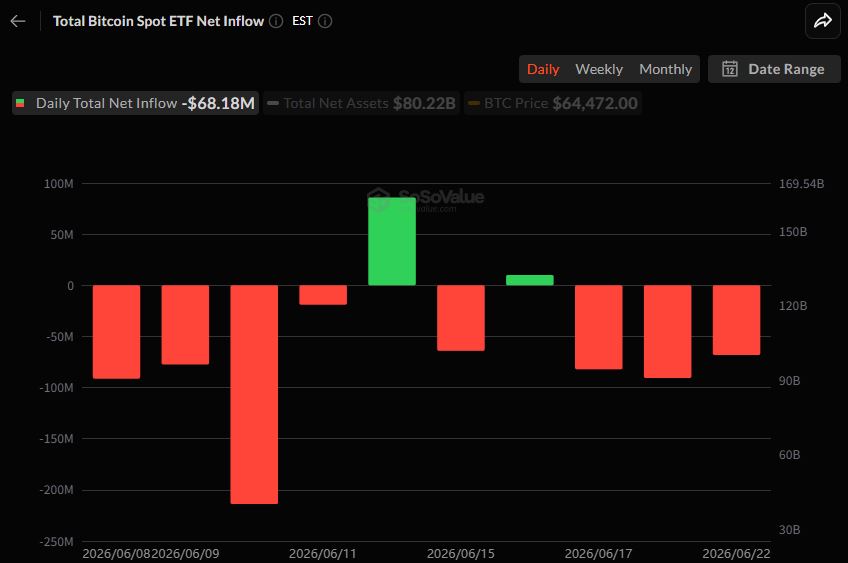
U.S. spot Bitcoin (BTC) ETFs extended their pullback for a third straight session, with BlackRock’s iShares Bitcoin Trust (IBIT) accounting for the bulk of the latest outflows—an early sign that near-term risk appetite may be cooling even as overall ETF adoption remains historically strong.
Data compiled by SosoValue shows that on June 22 (U.S. Eastern Time), the U.S. spot Bitcoin ETF cohort posted a net daily outflow of $68.18 million. The outflow streak has persisted for three consecutive trading sessions since June 17, though cumulative net inflows still stand at $53.33 billion, underscoring that the recent move is a retracement rather than a reversal of the broader trend.
Of the 13 spot Bitcoin ETFs currently trading, six products recorded modest inflows. ARK 21Shares Bitcoin ETF ($ARKB) led additions with $64.0 million, followed by Fidelity Wise Origin Bitcoin Fund ($FBTC) with $57.38 million and Grayscale Bitcoin Trust ETF ($BTC) with $48.14 million. Smaller inflows were seen in Morgan Stanley MSBTC ETF ($MSBT) with $8.11 million, Franklin Bitcoin ETF ($EZBC) with $3.72 million, and WisdomTree Bitcoin Fund ($BTCW) with $3.40 million.
Outflows, however, were concentrated in two funds. BlackRock’s iShares Bitcoin Trust ($IBIT) shed $171.96 million, while Grayscale Bitcoin Trust ($GBTC) saw $80.96 million leave the fund. The remaining ETFs were flat on the day, suggesting positioning changes were targeted rather than market-wide.
Trading activity remained elevated. Total dollar volume across spot Bitcoin ETFs reached $1.87 billion, led by IBIT at $1.37 billion. FBTC followed with $264.76 million, while GBTC recorded $64.89 million. The volume profile indicates that liquidity continues to cluster in the largest vehicles even as flows turn mixed—often a hallmark of institutional rebalancing rather than broad retail capitulation.
Total net assets across the category stood at $80.22 billion, representing roughly 6.21% of Bitcoin’s total market capitalization. By assets, IBIT remained dominant at $48.98 billion, followed by FBTC at $11.63 billion and GBTC at $8.95 billion—an ongoing illustration of how the post-launch ETF landscape has consolidated into a handful of large, highly liquid products.
While three straight sessions of net redemptions may invite caution, the flow split—smaller inflows across several issuers offset by heavier withdrawals from IBIT and GBTC—points to rotation and profit-taking rather than a broad-based exit from 'spot ETF' exposure. The next few sessions will be watched closely for whether this becomes a sustained de-risking cycle or simply a pause within the larger structural inflow trend tied to 'institutional demand' and improved onshore access to Bitcoin.
Article Summary by TokenPost.ai
🔎 Market Interpretation
Third straight outflow session signals cooling risk appetite: U.S. spot BTC ETFs posted a -$68.18M net outflow on June 22, extending the pullback since June 17. This reads as near-term caution rather than a structural breakdown.
Outflows were highly concentrated, not broad-based: Redemptions were largely driven by IBIT (-$171.96M) and GBTC (-$80.96M), while several other ETFs still took in capital—suggesting targeted re-positioning instead of a category-wide exit.
Big-picture adoption remains intact: Despite the recent retracement, cumulative net inflows remain elevated at $53.33B, reinforcing that the move is likely a pause/rotation within a larger trend.
Liquidity stayed strong even as flows turned negative: Total spot BTC ETF volume reached $1.87B, dominated by IBIT ($1.37B). High volume with mixed flows often aligns with institutional rebalancing rather than retail-driven capitulation.
Market structure continues to consolidate: Category net assets stand at $80.22B (~6.21% of BTC market cap). Asset leadership remains concentrated in IBIT ($48.98B), then FBTC ($11.63B) and GBTC ($8.95B).
💡 Strategic Points
Differentiate “headline net outflows” from “where the money moved”: With inflows into ARKB (+$64.0M), FBTC (+$57.38M), and BTC (+$48.14M), the data supports a rotation thesis—capital may be shifting toward preferred fee/liquidity profiles rather than leaving BTC exposure altogether.
Watch IBIT + GBTC as the primary sentiment barometers: Because the day’s net outflow was driven mainly by these two funds, continued redemptions there would be a clearer sign of sustained de-risking than small fluctuations across smaller issuers.
Use volume as a confirmation tool: Elevated turnover alongside modest net outflows can imply portfolio rebalancing, hedging, or profit-taking. A shift to falling volume + rising outflows would look more like weakening demand.
Key near-term scenarios to track:
Pause within uptrend: Outflows fade, cumulative inflows keep rising, and flows broaden across issuers.
Rotation persists: IBIT/GBTC see more redemptions while ARKB/FBTC continue attracting inflows.
De-risking cycle: Net outflows widen across most ETFs for multiple sessions, potentially pressuring spot BTC.
Structural support remains: The article frames “improved onshore access” and “institutional demand” as ongoing tailwinds—meaning short pullbacks may be treated by allocators as tactical adjustments rather than a thesis change.
📘 Glossary
Spot Bitcoin ETF: An exchange-traded fund designed to track Bitcoin’s price by holding actual BTC (as opposed to futures contracts).
Net inflow/outflow: The day’s net capital entering or exiting an ETF (creations minus redemptions), often used as a demand/sentiment proxy.
Redemption: The process where ETF shares are removed and underlying assets are delivered back to authorized participants (often shows up as outflows).
Rotation: Capital shifting from one product to another (e.g., from higher-cost or legacy funds to lower-cost or more liquid alternatives) without changing the underlying exposure.
Profit-taking: Investors selling after gains to lock in returns, which can create short-term outflows without implying a long-term bearish view.
Institutional rebalancing: Portfolio adjustments by large allocators (pensions, asset managers, hedge funds) that can increase volume and create concentrated flow changes.
Total net assets (AUM): The total market value of assets held by the ETF category; used to gauge scale and market influence.
Bitcoin market capitalization: Total value of all BTC in circulation (price × supply); the ETF share of market cap indicates how significant ETFs are as holders.