Bitcoin Cash Leads Inflows as Stablecoin Liquidity Rotates Into Crypto Markets
Bitcoin Cash led crypto inflows as over $30 million rotated out of USDT and USDC, signaling renewed trading activity across major assets.








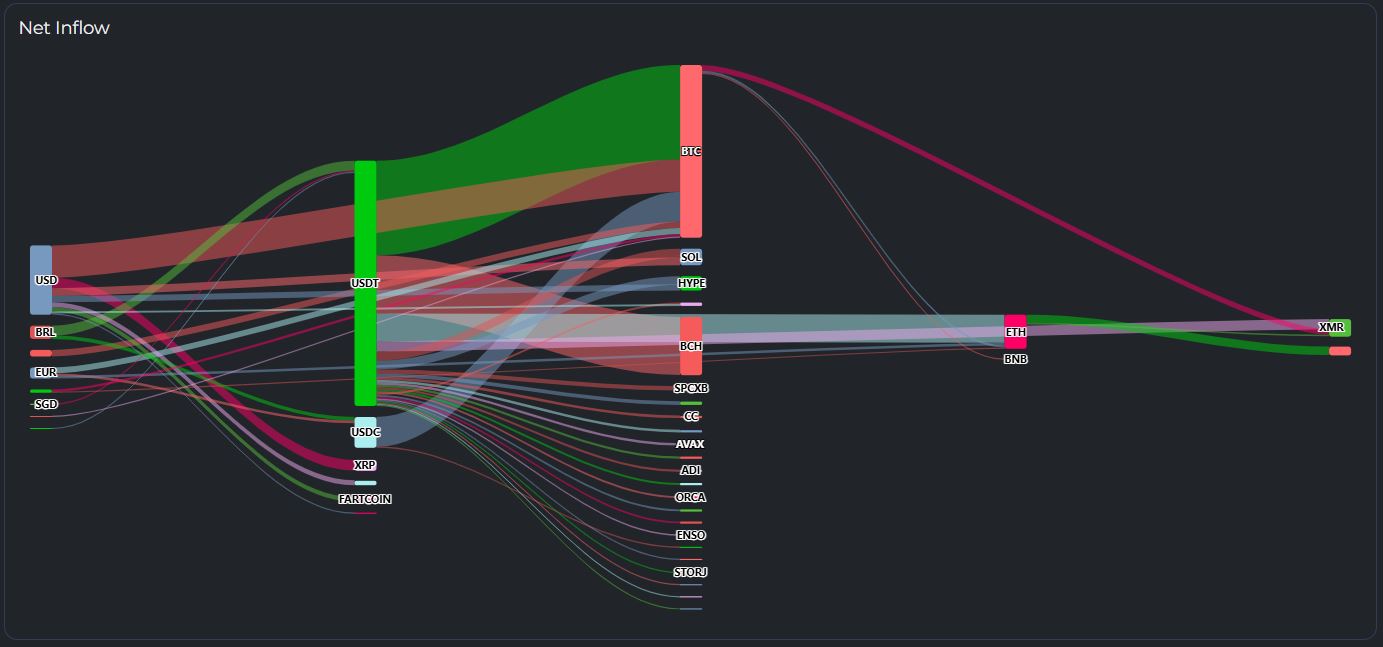
Fresh stablecoin flows rotated into major crypto assets over the past several hours, with Bitcoin Cash (BCH) posting the largest net inflow among tracked tokens—an early signal of renewed risk appetite as traders redeployed liquidity from Tether (USDT) into spot markets.
Data compiled by Cryptometer as of June 22, 1:10 p.m. KST (June 22, 12:10 a.m. ET) shows that roughly $9.18 million in U.S. dollars (USD), $1.79 million in Brazilian real (BRL), and $1.48 million in euros (EUR) moved from fiat and cash-equivalent channels into the crypto market over the prior five hours. At the same time, stablecoin distribution accelerated: about $32.57 million rotated out of Tether (USDT) and $4.12 million out of USD Coin (USDC), spreading across multiple cryptocurrencies.
Among the biggest recipients, Bitcoin Cash (BCH) attracted approximately $7.71 million, more than any other asset in the interval. Ethereum (ETH) followed with about $4.51 million, while Bitcoin (BTC) drew roughly $4.28 million. Additional inflows were recorded in Monero (XMR) at $2.28 million, Solana (SOL) at $2.24 million, Hyperliquid (HYPE) at $1.97 million, and XRP at $1.39 million.
The pattern reflects a familiar short-term market dynamic: when stablecoins—especially USDT—start dispersing into multiple liquid tokens, it often coincides with higher turnover and an uptick in speculative positioning. BCH’s relative outperformance in flows may hint at renewed interest in high-beta large caps during the window, though flow spikes can also be driven by exchange rebalancing or large one-off transfers.
Cryptometer’s five-hour outflow snapshot also showed pockets of selling or redeployment away from several tokens. Dogecoin (DOGE) saw about $1.70 million in outflows, Worldcoin (WLD) about $1.51 million, TRUMP about $1.43 million, XRP about $1.39 million, and NEAR Protocol (NEAR) about $1.12 million.
Some of the exiting capital appeared to consolidate back into stablecoins, with around $11.27 million gathering in Tether (USDT). Separate cash-out trends were also visible, including conversions into Korean won (KRW) worth roughly $8.16 million and into U.S. dollars (USD) worth about $5.89 million, underscoring that liquidity is not only rotating between tokens but also intermittently returning to fiat.
Overall, the latest flow data points to a market that remains tactically active: traders are cycling between 'stablecoin liquidity', major layer-1 assets, and selective altcoins, while keeping a portion of funds ready in USDT and fiat for rapid repositioning as volatility and headline risk evolve.
Article Summary by TokenPost.ai
🔎 Market Interpretation
Risk-on rotation signal: Over a five-hour window, a notable amount of liquidity rotated out of stablecoins—especially USDT—and into major crypto assets, a pattern that often aligns with rising short-term speculative activity and higher turnover.
Largest beneficiary: Bitcoin Cash (BCH) led inflows at ~$7.71M, exceeding Ethereum (~$4.51M) and Bitcoin (~$4.28M). This suggests a temporary preference for higher-beta large caps, though flows can be influenced by exchange rebalancing or one-off transfers.
Broad participation: Additional inflows into XMR (~$2.28M), SOL (~$2.24M), HYPE (~$1.97M), and XRP (~$1.39M) indicate the rotation was not limited to a single theme but spread across liquid majors and select altcoins.
Two-way liquidity: Despite dispersion from USDT/USDC, capital also reconsolidated back into USDT (~$11.27M) and partially returned to fiat (~$8.16M KRW, ~$5.89M USD), implying traders are actively hedging and keeping dry powder available.
Net takeaway: The market appears tactically active rather than purely directional—rotating between stablecoin liquidity, large layer-1s, and opportunistic alt positions while periodically de-risking into fiat.
💡 Strategic Points
Watch stablecoin dispersion as a momentum cue: When USDT/USDC balances decline while multiple majors rise, it can precede short-term volatility expansion. Confirm with price/volume and funding data before assuming a sustained trend.
BCH flow spike—confirm intent: Treat BCH’s leading inflow as a signal to monitor, not a standalone buy trigger. Check whether the flow coincides with spot bid strength, improving order-book depth, or potential catalysts; otherwise it may reflect internal exchange movements.
Rotation winners vs. laggards: Outflows from DOGE (~$1.70M), WLD (~$1.51M), TRUMP (~$1.43M), NEAR (~$1.12M) suggest capital is temporarily leaving certain high-volatility or narrative-driven tokens for more liquid majors.
Mixed XRP signal: XRP appears in both inflow and outflow lists (~$1.39M), implying two-sided positioning (profit-taking plus dip-buys). Traders may consider tighter risk controls and confirmation from net exchange flows.
Liquidity management posture: The presence of fiat conversions (KRW, USD) alongside stablecoin re-accumulation supports a strategy of keeping a cash buffer to respond to headline-driven swings.
📘 Glossary
Stablecoin rotation: Movement of capital from stablecoins (e.g., USDT, USDC) into volatile cryptoassets, often interpreted as increasing risk appetite.
Net inflow / net outflow: The estimated net amount of funds entering (inflow) or leaving (outflow) a specific asset over a given timeframe.
Spot market: Market where cryptocurrencies are bought and sold for immediate settlement, as opposed to derivatives.
High-beta asset: An asset that tends to move more than the broader market—often rising more in rallies and falling more in drawdowns.
Exchange rebalancing: Operational transfers by exchanges or large participants that can temporarily distort flow readings without reflecting true investor demand.
Liquidity / dry powder: Readily deployable capital (often in stablecoins or fiat) kept available for quick entry, hedging, or repositioning.