South Korean Lawmakers, Industry Push Stablecoin Framework Amid Global Race
South Korean lawmakers, global stablecoin issuers like Tether and Ripple, and industry leaders met at the National Assembly to accelerate efforts toward a domestic stablecoin framework amid intensifying global regulat…
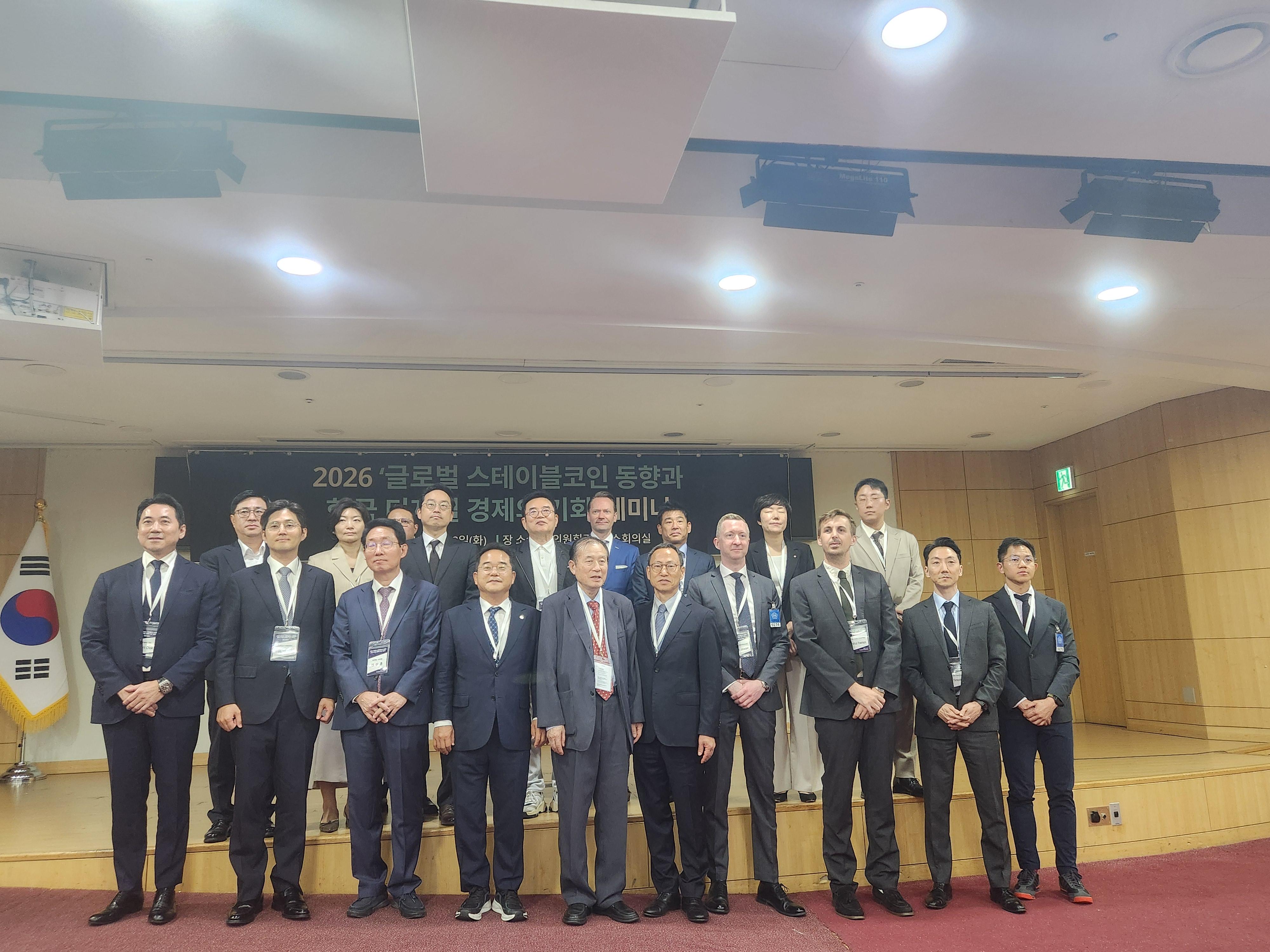
Lawmakers, global stablecoin issuers, and South Korea’s digital-asset industry convened at the National Assembly on Tuesday to debate how to formalize a Korean stablecoin framework—an effort participants framed as urgent as the global race to set rules for tokenized money accelerates.
The seminar, titled “2026 Global Stablecoin Trends and Opportunities for Korea’s Digital Economy”, was held Tuesday 2026-05-12 00:30 UTC (Monday 8:30 p.m. ET) at the National Assembly Members’ Office Building in Seoul’s Yeouido district. It was hosted by Democratic Party digital-asset task force lawmakers Lee Kang-il and Min Byeong-deok alongside the “Forum for Coexistence and Unification,” and co-organized by the Digital Convergence Industry Association (DCIA), the Korea Web3 Blockchain Association (KWBA), and the Digital Currency Governance Group (DCGG). Major Korean exchanges Bithumb, Coinone, and Korbit participated as sponsors, underscoring how closely the policy debate is being tracked by market infrastructure providers.
The event brought internationally known stablecoin and blockchain firms—including Tether, Ripple, and First Digital—into the same room as Korean policymakers and financial-sector veterans, with an agenda spanning global regulatory trends, issuer keynotes, and three roundtable discussions on financial innovation, stablecoin market structure, and Korea’s institutional path forward.
In opening remarks, People Power Party lawmaker Kim Sang-hoon argued Korea had missed key windows to support the sector, saying the government’s role had been “limited” even as domestic startups pushed the market forward. Kim also pointed to what he described as KRW 160 trillion (about $115 billion) in capital outflows last year, framing it as evidence of insufficient trust and institutional readiness. He said he would work to advance legislation around a digital-asset “basic law,” positioning it as a foundation for market formation and industry development.
Democratic Party lawmaker Min, in his congratulatory address, pushed a broader narrative: stablecoins are no longer simply crypto instruments, but an ‘operating system’ for the emerging digital economy. Min said the technology is expanding beyond payments and remittances into inter-institution settlement and ‘agentic commerce’—transactions initiated and completed by software agents—making stablecoins a central building block of future financial infrastructure.
Min warned that the center of gravity is currently tilted toward dollar-linked stablecoins, which he argued function as a new channel of U.S. digital influence as payment, settlement, and user data accumulate inside dollar-denominated networks. Calling it a “tsunami” of dollar stablecoins, he said Korea risks becoming passive in its monetary and financial order without proactive policy design.
Against that backdrop, Min made the case for a won-based stablecoin, describing it not merely as a defensive hedge but an ‘offensive tool’ to expand the won’s utility in digital environments. He suggested a won stablecoin could serve as a safety mechanism, a conduit to keep capital flows onshore, and a bridge between public and private payment rails.
He also urged rapid experimentation with real-world use cases, including consumer and small-business contexts. Min floated concepts such as loyalty- or community-style tokens—beyond existing local currency programs—as potential early commercialization routes, arguing they could reduce merchant fees and improve cash-flow efficiency for small businesses. He additionally highlighted Korea’s exportable cultural industries, saying the country’s K-content footprint could support cross-border payment and settlement models tied to global fandom and the creator economy.
Industry leaders echoed the call for speed while acknowledging political and regulatory friction. DCIA Chairman Kim Ki-heung said that while discussions around a digital-asset basic law were expected in the second half of the year, convincing the Bank of Korea and government stakeholders remained difficult. KWBA Chairman Cho Won-hee said stablecoins have become the “vascular system” connecting the real economy to digital ecosystems, adding that jurisdictions such as the U.S. and the European Union are moving quickly to secure a regulatory edge.
The day’s program was structured around policy and market implementation details. Attorney Kim Tae-rim of Axis Law Firm presented on global regulatory “best practices” and what they could mean for Korea. DCGG policy head Joshua Townson was set to compare the European Union’s Markets in Crypto-Assets framework with the U.K.’s differentiated approach, a timely topic as Asia-Pacific markets weigh how strictly to regulate issuers, reserves, disclosures, and redemption rights.
Issuer perspectives were also featured. First Digital CEO Vincent Chok delivered a keynote on stablecoin technology innovation and Asian market strategy, while Ripple’s Rahul Advani, co-head of global policy, delivered a video presentation emphasizing the importance of ‘regulation-based’ stablecoins in a digital economy where payments and tokenization increasingly converge.
Three roundtables brought together former senior banking and public-sector officials alongside global issuer compliance leaders and Korean market infrastructure executives. Participants included former NH NongHyup Financial Group chairman Kim Yong-hwan, former Korea Deposit Insurance Corporation president Yoo Jae-hoon, Gwangju Bank vice president Byun Mi-kyung, Tether Chief Compliance Officer Leonardo Real and global licensing head Giles Dixon, as well as representatives from DAXA, custody provider KODA, and Ledger’s APAC leadership.
The seminar comes as stablecoins move from a crypto-native product to a geopolitical and regulatory priority, with governments seeking to balance ‘consumer protection’ and ‘financial stability’ against innovation and competitiveness. With issuers, exchanges, custodians, and policymakers all represented, participants said the discussions could feed directly into the design of Korea’s forthcoming digital-asset basic law and a domestic stablecoin rulebook—an outcome that would shape how Korean markets access ‘liquidity’ and settlement rails in the next phase of digital finance.
Article Summary by TokenPost.ai
🔎 Market Interpretation
Korea is accelerating stablecoin rulemaking amid a global regulatory sprint: The National Assembly seminar signals a shift from broad “crypto” debate to concrete design choices for issuer licensing, reserve standards, disclosure, and redemption rights.
KRW stablecoin framed as strategic monetary infrastructure: Lawmakers emphasized that stablecoins are evolving from trading tools into settlement and commerce rails—raising policy stakes for currency sovereignty and payment-data control.
USD-stablecoin dominance viewed as a systemic externality: Participants warned dollar-linked stablecoins concentrate liquidity, settlement activity, and user data inside USD networks, potentially reinforcing U.S. financial influence and creating dependency risks for Korea.
Industry is positioning for a “rules-first” market expansion: Exchanges (Bithumb, Coinone, Korbit), custodians, and global issuers (Tether, Ripple, First Digital) highlighted readiness to build, but underscored that regulatory clarity—especially the stance of the Bank of Korea—will determine speed to market.
Policy outcomes may directly shape liquidity access: The article links stablecoin rule design to future settlement rails and liquidity distribution in Korean digital finance, implying that domestic frameworks could affect capital flows, onshore activity, and competitiveness.
💡 Strategic Points
Prioritize a Korean “digital-asset basic law” with stablecoin chapters: Establish clear definitions, permitted business models, and supervisory roles to reduce uncertainty and enable compliant issuance and distribution.
Design KRW stablecoin objectives beyond “defense”: Treat it as an “offensive tool” to expand KRW utility in digital commerce—supporting domestic settlement, programmable payments, and interoperable public/private payment rails.
Set non-negotiables for trust: Explicit rules on reserve composition, segregation, custody, audit/attestation frequency, disclosure standards, and guaranteed redemption timelines to address consumer protection and financial stability concerns.
Clarify the central bank interface early: The Bank of Korea’s position is portrayed as a key bottleneck; early alignment on issuer oversight, systemic-risk triggers, and settlement access can prevent delays and fragmented pilot programs.
Run targeted pilots with measurable KPIs: Focus on consumer and SME use cases—merchant fee reduction, faster settlement, improved cash-flow—before scaling to broader financial-market infrastructure.
Explore “community/loyalty token” commercialization pathways: Use local, membership, or fandom-based instruments as early demand drivers while keeping redemption, disclosures, and consumer safeguards consistent with stablecoin standards.
Leverage Korea’s K-content export channel: Build cross-border payment and settlement models tied to creator economies and global fandom, positioning KRW-linked instruments as practical rails for digital goods and services.
Benchmark against EU MiCA and the UK’s differentiated model: Compare approaches on issuer authorization, reserve requirements, marketing rules, and redemption rights to select a framework that balances innovation with systemic safeguards.
Align market infrastructure roles: Define responsibilities for exchanges, custodians (e.g., KODA), and industry bodies (e.g., DAXA) on listing, custody standards, travel rule compliance, and incident response.
Prepare for geopolitical and compliance scrutiny: Presence of global compliance heads implies heightened expectations on AML/CFT, licensing, and cross-border transaction monitoring for any Korea-linked stablecoin ecosystem.
📘 Glossary
Stablecoin: A cryptocurrency designed to track a stable reference value (commonly fiat currency) via reserves and/or other stabilization mechanisms.
KRW stablecoin (won-based stablecoin): A stablecoin pegged to the Korean won, intended to provide KRW-denominated settlement and payment utility in digital networks.
USD stablecoin dominance: The market reality where most stablecoin liquidity and usage are concentrated in dollar-pegged tokens, influencing global payment and settlement flows.
Redemption rights: The legal and operational guarantee that holders can exchange a stablecoin for its reference asset (e.g., fiat) under defined terms and timeframes.
Reserves: Assets backing a stablecoin’s value (cash, short-term treasuries, deposits, etc.), typically subject to custody, segregation, and disclosure rules.
MiCA (Markets in Crypto-Assets): The European Union’s comprehensive framework regulating crypto-asset issuance and service providers, including rules for stablecoins.
Agentic commerce: Commerce where software agents initiate and complete transactions on behalf of users or businesses, increasing demand for programmable, always-on settlement assets.
Tokenization: Representing real-world assets or financial claims in token form on a blockchain to enable programmable transfer, settlement, and ownership tracking.
Settlement rails: The infrastructure and networks used to finalize transfers of money or assets, increasingly extending from banking systems into blockchain-based systems.
Onshore capital flows: Keeping financial activity within domestic systems and institutions rather than moving liquidity abroad through external networks or instruments.