
K Bank Outlines ‘Agentic AI Bank’ Strategy to Drive Next Phase of Banking
K Bank presented its ‘Agentic AI Bank’ vision at METACON 2026, emphasizing organizational transformation and human-AI collaboration as key to scaling AI adoption in banking.

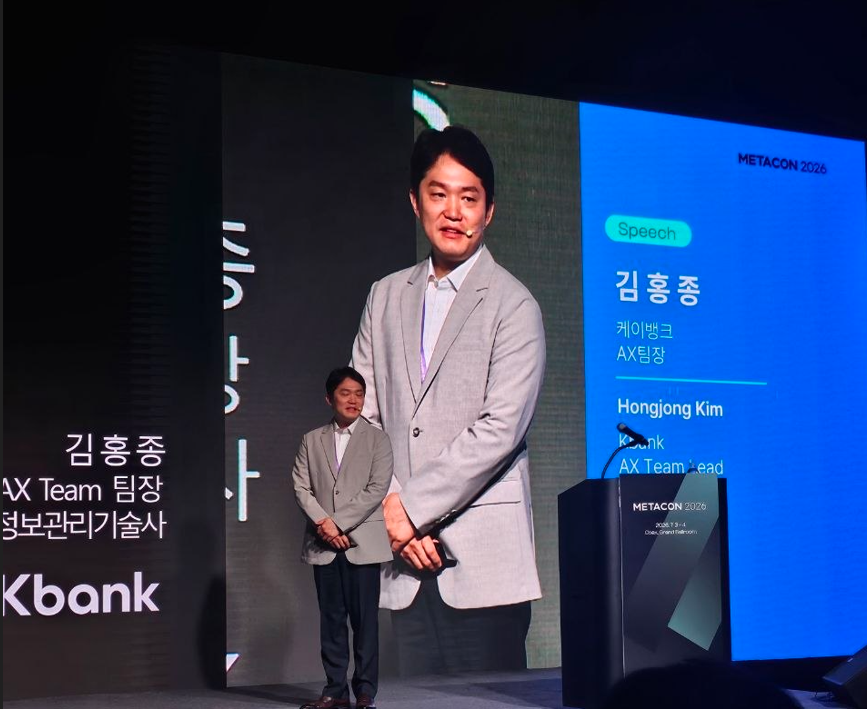
K Bank outlined a roadmap for how banks should evolve beyond simply offering financial services, arguing that the next phase of competition will be defined by whether institutions can become an 'Agentic AI Bank'—a model in which AI systems autonomously execute meaningful parts of day-to-day work under human oversight.
The strategy was presented on Thursday ET (July 2) at METACON 2026, an AI and technology business conference co-hosted by TokenPost, held at COEX in Seoul. Hongjong Kim, head of K Bank’s AX team, delivered a session titled “Transition to an Agentic AI Bank: K Bank’s AI Strategy, Change Management, and Case Studies,” emphasizing that successful adoption is less about deploying a model and more about organizational 'transformation'—changing how people work, decide, and collaborate with AI.
Kim framed the discussion through the historical evolution of banking, noting that the word “bank” traces back to the Latin “banca,” a bench used for money exchanges in medieval Europe. He then referenced a well-known remark attributed to Bill Gates—“Banking is necessary, banks are not”—to argue that while financial functions remain essential, the institutional form and operating model of banks must continually adapt. In his view, the industry has progressed from branch-centric Bank 1.0 to ATM and telephone banking (2.0), mobile-first banking (3.0), and 'hyper-personalized finance' (4.0), and is now entering a fifth era built around agentic AI.
To illustrate the broader shift, Kim pointed to BNP Paribas, which has publicly described itself as a technology company rather than a traditional financial firm and has developed more than 2,000 AI use cases. He also cited McKinsey research suggesting financial services will be among the sectors most impacted by generative AI, with particularly rapid change expected in software development, customer service, marketing, and risk management.
Still, Kim argued that the financial sector faces structural barriers that slow AI deployment compared with less-regulated industries. The first is Korea’s segregated network environment, where many 업무 systems operate without internet access and where importing source code and tools involves complex approval processes—conditions that can delay even basic integration of updated AI models. The second is the difficulty of securing usable training data under strict privacy rules, where institutions often must navigate pseudonymization and anonymization requirements as well as reviews by internal information security governance bodies.
But Kim described the hardest challenge as “finding the right AI problems.” In practice, AI teams seek well-defined tasks and quality datasets, while business units are often stretched thin and respond that they lack time to participate—creating a recurring disconnect. “If you rely on a small group of intermediaries to connect AI and the business, AI transformation won’t last,” he said, arguing that banks need a culture where AI teams and frontline units jointly define problems and co-own outcomes. He added that hiring only AI specialists is not a cure-all; change often depends on talent that combines planning ability, practical AI literacy, and strong communication skills.
K Bank’s own AI path, Kim said, shows how a single high-impact use case can shift internal sentiment. After joining the lender in 2019, he visited roughly 60 departments to identify AI opportunities, but struggled to build buy-in. Momentum changed when the bank applied facial recognition to fraud detection—flagging cases where the same individual attempted repeated sign-ups under different names or where an existing customer’s facial data suddenly changed. That capability helped uncover identity fraud involving forged IDs, and the success accelerated wider adoption.
From there, the bank expanded AI efforts across operations and compliance. Kim said K Bank generated about KRW 8.7 billion (roughly $6.3 million) in economic value through more than 40 AI initiatives through last year, and is now running over 80 AX projects in 2026. He described workflow changes that followed, including replacing slide-based reporting with HTML-based interactive reports and using AI to surface multiple analytical perspectives so employees can focus on decision-making rather than manual compilation.
He also highlighted internal tooling meant to keep AI usable within bank-grade security constraints, including a “copilot”-style productivity layer, “CoWork” collaboration features, and an internal LLM-based assistant designed for controlled access and safe usage in regulated environments.
Throughout the talk, Kim repeatedly returned to the idea that change management—not model performance—will determine whether banks can realize AI’s benefits. He said K Bank’s goal has evolved from “Practical AI” to “a bank that grows with AI,” and now toward the 'Agentic AI Bank' vision. The next phase, he argued, is not a centralized AI unit building everything, but business departments directly using AI with governance guardrails in place.
To support that shift, K Bank is running internal programs aimed at raising AI literacy and improving participation, including prompt-based hack events such as a “Promptathon” and internal AI pitching sessions. Kim also shared examples of deployments: an “AI Quiz Challenge” that automatically generates quiz questions and explanations; smishing message interpretation using generative AI with retrieval-augmented generation (RAG); a system that recommends a financial institution even when users input only part of an account number; and an automated compliance review workflow for financial advertising.
Kim closed with a straightforward message: execution matters more than hesitation. Rather than waiting for perfect conditions, he argued, banks should start with small tasks and scale what works—using early wins to build a culture where humans and AI routinely work side by side. That cultural shift, he said, is the real starting point of an 'Agentic AI Bank'.
METACON 2026 runs from July 3–4 in Seoul under the theme “AI Makers Rise,” bringing together companies and builders to share strategies and operational experience across AI technology, enterprise transformation, marketing, and investment.
Article Summary by TokenPost.ai
🔎 Market Interpretation
Banking’s competitive frontier is shifting from “digital channels” to “autonomous execution”: K Bank argues the next era is defined by whether banks can operationalize agentic AI—AI that carries out meaningful work steps under human oversight—rather than merely deploying chatbots or analytics.
Transformation is organizational, not technical: The core differentiator is change management—how teams redesign workflows, decision-making, and accountability with AI embedded—more than model accuracy alone.
Regulation and infrastructure create asymmetric adoption speed: Korea’s segregated network environments and stringent privacy/data governance slow iteration compared with less-regulated industries, raising the premium on secure internal tooling and on-prem/controlled LLM deployment patterns.
“Use-case discovery” is the main bottleneck: The largest friction is aligning AI teams (who need clear tasks and datasets) with business units (who lack bandwidth), implying that banks that solve cross-functional problem definition will outpace peers.
Proof points suggest scale is possible: K Bank reports KRW 8.7B in economic value from 40+ AI initiatives and has expanded to 80+ AX projects in 2026, signaling that incremental wins can compound into enterprise-wide momentum.
💡 Strategic Points
Start with a “sentiment-shifting” flagship use case: K Bank’s facial-recognition fraud detection (detecting repeated sign-ups under different names and sudden facial-data changes) created measurable impact and unlocked internal buy-in for broader AI adoption.
Design governance so business teams can operate AI directly: The target state is not a centralized AI team building everything; it’s frontline departments using AI within guardrails (security, privacy, auditability, model access controls).
Build bank-grade AI tooling layers: Internal “copilot” productivity tooling, collaboration features (“CoWork”), and a controlled internal LLM assistant help reconcile usability with regulated-environment constraints (access control, data handling, safe prompting).
Re-engineer reporting and analysis workflows: Moving from slide-based reporting to HTML interactive reports and using AI to generate multiple analytical perspectives shifts employees from manual compilation to higher-value judgment and decision-making.
Invest in AI literacy and participation mechanisms: Promptathons, internal pitching sessions, and hands-on programs reduce the “AI team vs. business” gap and make problem definition a shared responsibility.
Deploy “small tasks first,” then scale: The recommended execution playbook is rapid pilots → measurable wins → broader rollout, rather than waiting for perfect data or infrastructure conditions.
Representative deployments highlighted:
Generative AI Quiz Challenge that auto-creates questions and explanations.
Smishing interpretation using GenAI + RAG for grounded responses.
Partial account-number input that still recommends the correct financial institution.
Automated compliance review for financial advertising content.
📘 Glossary
Agentic AI: AI systems that can plan and execute multi-step tasks (often using tools and workflows) with humans providing oversight, approvals, and accountability.
Agentic AI Bank: A banking operating model where AI autonomously performs substantial daily work (e.g., reviews, analyses, routing, draft decisions) within governance controls.
AX (AI Transformation): Organization-wide transformation program integrating AI into processes, roles, and governance—not just deploying models.
Generative AI: Models that create content (text, code, summaries) and can assist in customer service, marketing, development, and operations.
RAG (Retrieval-Augmented Generation): A method where a model retrieves relevant documents/data and uses them to generate responses, improving accuracy and auditability.
Pseudonymization / Anonymization: Privacy techniques that reduce identifiability of personal data; often required for AI training in regulated industries.
Segregated network environment (망분리): Security architecture where internal 업무 systems are isolated from the internet, complicating tool import, updates, and AI integration.
Smishing: SMS phishing attempts that trick users into clicking malicious links or sharing sensitive information.
Change management: The structured approach to shifting processes, incentives, and behaviors so new tools (like AI) are adopted and sustained.