
Enterprises Shift to AI-Native Models as MetaCon 2026 Highlights Operational Overhaul
MetaCon 2026 in Seoul highlighted companies like Hyundai, SAP, and Anthropic shifting from AI adoption to AI-native operations as a core business transformation strategy.

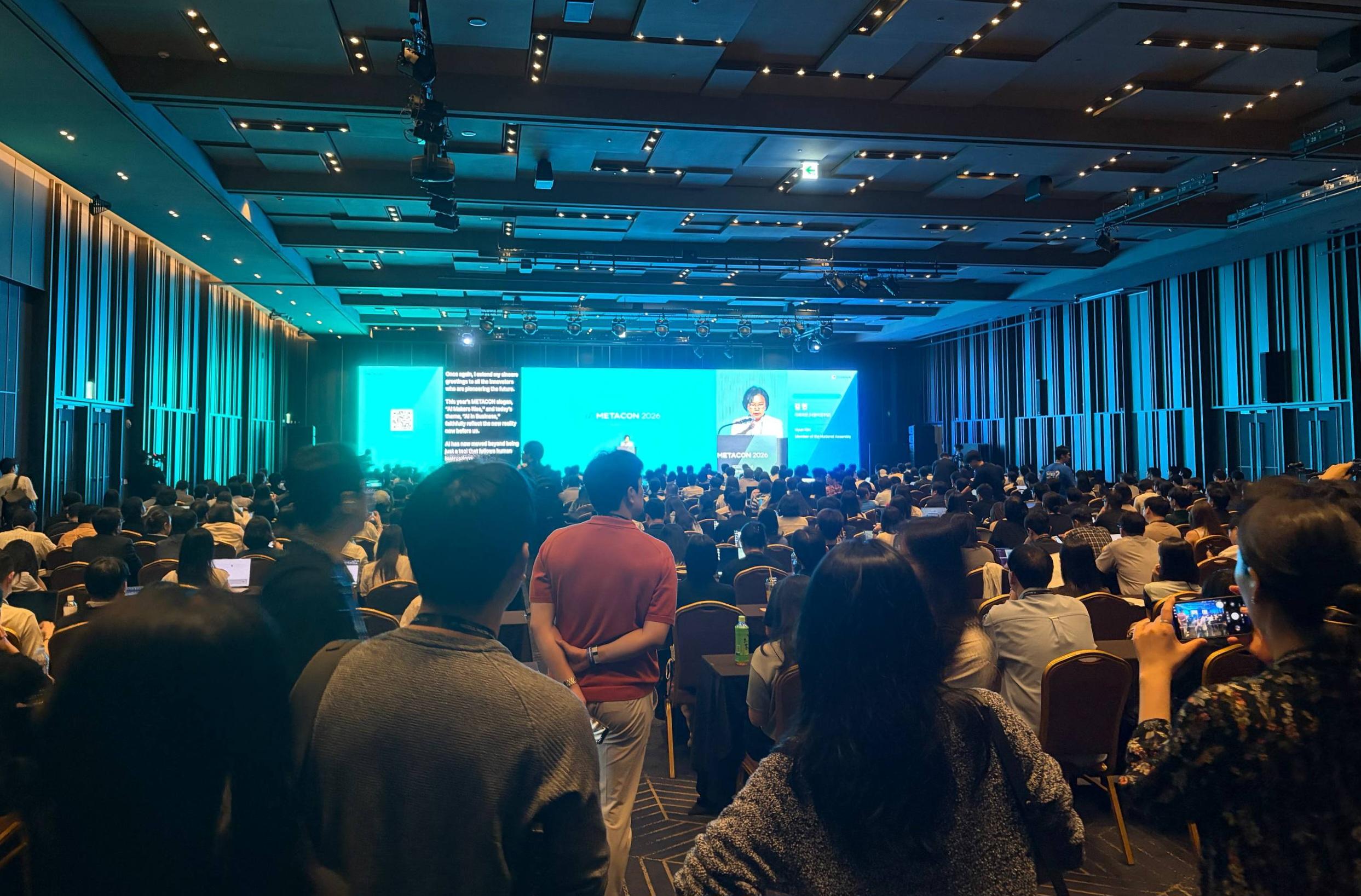
Artificial intelligence is no longer “coming” to enterprise—it is already embedded in how companies plan, decide, and execute. That was the overriding message from MetaCon 2026, which opened Thursday ET (July 3) at Seoul’s COEX, where standing-room-only crowds underscored how quickly AI has shifted from a specialist toolset to a board-level operating concern.
The conference’s theme—'AI in Business. Already Happened'—captured the mood: the most consequential word was not “AI,” but “already.” Speakers from Hyundai Motor, K bank, Anthropic, Salesforce, LG CNS, KT, Deloitte, and SAP came from different industries and markets, yet converged on a single conclusion: AI is moving from an add-on feature to a foundational assumption in corporate operations.
Maeng Sung-hyun, emeritus professor at KAIST, framed the shift as a move beyond simply “using” AI. The popular notion of 'AI adoption', he argued, often implies minimal disruption—taking an existing process and attaching an AI tool on top. That pattern resembles earlier digital transformation efforts, where paper became screens and ledgers became databases, while decision-making structures frequently stayed intact.
AI transformation, by contrast, is changing the logic of work itself. Maeng distinguished between 'AI+X'—adding AI functions to an existing business—and 'X+AI', redesigning the business model around AI from the ground up. Deploying a chatbot or automating document summaries fits the former; reworking manufacturing workflows, insurance underwriting, customer service, or financial product delivery to be AI-native fits the latter. In his view, the enduring competitive advantage will accrue to companies that pursue the second path.
Anthropic’s Applied AI Architect Jang Dong-jin described the same evolution in practical terms: software is shifting from “tool” to “colleague.” Tools are used on demand, but a “colleague” changes how responsibilities are assigned, how meetings are run, and how accountability is structured. The implication is not that humans disappear from the loop, but that their role changes—setting direction, supervising outcomes, and intervening when judgment or risk requires it.
Salesforce Director Jude Wamme echoed that reframing, arguing the more important question is not whether AI becomes smarter than humans, but what humans can do with AI that they could not do before. Even in highly automated settings, speakers stressed, decision rights and responsibility remain human. The practical challenge is designing work so that human oversight is clear and measurable, rather than assumed.
Despite the urgency, panelists warned that many organizations are still approaching AI as a procurement exercise. Deloitte Korea Partner Jessica Kim cited internal industry benchmarks suggesting only about 5% of companies have translated AI deployments into measurable financial performance and return on investment. The shortfall is often not model capability, she argued, but execution: unclear problem definitions, unprepared data foundations, and pilots run as isolated IT projects without deep involvement from operating teams.
Several executives pointed to a familiar failure mode in generative AI: when data, incentives, and governance are misaligned, errors surface as 'hallucinations'—confident outputs that are wrong. SAP APAC Business AI Strategy Advisor Jeong Su-ji added that failure often begins when AI becomes the objective rather than the means. The correct sequencing, she said, starts with a concrete operational pain point, followed by process redesign and only then model selection and deployment. Companies that “look for problems to justify AI” tend to stall; those that “use AI to solve defined problems” scale.
Cost—and the operating economics of AI—emerged as a second major theme. While public discourse still focuses on model benchmarks, enterprise buyers are increasingly preoccupied with stability, predictability, and unit economics: not “Should we adopt AI?” but “How reliably can we run it, and at what cost?”
KT executive Lee Jin-hyung said token budgets are no longer a simple expense line; they have become a performance variable. Even mundane workflows can consume millions of tokens at scale, and as per-token prices fall, usage frequently increases rather than declines—an enterprise version of 'Jevons paradox'. LG CNS AI Center head Jin Yo-han described the operational dilemma: if organizations allow unrestricted token consumption, costs can quickly become unmanageable. Competitive advantage, he argued, will come from orchestration—deciding where large models are necessary, where smaller models suffice, and where humans must verify outputs for safety or compliance. AI does not “finish” at purchase; the hardest part is ongoing operations.
K bank offered a sector-specific example of what AI-native design can unlock: 'hyper-personalized finance' and “agentic banking,” where systems can adapt services to each customer in near real time based on behaviors, risks, and preferences. Personalization has long been a marketing promise, executives noted, but was difficult to deliver manually across millions of users. With AI embedded into workflows, it can become a system capability rather than a slogan—though speakers emphasized it is not “free.” The ability to deliver hyper-personalization depends on redesigned data pipelines, governance, and organization-wide alignment.
That alignment—the cultural operating model around AI—was repeatedly cited as the key bottleneck. Across sessions, speakers argued that AI is not primarily an IT modernization effort but a 'business transformation'. If frontline teams do not use it, nothing changes; if frontline teams do not define the problem, AI can produce irrelevant answers at scale. K bank’s Kim Hong-jong said delegating the transition to a small “connector” team is insufficient. Sustainable change requires business owners and AI teams to co-define goals, run experiments, absorb failures, and iterate together.
Notably, most speakers rejected grand, multi-year master plans in favor of small, fast iterations. SAP’s Jeong advocated starting with narrowly scoped MVPs that resolve specific pain points. Kim Dong-hwan, CEO of FortyTwoMaru, argued that because AI capabilities evolve on a weekly cadence, oversized projects can collapse under shifting assumptions. The dominant rule, speakers suggested, is to start small but design for expansion.
K bank presented a case study that linked incremental wins to scale: a single success using facial recognition to detect a financial fraud incident reportedly expanded into more than 40 internal initiatives, delivering an estimated 8.7 billion won in impact, with the bank now targeting 80 projects this year. The lesson was straightforward—execution compounds. For many attendees, the most lasting takeaway was that durable results are built through repeated operational wins, not declarations.
MetaCon 2026 ultimately framed the competitive question for the next phase of the AI cycle: not which company buys the most advanced model first, but which organization redesigns itself first. Companies that treat AI as a tool may only change their tools. Companies that treat AI as a premise may change their structure, workflows, and culture—and that, speakers argued, is where the real market gap will open.