
Ethereum Options Open Interest Hits $6.3 Billion as Calls Dominate Positioning
Ethereum options open interest rose to $6.34 billion with call options dominating flows, signaling growing bullish positioning among traders.


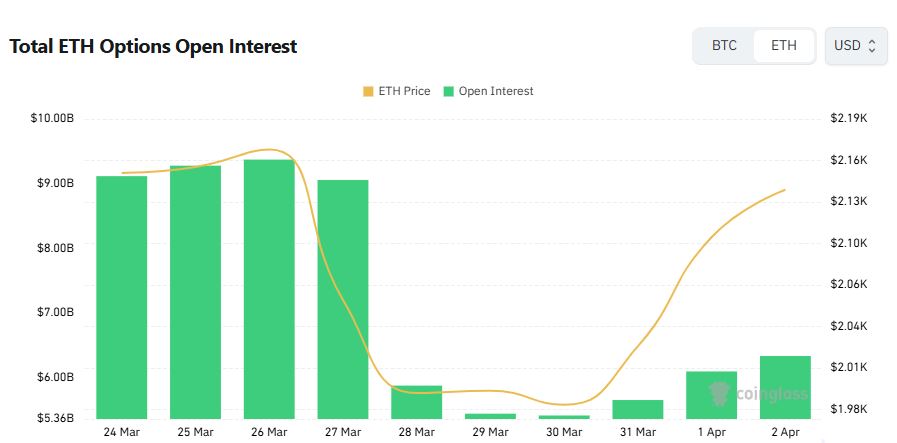
Ethereum (ETH) options markets showed a renewed tilt toward bullish positioning on Wednesday, with open interest climbing and call options taking a clear majority share—signaling that traders are increasingly paying for upside exposure even as short-dated flows concentrate around higher strike levels.
As of 00:00 UTC on April 2, aggregated data from Coinglass put total Ethereum options open interest (OI) at $6.34 billion, up about 3.9% from $6.10 billion a day earlier. Calls accounted for 63.28% of outstanding contracts, compared with 36.72% for puts—an allocation that points to stronger demand for 'upside bets' across the broader options complex.
Trading activity over the past 24 hours also leaned toward calls, though less decisively. Coinglass data showed call options representing 59.09% of volume, versus 40.91% for puts—suggesting that while traders are adding bullish exposure, a meaningful share of flows remains dedicated to downside hedging and volatility positioning.
By open interest, several large call strikes stood out as key magnets for positioning. The biggest concentrations were in the $3,200 call expiring Dec. 25 on Deribit, followed by the $2,500 call and the $2,000 call—both expiring June 26 on Deribit. The clustering around those levels suggests longer-dated participants are building exposure around widely watched psychological and technical zones, with a notable emphasis on strikes that would benefit from a sustained ETH recovery.
Shorter-dated activity, however, painted a more tactical picture. In the past 24 hours, the most actively traded contracts were the $3,500 call expiring April 3 on Bybit, the $3,000 call expiring April 3 on Bybit, and a $500 put expiring April 10 on Bybit. Heavy turnover in near-expiry calls often reflects traders positioning for a quick upside move or using options to express directional views with defined risk, while activity in deep-out-of-the-money puts can be consistent with 'tail-risk' hedging strategies.
Options are derivatives that allow investors to take leveraged views on an underlying asset’s price or hedge existing holdings. A 'call option' grants the right—without the obligation—to buy the asset at a predetermined price by a set date, typically used to express a bullish outlook. A 'put option' similarly provides the right to sell at a set price, often used to position for declines or to protect spot exposure.
Market participants commonly watch open interest for clues about positioning depth. Rising OI generally indicates fresh capital entering the market and the buildup of multi-session exposure rather than purely intraday turnover. Still, the split between OI and volume can matter: even in a call-heavy market, elevated put volume can indicate simultaneous demand for protection against short-term pullbacks or a preference for volatility trades alongside directional bets.
For Ethereum, the latest data underscore a market that is increasingly structured around upside potential—particularly in calls—with traders concentrating liquidity at higher strikes near-term while building larger positions further out on major venues such as Deribit and Bybit.
Article Summary by TokenPost.ai
🔎 Market Interpretation
Options sentiment tilted bullish: Ethereum options open interest (OI) rose to $6.34B (+3.9% day-over-day), with calls at 63.28% of OI vs puts at 36.72%, signaling stronger demand for upside exposure.
Flow confirms optimism but not one-sided: Last 24h options volume was 59.09% calls vs 40.91% puts, implying traders are adding bullish positions while still allocating meaningful activity to hedging and volatility plays.
Term structure divergence: Longer-dated positioning clusters at major call strikes (recovery narrative), while short-dated activity targets higher strikes (tactical upside attempts) alongside deep OTM puts (tail hedges).
Venue concentration matters: Large OI concentrations appear on Deribit (longer-dated strikes), with the most active near-term contracts highlighted on Bybit, indicating liquidity and trader intent may differ by exchange and maturity.
Rising OI suggests commitment: Increasing OI is framed as fresh capital and multi-session exposure rather than only intraday churn, reinforcing that the bullish skew may be more structural than fleeting.
💡 Strategic Points
Map key strike “magnets”: Monitor large call OI at $3,200 (Dec 25), $2,500 (Jun 26), and $2,000 (Jun 26) on Deribit as areas where dealer hedging and positioning could influence price behavior into moves or expiries.
Separate tactical vs strategic demand: Near-expiry call activity at $3,500 and $3,000 (Apr 3) suggests traders are paying for immediate upside optionality; treat this as event-driven/timing-sensitive rather than long-horizon conviction.
Don’t ignore defensive flow: The actively traded $500 put (Apr 10) is consistent with tail-risk hedging; elevated put participation alongside call dominance can imply “bullish but cautious” positioning.
Use OI vs volume as a positioning check: Call-heavy OI with notably high put volume can indicate traders are simultaneously long-upside and long-protection—often associated with uncertainty/volatility demand even during bullish setups.
Risk framing for traders: Calls offer defined-risk upside participation; puts can protect spot ETH during pullbacks. In a call-skewed market, consider the cost of upside (premiums) and the possibility of quick reversals around near-term expiries.
📘 Glossary
Options Open Interest (OI): The total number of outstanding (not yet closed) option contracts. Rising OI often signals new capital and sustained positioning.
Call Option: A contract giving the right (not obligation) to buy the underlying at a preset strike price before/at expiration—typically used for bullish exposure.
Put Option: A contract giving the right (not obligation) to sell the underlying at a preset strike price before/at expiration—often used for bearish positioning or hedging.
Strike Price: The price level at which the option can be exercised (buy for calls, sell for puts).
Expiration: The date/time when an option contract ceases to exist; near-expiry contracts are more sensitive to short-term price moves.
Out-of-the-Money (OTM) Put: A put with a strike far below current price; often used as inexpensive tail-risk insurance against rare, large drawdowns.
Tail-Risk Hedging: Strategies designed to profit from or reduce losses during extreme market moves, typically using deep OTM options.