
 Add as a preferred source on Google
Crypto Liquidations Hit $171 Million as Short Squeeze Signals Upward Move
Over $171 million in crypto positions were liquidated in 24 hours, led by short sellers, signaling a rapid upward move in Bitcoin and Ethereum markets.





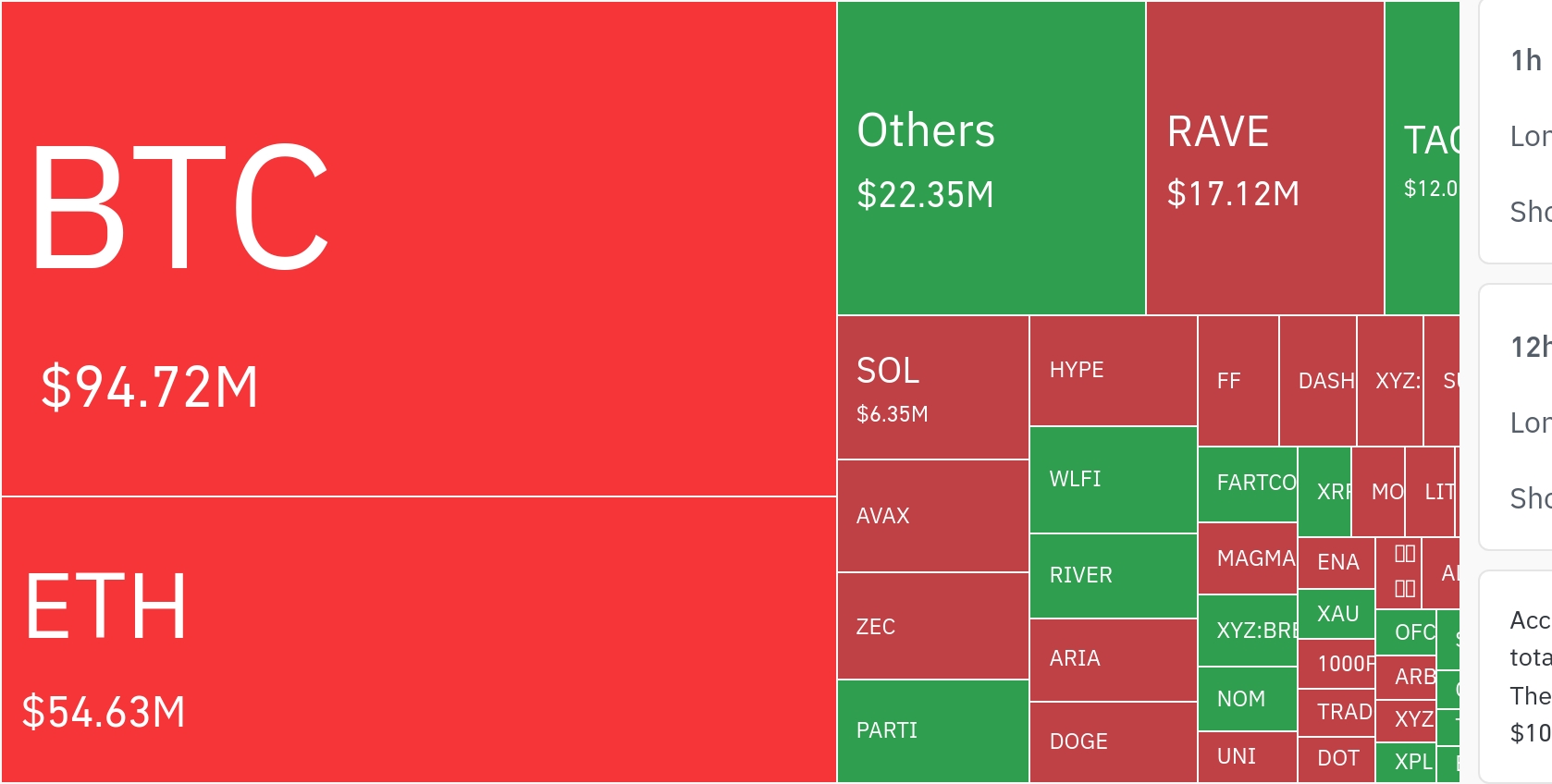
Roughly $171.45 million in leveraged crypto positions were liquidated over the past 24 hours, with short sellers absorbing the bulk of the damage—an outcome that typically reflects a fast, upward move that catches bearish positioning offside.
According to aggregated liquidation data from CoinGlass, short liquidations totaled about $114.83 million, accounting for 66.87% of the 24-hour sum. Long liquidations came in at approximately $56.62 million, or 33.13%, underscoring a market that has recently punished downside bets more aggressively than overly optimistic leverage.
On a shorter time horizon, exchange-level figures over the past four hours point to Binance as the main venue where forced unwinds concentrated. The platform recorded about $19.74 million in liquidations—56.6% of the tracked total in that window—with shorts making up roughly $13.47 million (68.22%). OKX followed with around $4.18 million (11.99%) in liquidations, of which $3.18 million (75.98%) were short positions. Bybit posted approximately $3.06 million (8.79%), also skewed toward shorts at 68.45%.
One notable outlier was Hyperliquid, where liquidations were overwhelmingly long-heavy: 96.06% of forced closures were long positions. Such divergences can arise from differences in user positioning, product mix, and liquidity conditions across venues, and they often highlight how leverage is distributed unevenly throughout the market.
By asset, Bitcoin (BTC) led the liquidation tally. BTC-linked positions saw about $94.72 million liquidated over 24 hours, with as much as $38.80 million wiped out within a four-hour stretch. Ethereum (ETH) followed with roughly $54.63 million in 24-hour liquidations and a peak four-hour figure of around $37.00 million, suggesting heightened sensitivity to rapid price swings in the two largest digital assets.
Among major altcoins, Solana (SOL) registered about $6.35 million in liquidations over 24 hours. The dataset also flagged sizable liquidations in smaller-cap tokens including RAVE (about $17.12 million) and TAG (about $12.00 million). Dogecoin (DOGE) saw a shorter-term burst of activity as well, with up to $3.80 million liquidated over four hours alongside a modest price increase of roughly 1.83%.
In crypto derivatives markets, a 'liquidation' occurs when a leveraged trader can no longer meet margin requirements and the position is forcibly closed by the exchange. Elevated liquidation totals are widely watched as a proxy for rising volatility and crowded positioning—conditions that can amplify price moves as stop-outs cascade through order books.
While liquidations do not explain direction on their own, the heavy short skew in this episode suggests many traders were positioned for downside or mean reversion and were forced to exit as prices moved against them. For market participants, the latest flush is a reminder that leverage can turn routine intraday swings into abrupt, market-wide dislocations—especially when liquidity thins and positioning becomes one-sided.
Article Summary by TokenPost.ai
🔎 Market Interpretation
Leverage flush tilted bullish: About $171.45M in 24h liquidations were dominated by shorts ($114.83M / 66.87%), a pattern typically seen when price moves up quickly and squeezes bearish positioning.
Intraday squeeze dynamics: In the last 4 hours, Binance concentrated the most forced unwinds ($19.74M, ~56.6% share), again mostly shorts—consistent with a rapid, exchange-led cascade as stops/margins triggered.
BTC and ETH remain the volatility transmitters: BTC led 24h liquidations ($94.72M) while ETH followed ($54.63M), showing that the largest assets are still where leverage stress expresses first and then ripples outward.
Venue divergence matters: Hyperliquid was a major outlier with liquidations overwhelmingly long-heavy (96.06%), implying its user base/product mix was positioned differently—highlighting that “market sentiment” can vary sharply by venue.
Altcoin pockets of stress: Beyond majors, liquidations clustered in SOL and smaller-cap tokens (notably RAVE and TAG), indicating that idiosyncratic leverage can build in thin books and unwind abruptly.
💡 Strategic Points
Short-squeeze risk management: When short liquidations dominate, expect potential follow-through volatility (continuation or sharp retrace). Consider tighter risk limits on directional shorts during momentum spikes.
Watch the 4-hour liquidation leader: With Binance driving over half of near-term liquidations, monitoring its liquidation/oi spikes can help anticipate cascades before they propagate to other venues.
Use liquidation skew as positioning signal (not a forecast): Heavy short skew indicates crowded downside bets were punished, but direction can flip quickly once weak hands are cleared. Pair liquidation data with price structure and open interest.
Mind cross-exchange positioning: Hyperliquid’s long-heavy flush suggests opportunities and risks in basis/positioning dispersion. Traders should avoid assuming uniform leverage across venues and consider venue-specific liquidity conditions.
Size appropriately in smaller caps: Large liquidations in RAVE/TAG underscore that thin liquidity can create air pockets. Reduce leverage, widen stop tolerance, or avoid trading during volatility bursts.
📘 Glossary
Liquidation: Forced closure of a leveraged position when margin requirements are no longer met.
Short liquidation: A short position is forcibly closed—often occurring during sharp upward moves when shorts are squeezed.
Long liquidation: A long position is forcibly closed—often occurring during sharp downward moves.
Leverage: Borrowed exposure that amplifies gains and losses; increases the chance of liquidation during fast moves.
Margin requirements: Minimum collateral needed to keep a leveraged position open; falling below triggers liquidation.
Cascade (liquidation cascade): Chain reaction where forced closures push price further, triggering more stop-outs/liquidations.
Order book liquidity: The depth of buy/sell orders; thinner liquidity can magnify price impact during liquidations.
Positioning skew: Imbalance of longs vs shorts; extreme skew can signal crowded trades vulnerable to squeezes.