Crypto Venture Funding Slows to $76.35 Million in Early August as Deal Activity Cools
Crypto venture funding dropped to $76.35 million across 10 rounds in early August, led by Yellow Card’s $40 million raise, signaling cooling market momentum and reduced risk appetite.

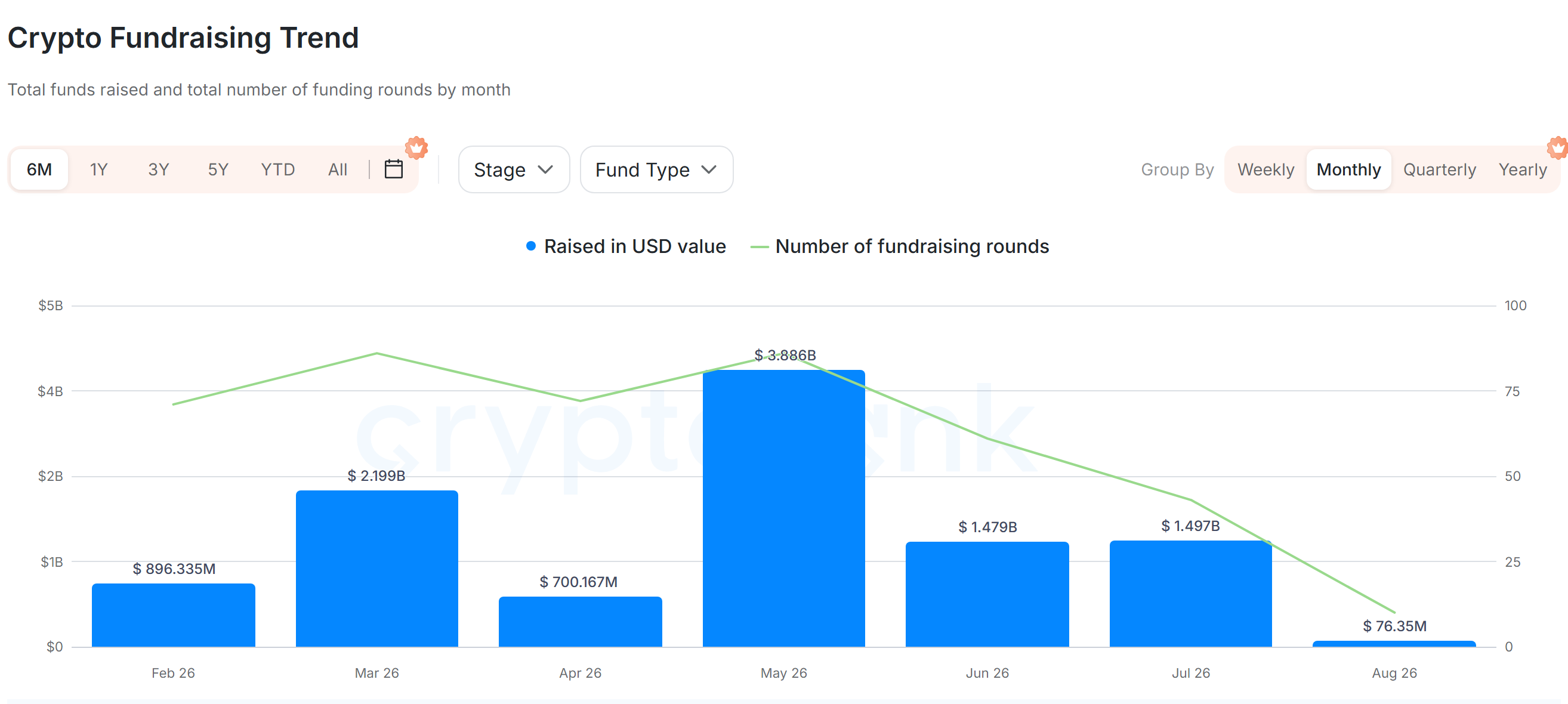
Crypto venture funding slowed in early August, with projects raising a combined $76.35 million across 10 disclosed rounds between Aug. 1 and Aug. 9, according to data compiled by CryptoRank. The muted start underscores a broader cooling in deal momentum after the market closed July with roughly $1.50 billion raised across 43 rounds and June with about $1.48 billion across 61 rounds.
The largest single deal of the week was secured by Yellow Card, an Africa-focused crypto platform, which raised $40 million in a strategic round led by Polychain Capital and other participants. The deal stood out in a week where most financings clustered at smaller sizes and where strategic capital—often tied to ecosystem expansion or distribution—continued to dominate activity.
Other notable raises during the period included Investipay’s $20 million strategic funding, JPYC’s $6.35 million extended Series B, and Banggrid’s $9 million seed round backed by HashKey Capital and additional investors. Several rounds did not disclose amounts, including strategic investments in Liquido and ZILO by Ripple, along with other undisclosed financings such as Blockspace and ZigChain. CryptoRank’s dataset also recorded a mergers-and-acquisitions transaction involving Global Ledger, acquired by OpenFX.
Market-wide indicators point to a pullback in risk appetite. Over the most recent 30-day window, CryptoRank’s investment activity index fell 43.0% month over month, placing activity in a ‘Low’ range. Total rounds during that window reached 60, down 4.8% from the prior month, while aggregate capital deployed declined 7.4% to roughly $2.69 billion.
Deal sizes remained concentrated in the lower middle of the market. Average round sizes were typically in the $3 million to $10 million range, suggesting investors are still writing checks but favoring tighter underwriting, clearer revenue paths, and partnerships that can accelerate user acquisition. The tilt toward strategic rounds also implies that large ecosystem players are selectively supporting infrastructure and distribution-focused bets rather than broad-based, high-valuation growth funding.
By sector, ‘API’ funding represented the largest share of investment flow over the past six months, accounting for 26.15% of tracked activity—an indication that back-end connectivity, data access, and developer-facing rails remain central priorities as teams build products that need to interact seamlessly with exchanges, wallets, and onchain applications. Payments followed closely at 25.13%, while real-world assets (RWA) captured 16.92%. Developer tools and decentralized exchanges (DEX) each represented 15.90%.
On the investor side, Coinbase Ventures led activity with 30 deals over the period tracked, followed by Animoca Brands with 17, Tether with 16, and Andreessen Horowitz’s a16z crypto with 15. Market makers and liquidity providers remained active as well, with GSR logging 10 deals. Y Combinator and Ripple each recorded nine.
While the early-August totals do not necessarily signal a structural downturn, the contrast with June and July highlights a market that is recalibrating after a strong summer stretch. If strategic rounds continue to outpace traditional venture financings, deal flow may remain steady even as headline dollar amounts fluctuate—shifting the focus from valuation expansion to ‘distribution’ and ‘infrastructure’ as the next cycle of crypto product growth takes shape.
Article Summary by TokenPost.ai
🔎 Market Interpretation
Early-August funding cooled sharply: $76.35M raised across 10 disclosed rounds (Aug. 1–9), a muted pace versus July (~$1.50B / 43 rounds) and June (~$1.48B / 61 rounds).
Risk appetite is contracting: CryptoRank’s investment activity index fell 43.0% MoM into a “Low” range, signaling more cautious deployment and fewer aggressive bets.
Capital is concentrating in fewer, more purposeful checks: Over the last 30 days, rounds dipped modestly (60 rounds, -4.8% MoM) but capital deployed also declined (-7.4% to ~$2.69B), implying smaller average allocations and stricter selection.
Strategic rounds are leading the market narrative: The week’s biggest deal (Yellow Card $40M led by Polychain) and multiple strategic investments (including Ripple-linked strategic deals) reinforce a shift from “growth at valuation” to “ecosystem and distribution-driven” funding.
Check sizes cluster in the lower-middle band: Typical rounds land in the $3M–$10M range, consistent with tighter underwriting and clearer expectations on revenue paths and user acquisition efficiency.
💡 Strategic Points
Founders should optimize for distribution partnerships: With strategic capital dominating, teams with credible go-to-market tie-ins (wallet/exchange integrations, enterprise distribution, stablecoin/payment rails) may raise more reliably than teams selling long-horizon narratives.
Infrastructure and “rails” remain investable: Sector mix over six months shows sustained preference for builder-facing primitives—APIs (26.15%) and Payments (25.13%)—suggesting investors still fund picks-and-shovels businesses that support many downstream applications.
RWA remains a meaningful third pillar: Real-world assets (16.92%) hold a notable share, indicating continued interest in tokenizing offchain value, but likely with higher diligence on compliance, custodianship, and cash-flow clarity.
DEX and developer tools funding is steady but selective: DEX (15.90%) and Dev tools (15.90%) remain relevant, yet the current environment likely favors measurable traction (fees, active developers, retention) over experimental designs.
Investor landscape signals where momentum may form: High deal counts from Coinbase Ventures (30), Animoca (17), Tether (16), a16z crypto (15), plus activity from GSR (10) and Ripple (9), suggest that ecosystems, liquidity providers, and major incumbents are key sources of near-term capital.
Operational takeaway for teams fundraising now: Expect more tranche-like processes, milestone gating, and emphasis on unit economics; communicate concrete distribution channels, integration roadmaps, and time-to-revenue.
📘 Glossary
Strategic round: Financing led by an investor (often an industry incumbent) seeking ecosystem expansion, product integration, or distribution synergies—beyond pure financial return.
Seed round: Early-stage funding used to validate product-market fit, build an initial team, and launch a minimum viable product.
Series B (extended): Follow-on financing after Series A, typically for scaling; “extended” indicates additional capital added around the same stage/terms later.
M&A (Mergers and Acquisitions): Corporate transaction where one company buys or combines with another (e.g., Global Ledger acquired by OpenFX).
Underwriting (venture context): The diligence and risk assessment process investors use to decide terms, valuation, and allocation size.
Investment activity index: A composite indicator (as referenced by CryptoRank) reflecting changes in investment pace and intensity over time.
API (Application Programming Interface): A standardized interface enabling software systems to communicate—critical for connecting apps to exchanges, wallets, and onchain services.
Payments (crypto): Infrastructure or applications enabling transfers/settlement—often involving stablecoins, on/off-ramps, and merchant acceptance.
RWA (Real-World Assets): Tokenized representations of offchain assets (e.g., treasuries, credit, real estate), typically requiring strong legal and custody frameworks.
DEX (Decentralized Exchange): An onchain trading venue where users swap assets via smart contracts instead of a centralized order book operator.
Market maker / liquidity provider: A firm that supplies bid/ask liquidity to markets, supporting trading efficiency and, in many cases, token distribution.