
 Add as a preferred source on Google
DEX Volume Nears $12 Billion as Micro-Cap Tokens Drive Volatile Trading
Decentralized exchanges processed nearly $12 billion in daily volume as traders rotated into volatile micro-cap tokens and major liquidity pairs, according to DEX Screener data.








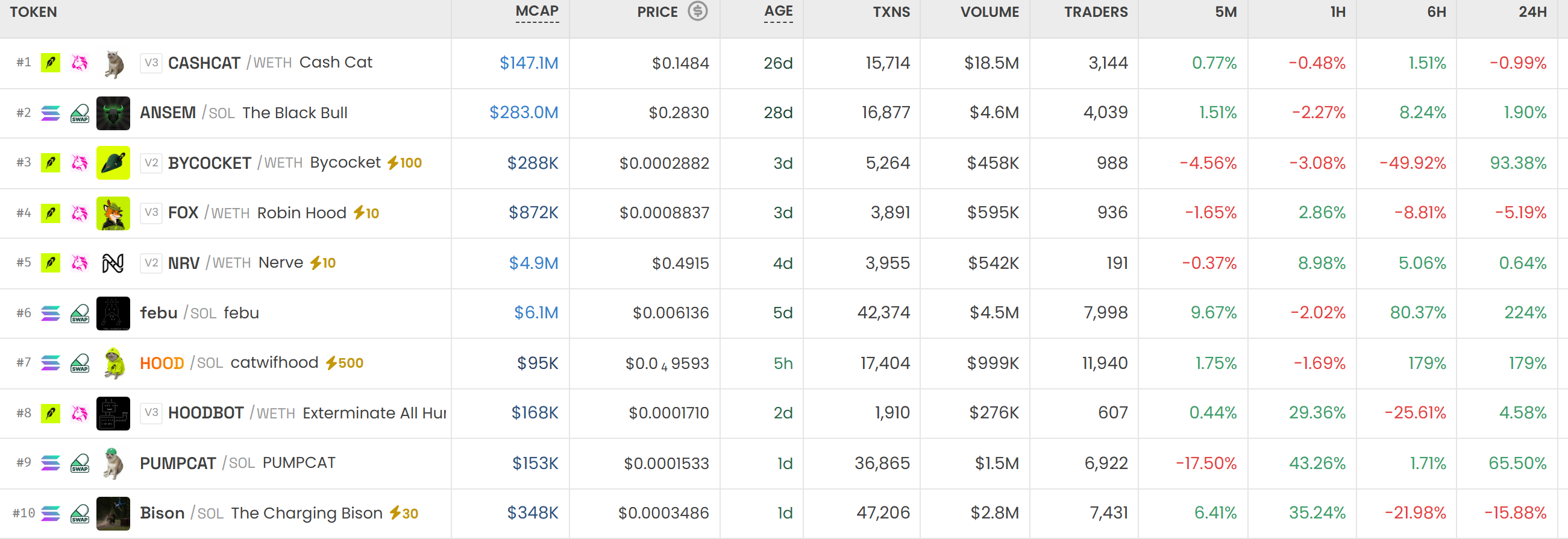
Decentralized exchange (DEX) activity remained elevated over the past 24 hours, with aggregate volume reaching approximately $11.94 billion as traders rotated aggressively through a mix of established liquidity pairs and highly volatile micro-cap tokens. The data underscores how quickly on-chain attention can shift, particularly when speculative flows concentrate in newly trending pairs.
According to DEX Screener data published Tuesday UTC (July 14), the most-watched trending pairs were Cash Cat (CASHCAT)/Wrapped Ether (WETH), The Black Bull (ANSEM)/Solana (SOL), and Bycocket (BYCOCKET)/WETH.
Cash Cat (CASHCAT)/WETH ranked first on the DEX trending list, trading at $0.1484, down 0.99% over 24 hours. The Black Bull (ANSEM)/SOL was second, rising 1.90% to $0.2830. Bycocket (BYCOCKET)/WETH took third place, posting a sharp 93% gain to $0.0002882—an outsized move that highlights the thin liquidity and reflexive momentum common in early-stage tokens.
Among the day’s biggest movers, Sherwood Protocol (WOOD)/WETH recorded the largest jump, up roughly 169,000% over 24 hours. Febu (febu)/SOL climbed 225%, while Supergemma4-26b-Multimodal (SUPERGEMMA)/WETH gained 196%. Such extreme percentage increases are often associated with very low starting market capitalization, limited order depth, and rapid social-driven inflows—conditions that can amplify both upside and downside in short windows.
On the downside, USMCA (USMCA)/Wrapped BNB (WBNB) led decliners with a 58% drop over 24 hours. LAB (LAB)/USDT fell 38%, and Alchemist AI (ALCH)/SOL slid 34%, reflecting the same fast-turnover risk dynamics as capital rotates away from fading narratives.
In terms of raw liquidity flow, the largest-volume pairs were concentrated in blue-chip wrapped assets and stablecoin rails. Wrapped Ether (WETH)/USDC printed about $102.1 million in volume, while Coinbase Wrapped BTC (cbBTC)/USDC posted roughly $99.7 million. Another WETH/USDC market registered around $91.9 million, suggesting fragmented liquidity across venues and pools even for the most widely used pairs.
Transaction activity was similarly robust, led by Longinus (LGNS)/DAI with approximately 634,510 transactions. EVAA (EVAA)/USDT recorded about 160,744, while LAB (LAB)/USDT saw roughly 111,182—an indication that some of the most active markets by transaction count do not necessarily align with the highest-volume pairs, often reflecting smaller average trade sizes and automated routing behavior.
Overall, DEXs processed about 38.28 million transactions over the past day. While the headline volume figure points to sustained on-chain participation, the dominance of sharp gainers and steep losers in the trending ranks shows that 'liquidity inflow' remains highly selective—favoring established wrappers for size, while speculative tokens capture attention through abrupt price dislocations.
Article Summary by TokenPost.ai
🔎 Market Interpretation
DEX activity stayed hot: Aggregate DEX volume reached ~$11.94B in the last 24 hours, indicating sustained on-chain participation rather than a one-off spike.
Attention is rotating fast: Trending pairs were led by CASHCAT/WETH, ANSEM/SOL, and BYCOCKET/WETH, showing speculative focus can shift rapidly between chains and token narratives.
Micro-cap reflexivity is dominant at the edges: BYCOCKET/WETH surged +93%, while WOOD/WETH posted an extreme ~+169,000%—moves consistent with thin liquidity and momentum-driven order flow.
Risk is two-sided and immediate: Sharp decliners (e.g., USMCA/WBNB -58%, LAB/USDT -38%) highlight fast capital rotation away from weakening narratives.
Deep liquidity remains in majors: The largest raw volumes clustered in WETH/USDC (~$102.1M) and cbBTC/USDC (~$99.7M), implying traders still use blue-chip wrapped assets and stablecoin rails for size.
Liquidity fragmentation persists: Multiple WETH/USDC pools each saw large volume (another at ~$91.9M), suggesting activity is dispersed across venues/pools even in core markets.
Transactions don’t equal volume: Highest transaction count pair LGNS/DAI (~634,510 tx) did not correspond to highest volume, implying smaller average trade sizes and/or automated routing.
Scale of activity: DEXs processed ~38.28M transactions over the day, reinforcing that the on-chain “base layer” of participation is broad even as speculation concentrates in a few tokens.
💡 Strategic Points
Separate “attention” from “capacity”: Trending micro-caps may dominate headlines, but deployable size tends to sit in WETH/USDC, cbBTC/USDC, and other deep rails—use majors for execution, micro-caps for optionality only.
Treat extreme % gainers as liquidity events, not fundamentals: Moves like +169,000% often reflect tiny starting caps and sparse order books; slippage and reversals can be severe.
Use transaction-count signals carefully: Very high tx counts can indicate bots, routing, or farming-like behavior; validate with net liquidity change, unique traders, and average trade size.
Watch for narrative decay via decliners: Large drops in previously active pairs (e.g., USMCA/WBNB, LAB/USDT) can signal capital exiting a theme; avoid chasing late-stage momentum.
Account for fragmented pools when executing: With liquidity split across venues/pools, best execution may require aggregation and route optimization to reduce slippage.
Risk controls for micro-caps: Prefer small sizing, predefined exits, and monitoring of LP depth, price impact, and rapid spread widening—especially during sudden inflows/outflows.
📘 Glossary
DEX (Decentralized Exchange): On-chain venue where trades occur via smart contracts rather than a centralized order book.
Trending pair: A token pair receiving outsized attention (views/volume/price movement) over a short period on analytics platforms.
Wrapped asset (e.g., WETH, WBNB, cbBTC): Tokenized representation of a native asset (ETH/BNB/BTC) used for easier DeFi compatibility and trading.
Stablecoin rails (e.g., USDC, USDT, DAI): Common quote assets used to price and route trades, enabling liquidity and reduced volatility versus crypto-native pairs.
Liquidity / order depth: How much capital is available in a pool across price levels; low depth increases slippage and volatility.
Slippage: Difference between expected execution price and actual fill price, often larger in low-liquidity pools.
Liquidity fragmentation: When trading liquidity for the same pair is split across multiple pools/DEXs, affecting pricing and execution.
Automated routing: Smart order routing that splits a trade across pools/venues to seek better pricing, often increasing transaction counts.
Micro-cap token: Low market-cap asset that can move sharply due to small liquidity and concentrated flows.
Reflexive momentum: Feedback loop where price rises attract more buyers, which pushes price higher—until liquidity thins and reversals occur.