

 News
News  Coin Information
  About us
  Customer Service


 Add as a preferred source on Google
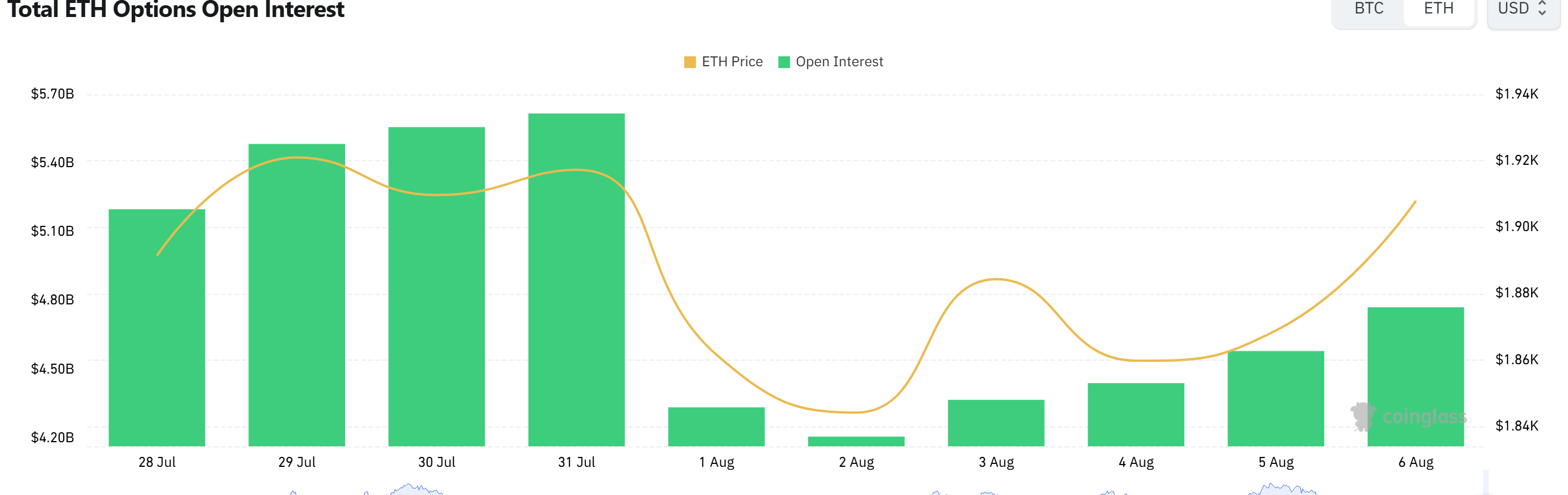
Ethereum (ETH) options traders are leaning increasingly bullish across both medium- and short-term horizons, as rising open interest and call-heavy positioning point to stronger risk appetite despite persistent demand for downside protection.
According to CoinGlass data as of Wednesday 01:50 UTC, total Ethereum options 'open interest' (OI) stood at $4.63049 billion, up 4.20% from $4.44369 billion a day earlier. Aggregate options trading volume over the same window reached roughly $836.69 million, underscoring active repositioning as ETH hovers around widely watched strike levels.
The composition of outstanding positions showed calls accounting for 61.22% of OI versus 38.78% for puts. In the past 24 hours, calls represented 58.47% of volume compared with 41.53% for puts. The split suggests that traders are not only holding a net bullish structure in longer-dated positioning, but are also expressing near-term upside expectations through fresh flow—while still maintaining meaningful hedges against volatility or pullbacks.
On Deribit, the largest concentration of OI was clustered in higher-strike December contracts, led by the $3,200 call expiring Dec. 25, followed by the $2,200 call expiring Dec. 25. The third-largest OI contract was the $2,000 call expiring Aug. 7. The prominence of these strikes indicates that a portion of the market is positioning for an extended rally into year-end, even as shorter-dated contracts reflect more immediate tactical views.
Meanwhile, the most heavily traded contracts over the last 24 hours were concentrated on Bybit’s same-day expiries: the $1,900 call expiring Aug. 6 led all contracts by volume, followed by the $1,925 call and the $1,950 call—also expiring Aug. 6. Such clustering around nearby strikes typically signals heightened sensitivity to spot price moves and an increased use of options for short-term leverage, gamma exposure, or rapid hedging around intraday swings.
Options markets often provide a clearer read on positioning than spot alone because they capture both directional bets and hedging demand. Rising 'open interest' generally implies new positions entering the market, potentially reflecting more conviction than transient day trading. Still, analysts caution that heavy call positioning can coexist with defensive activity, particularly when traders use puts or spreads to protect against sudden volatility spikes.
For now, the balance of flows suggests Ethereum’s derivatives market is tilting toward further upside while keeping one foot planted in risk management—an equilibrium that could shape liquidity and volatility as key expiries roll through the week.
🔎 Market Interpretation
- Options sentiment is bullish, but not reckless: Ethereum options positioning is skewed toward calls (61.22% of total OI) and recent trading flow is also call-heavy (58.47% of 24h volume), implying rising appetite for upside exposure while still keeping meaningful put hedges in place.
- Participation and conviction appear to be increasing: Total ETH options open interest rose to $4.63049B (+4.20% day-over-day), alongside robust volume of $836.69M, signaling active repositioning rather than a quiet drift in spot.
- Market focus is split between near-term “pin/gamma” zones and longer-term upside bets: Very short-dated activity is concentrated around Bybit’s Aug. 6 expiries near $1,900–$1,950, while Deribit shows notable longer-dated OI piled into higher strikes (e.g., $3,200 Dec. 25 call).
- Strike clustering suggests potential volatility near key levels: Heavy same-day volumes around nearby strikes indicate sensitivity to spot movement and potential for sharper intraday swings as dealers and traders manage gamma/hedges.
- Net read-through: Derivatives flows currently point to a market leaning toward continued upside into upcoming expiries, but with persistent demand for protection—an environment that can amplify volatility as hedges are adjusted.
💡 Strategic Points
- Watch expiration dynamics (Aug. 6–7): Concentrated same-day calls around $1,900–$1,950 and the notable $2,000 Aug. 7 call can create strong “magnet” effects or abrupt moves if spot breaks away from these strikes.
- Interpret rising OI with context: Increasing open interest often implies new risk is being added; however, call-heavy OI can be driven by outright longs or by structured trades (e.g., call spreads) that cap upside and reduce cost—so OI alone is directional but not definitive.
- Expect active hedging if spot approaches clustered strikes: When large volumes sit at nearby strikes, traders may use options for fast hedging or leverage, which can intensify short-term volatility and liquidity pulls.
- Year-end positioning remains optimistic: Large OI in the $3,200 Dec. 25 call suggests a market segment pricing in an extended rally scenario into year-end, potentially shaping sentiment and volatility skews for longer tenors.
- Risk-control remains a key theme: The still-material put share (38.78% of OI; 41.53% of volume) indicates participants are preparing for pullbacks/vol spikes—supporting the view of “bullish bias with protection.”
📘 Glossary
- Options Open Interest (OI): The total number (or notional value) of outstanding options contracts that remain open. Rising OI often indicates new positions are being initiated.
- Call Option: A contract that gives the buyer the right (not obligation) to buy the underlying asset at a specified strike price before/at expiry; typically used to express bullish views.
- Put Option: A contract that gives the buyer the right (not obligation) to sell at a specified strike; commonly used for downside protection or bearish positioning.
- Strike Price: The price level at which an option can be exercised. Markets often “gravitate” toward heavily traded or high-OI strikes near expiry.
- Expiry (Expiration): The date/time when an options contract ends and settles/expires.
- Gamma Exposure (Gamma): Measures how fast an option’s delta changes as price moves. High gamma near expiry can force frequent hedging, potentially increasing volatility.
- Hedging: Using derivatives (often puts or spreads) to reduce downside risk or volatility exposure rather than purely to speculate.



















Comment 0