
Circle Loses $5 Billion as US Stablecoin Bill Targets Yield Rewards
Circle’s market value dropped $5 billion after a U.S. draft bill signaled restrictions on stablecoin yield rewards, raising concerns over its USDC-driven revenue model.


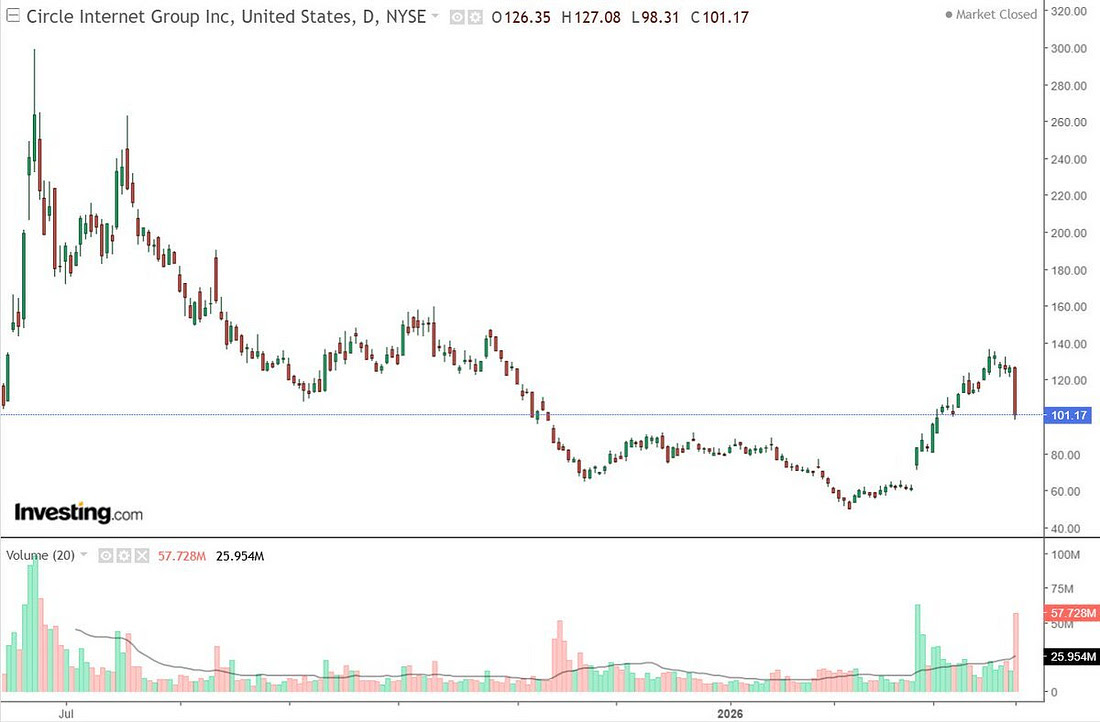
Circle’s market value shed roughly $5 billion in a single session after a U.S. legislative draft signaled a potential crackdown on 'interest-like' returns for simply holding stablecoins—an earnings-sensitive issue for the company’s business model and a flashpoint for the broader stablecoin economy.
According to Artemis Analytics, the sell-off followed the emergence of a draft 'Clarity Act' provision that would prohibit exchanges and intermediaries from offering direct or indirect compensation resembling interest on customers’ stablecoin balances. While rewards tied to payments or trading activity would remain permissible, the draft envisions that the Securities and Exchange Commission, Commodity Futures Trading Commission, and the Treasury Department would jointly define the detailed standards within about a year.
Markets quickly repriced the implications. Circle shares posted their steepest drop since listing, falling about 20% on Tuesday ET, with volume jumping to roughly 56.4 million shares—around four times the 90-day average. Coinbase ($COIN), often viewed as a bellwether for U.S. crypto rails and stablecoin distribution, slid about 11% in sympathy.
The regulatory language does not directly cap the yield Circle earns on reserve assets, but investors focused on second-order effects: if platforms can no longer entice users with passive stablecoin yield, demand for holding certain stablecoins could soften, shrinking the reserve base that generates income. Circle is particularly exposed because its revenue is heavily concentrated in reserve income from USD Coin (USDC). Artemis estimates around 95.5% of Circle’s revenue is tied to interest income on USDC reserves, which are primarily managed in short-dated U.S. Treasuries and repurchase agreements.
Circle’s recent financial trajectory underscores why the market reacted so sharply to anything that could slow USDC’s growth engine. Reserve income in 2025’s fourth quarter reached about $711 million, up roughly 60% year over year, while annual revenue rose to about $2.7 billion, a 64% increase. At the same time, declining rates are already pressuring margins: the reserve yield fell to 3.81% in 2025’s fourth quarter from 4.49% a year earlier, amplifying concerns that stablecoin issuers may face a tougher macro backdrop even without new rules.
Still, underlying usage metrics have remained firm. USDC circulation stood around $81 billion as of March, up from roughly $76 billion at the end of 2025. On-chain transaction volume for 2025’s fourth quarter reached about $6.8 trillion—more than double the prior year. Artemis data also suggests USDC’s transaction volume has exceeded Tether’s since August 2025, with USDC’s share of the segment rising above 80% by 2026, highlighting the token’s growing role in settlements and exchange flows.
Investors also weighed an apparent confidence shock around centralized controls. Circle recently froze 16 corporate wallets, a move reportedly linked to an undisclosed civil matter that disrupted some exchange and FX-platform operations. While blacklist functions embedded in smart contracts are often framed as necessary for compliance, the episode revived concerns about 'centralization risk'—the ability of an issuer to restrict transfers—which can affect adoption among certain crypto-native users and liquidity venues.
Not all signals were negative. Because the draft focus is on rewards for passive holding, 'activity-based' incentives tied to payments and trading could remain a viable channel for platforms to support stablecoin engagement, and firms are already exploring alternative structures. The bill is not final, and the language could change through negotiations. Circle is also expanding non-interest revenue streams: platform services and transaction-fee related revenue reportedly rose 15-fold year over year to about $37 million, suggesting early progress toward diversification even as reserve income remains dominant.
At current levels, Circle trades at roughly 9x annual revenue, placing the next phase of valuation squarely on regulatory clarity and the durability of USDC’s distribution model. The central question for markets is whether Washington’s push to define stablecoins as payment instruments—rather than deposit-like products—ultimately constrains growth, or forces the sector to evolve into new incentive and settlement architectures.
Article Summary by TokenPost.ai
🔎 Market Interpretation
Trigger event: A draft “Clarity Act” provision signaled tighter limits on offering interest-like rewards to users who simply hold stablecoins, sparking a rapid reassessment of stablecoin-driven revenue models.
Price action and contagion: Circle lost roughly $5B in market value as shares fell ~20% on heavy volume (~4× the 90-day average). Coinbase fell ~11%, reflecting its role as a key distribution rail for stablecoins.
Why Circle is uniquely sensitive: Investors focused on second-order effects—if platforms can’t market passive yield, demand for holding certain stablecoins may weaken, reducing the reserve base that generates issuer income. Artemis estimates about 95.5% of Circle revenue is tied to interest income on USDC reserves.
Macro headwind already visible: Falling rates are compressing reserve returns (reserve yield down to 3.81% from 4.49% YoY), so any regulatory friction on growth compounds margin pressure.
Fundamentals vs. sentiment: Despite the sell-off, USDC usage metrics remain strong (circulation ~$81B; Q4 on-chain volume ~$6.8T), suggesting the market is pricing policy risk and business-model concentration more than immediate demand collapse.
Centralization-risk overhang: The reported freeze of 16 corporate wallets revived concerns that issuer-controlled blacklisting can disrupt counterparties and deter some crypto-native liquidity, adding a non-regulatory risk premium.
💡 Strategic Points
Key policy nuance: The draft reportedly targets compensation resembling interest for passive holding via exchanges/intermediaries, while potentially allowing activity-based rewards tied to payments or trading—an important distinction for go-to-market design.
12-month rulemaking window risk: Standards would be jointly defined by the SEC, CFTC, and Treasury over ~one year, implying an extended period of uncertainty that can restrain valuation multiples and product launches.
Business-model pressure points:
Distribution incentives: If passive yield is curtailed, exchanges may shift to fee rebates, trading-linked rewards, or payments-linked cashback to keep stablecoin balances sticky.
Issuer economics: Even without direct caps on reserve yield, reduced stablecoin balances can lower reserve income—critical for Circle given its heavy dependence on USDC reserves managed in T-bills and repos.
Diversification signal (early but growing): Non-interest revenue (platform services/transaction-fee related) reportedly rose 15× YoY to ~$37M, indicating movement toward revenue streams less exposed to rate cycles and distribution incentives.
What to watch next:
Legislative edits: Whether the final bill narrows/broadens the definition of “interest-like” compensation and which entities are covered.
Exchange product redesign: Migration from passive APY to activity-based rewards and how that affects net stablecoin balances.
Competitive positioning: USDC’s reported transaction-volume outperformance vs. Tether since Aug 2025 may help resilience if the market prioritizes settlement utility over yield marketing.
Risk management optics: Frequency and transparency of wallet freezes/blacklisting events, and whether they affect institutional and venue adoption.
Valuation framing: At ~9× annual revenue, the next leg of pricing hinges on regulatory clarity and whether USDC’s distribution model can thrive when stablecoins are treated more like payment instruments than deposit-like products.
📘 Glossary
Stablecoin: A crypto token designed to maintain a stable value (often pegged to the U.S. dollar) and widely used for trading, payments, and settlement.
USDC: USD Coin, a dollar-pegged stablecoin issued by Circle; issuer revenue is largely driven by income earned on reserves backing tokens in circulation.
Reserve income (reserve yield): Earnings generated from investing stablecoin backing assets (e.g., Treasury bills, repos). The yield is the effective return on those assets.
Repurchase agreement (repo): A short-term financing instrument where securities are sold with an agreement to repurchase them later; commonly treated as low-risk and liquid in money markets.
Interest-like compensation: Rewards that economically resemble interest paid for simply holding a balance (e.g., passive APY), even if structured as “rewards.”
Activity-based rewards: Incentives earned only when users perform actions such as trading, payments, or card spend—often treated differently than passive yield.
Second-order effects: Indirect impacts of a rule—here, not limiting issuer reserve yield directly, but reducing incentives to hold stablecoins, which can shrink reserves and revenue.
Centralization risk / blacklisting: The ability of an issuer to freeze or restrict wallet addresses via smart-contract controls, which can help compliance but may deter some users/venues.
Distribution model: The channels (exchanges, wallets, payment platforms) and incentives used to drive adoption and maintain stablecoin balances.