

 News
News  Coin Information
  About us
  Customer Service


 Add as a preferred source on Google

Crypto markets climbed on Sunday as traders weighed a narrowing legislative window for a long-awaited U.S. ‘market structure’ bill, with analysts pointing to the Memorial Day holiday on May 25 as a potential inflection point that could determine whether the proposal advances before the summer election season constrains momentum.
According to Odaily, progress on the bill has been limited in recent weeks, even as industry groups push lawmakers to begin formal review. More than 100 organizations reportedly sent a joint letter to the Senate Banking Committee last week urging the committee to open deliberations and move the so-called ‘Clarity’ bill to its next stage. The effort reflects a broader push to codify baseline crypto oversight in statute—reducing uncertainty from regulatory shifts and changing enforcement priorities.
Key points remain unresolved, including how to treat stablecoin-related yield, the classification of certain DeFi sales activity, and how responsibilities should be divided across regulators. Market participants have increasingly framed late May as a deadline: if Congress fails to build traction before the holiday recess, attention may turn to campaigning, making consensus harder to secure.
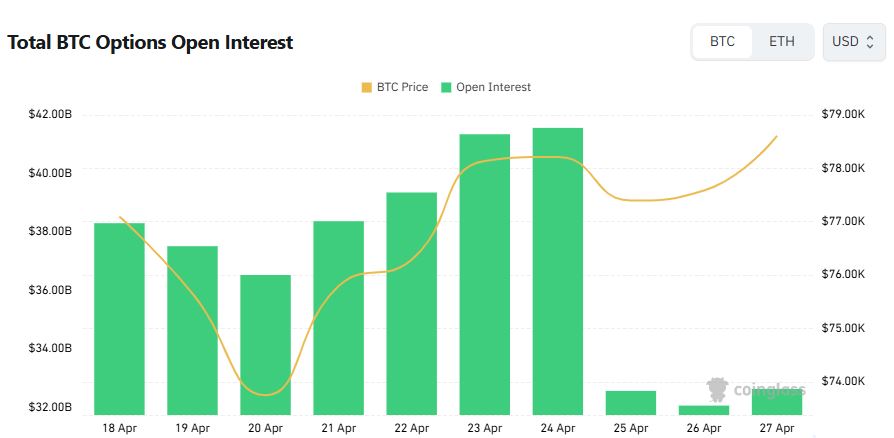
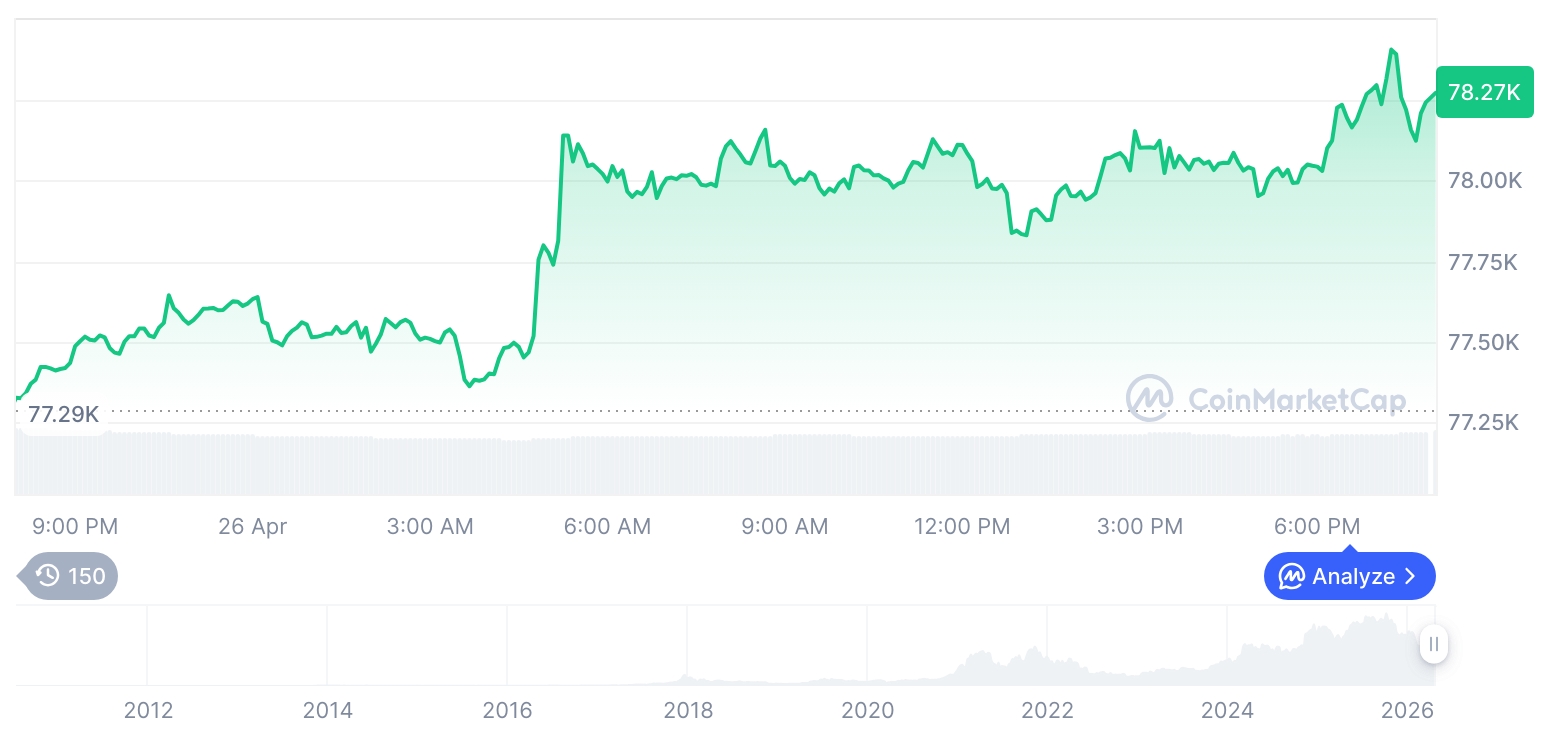
Against that backdrop, major tokens extended gains. Bitcoin (BTC) briefly traded above $79,000, changing hands around $79,014 on OKX data, while Ethereum (ETH) rose past $2,400 to about $2,400.15. The move came alongside a broader risk-on tone in crypto derivatives and spot markets, though liquidity remained concentrated in large caps.
Sector performance also pointed to renewed appetite for thematic exposure. Real-world assets (‘RWA’) led the market with roughly 4.8% gains over 24 hours, outpacing NFTs, DeFi, and AI-linked tokens, according to data cited by Odaily. Within the RWA cohort, Pendle (PENDLE) and Centrifuge (CFG) were among the stronger performers, while Ondo (ONDO) and Keeta (KTA) also advanced. SoSoValue’s sector indices similarly showed RWA, NFT, and DeFi baskets outperforming on the day.
Still, on-chain flows hinted at potential near-term supply pressure in pockets of the market. Blockchain analytics firm Ember reported that a whale address unstaked and withdrew roughly 300,000 Solana (SOL) and transferred the full amount to Binance—an inflow worth about $26 million at prevailing prices. Large exchange deposits are often interpreted as potential sell-side intent, though the transfer alone does not confirm that liquidation is imminent.
Ethereum-related positioning also drew attention after Onchain Lens data cited by PANews indicated a whale wallet deposited 5,532 ETH—about $13 million—into Hyperliquid. The address reportedly closed a 20x ETH short on Hyperliquid while maintaining a high-leverage ETH short on another venue, underscoring how large traders may rotate exposure across platforms rather than fully unwind a directional view.
Elsewhere, Odaily reported that a Bitlayer team multisig moved BTR tokens from Ethereum to BNB Smart Chain and transferred a total of 20 million BTR to a Binance Alpha wallet in two tranches. CoinMarketCap data cited in the report put the transfer at roughly 6% of circulating supply, a noteworthy move for a token with a relatively small float, even as BTR traded higher on the day.
Macro risk headlines also entered the conversation. Odaily, citing Jinshi, reported that U.S. Central Command instructed 38 vessels to return to Iranian ports amid rising Middle East tensions. Any disruption to shipping routes could weigh on global risk sentiment, with crypto often reacting to shifts in broader liquidity conditions and volatility expectations.
In DeFi, the Babylon Foundation said it plans to deposit $3 million worth of Tether (USDT) into Aave—allocating $2 million to Aave V3 and $1 million to Aave V4—describing the move as a signal of support for Aave and decentralized finance. The foundation said it intends to redirect interest earned through integration incentives back into the Aave ecosystem, positioning the deposit as both a liquidity contribution and an ecosystem-growth mechanism.
On the institutional side, Four Pillars announced it has raised a Series A round from Pantera Capital and Further Ventures, though the amount was not disclosed. The firm said it is shifting from a traditional research organization toward providing blockchain research and infrastructure services for institutional clients, citing collaborations with more than 100 protocols and companies and the publication of over 600 research reports over the past three years.
For markets, the coming weeks may test whether Washington can deliver clearer rules of the road at a time when prices are again edging higher. With large-cap momentum improving and thematic sectors like RWA attracting flows, traders are likely to keep one eye on legislative timelines—especially if the late-May window becomes the last realistic chance to move a comprehensive ‘market structure’ framework before election-year dynamics take hold.
🔎 Market Interpretation
- Policy-driven risk-on bid: Crypto prices rose as traders priced in a potentially narrowing timeline for U.S. crypto “market structure” legislation, treating late May (Memorial Day recess) as a key inflection point for momentum before election-season constraints.
- Large caps lead, liquidity concentrated: BTC briefly moved above $79,000 and ETH climbed past $2,400, reflecting a risk-on tone while activity remained focused in higher-liquidity assets.
- Rotation into themes: RWA outperformed (~+4.8% in 24h), beating NFT/DeFi/AI-linked baskets—suggesting investors are seeking structured, narrative-driven exposure rather than broad beta alone.
- Supply-overhang signals: Notable whale transfers (e.g., 300,000 SOL to Binance; 20M BTR to a Binance Alpha wallet) introduced near-term distribution risk in specific tokens despite broader market strength.
- Leverage and cross-venue positioning: A whale depositing 5,532 ETH into Hyperliquid and adjusting shorts highlights active derivatives positioning and the likelihood of volatility around funding/liquidation dynamics.
- Macro headline sensitivity remains: Middle East shipping-risk headlines may impact broader risk sentiment; crypto could react via liquidity/volatility channels even if fundamentals are unchanged.
💡 Strategic Points
- Watch the legislative calendar as a catalyst window: Treat the pre–Memorial Day period as a “decision zone.” A lack of progress could shift expectations toward delay, increasing chop/mean reversion risk; progress could support sustained risk-on flows.
- Base-case positioning: large caps + selective themes: With liquidity concentrated, core exposure may skew to BTC/ETH, while satellite allocation targets relative-strength sectors like RWA (e.g., PENDLE/CFG mentioned) rather than indiscriminate alt exposure.
- Monitor exchange inflows for local sell pressure: Large deposits to centralized venues (e.g., SOL to Binance) can precede distribution. Traders may tighten risk, place alerts on exchange netflows, and avoid chasing thin liquidity tokens during spike days.
- Respect derivatives-driven whipsaws: Cross-platform short management (closing one short while keeping another high-leverage short) can produce abrupt moves. Using smaller size, wider stops, or options-based hedges may be preferable around high-leverage activity.
- Token-specific float/treasury movements matter: The BTR cross-chain transfer and Binance-linked movement (~6% of circulating supply) elevates event risk. Consider lockups, circulating supply, and market depth before sizing positions.
- DeFi liquidity support as a sentiment signal: Babylon Foundation’s planned $3M USDTAave suggests continued institutional-style support for blue-chip DeFi; watch for follow-through (TVL, borrow demand, incentive effects).
- Institutional infrastructure trend: Four Pillars’ Series A underscores continued buildout of research/infrastructure services, implying longer-horizon commitment even as near-term prices hinge on policy and macro.
📘 Glossary
- Market structure bill: Proposed U.S. legislation to define regulatory responsibilities and rules for crypto markets (e.g., oversight, classifications, compliance pathways).
- Clarity bill: A referenced “market structure” proposal aimed at codifying baseline crypto oversight to reduce regulatory uncertainty.
- Stablecoin-related yield: Returns generated from holding or deploying stablecoins (e.g., lending, incentives); a key unresolved policy area due to securities/consumer-protection questions.
- DeFi (Decentralized Finance): Financial services (lending, trading, derivatives) run via smart contracts rather than centralized intermediaries.
- RWA (Real-World Assets): Tokenized representations of off-chain assets (e.g., treasuries, credit, commodities) traded on-chain.
- Whale: A large holder whose transactions can materially impact market liquidity and price.
- Unstaking: Withdrawing tokens previously locked in a staking contract, increasing liquid supply available to transfer or sell.
- Exchange inflow: Tokens moved into a centralized exchange address; often watched as a possible precursor to selling (not definitive).
- Hyperliquid: A derivatives-focused crypto trading venue where leveraged positions (e.g., shorts) can amplify volatility.
- 20x short: A leveraged bet that an asset’s price will fall, using 20 times leverage; higher leverage increases liquidation risk.
- Multisig: A wallet requiring multiple approvals to move funds, commonly used by teams/treasuries for security and governance.
- Circulating supply: Tokens available on the market (excluding locked/vested amounts); large transfers relative to circulation can affect price dynamics.
- Risk-on / risk-off: Market regimes where investors favor higher-risk assets (risk-on) or seek safety (risk-off), often influenced by macro headlines and liquidity.

















Comment 0