
 Add as a preferred source on Google
U.S. Law Enforcement Group Backs Updated Clarity Act as Crypto Rules Advance
A U.S. law enforcement advocacy group endorsed the revised Clarity Act, boosting momentum for federal crypto regulation focused on fraud prevention and compliance.

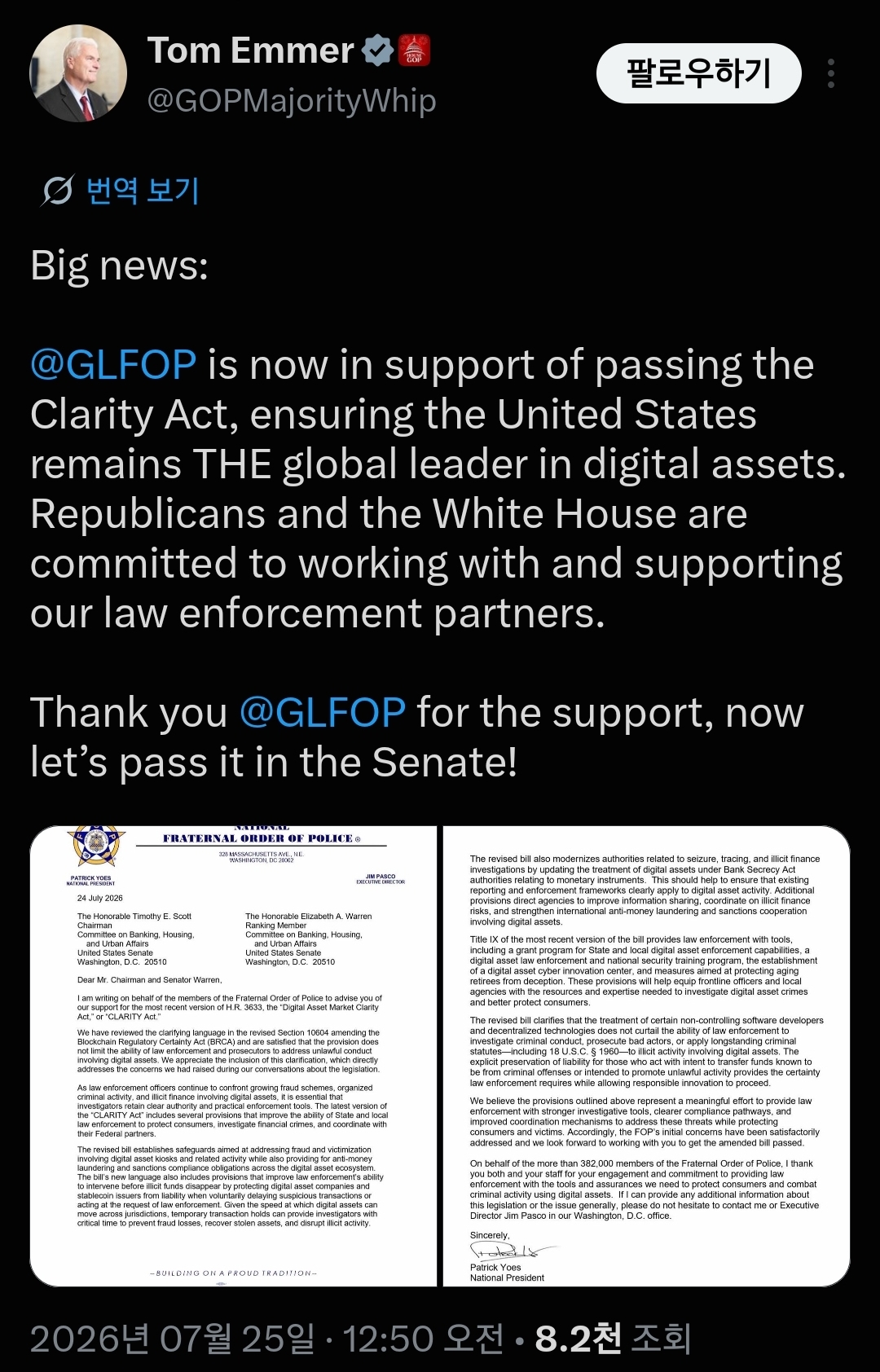
A major U.S. law-enforcement advocacy organization has publicly backed the latest version of the proposed ‘Clarity Act,’ adding political momentum to a long-running effort in Washington to define federal rules for the crypto market. The endorsement underscores how consumer protection and financial-crime enforcement—particularly around crypto ATMs—are becoming central selling points for the bill as it moves through Congress.
The National Police Credit Union Association said Friday, July 24 ET, that it supports the updated draft of the Clarity Act, according to a statement addressed to Sen. Elizabeth Warren and Sen. Tim Scott. The group advocates for improved working conditions and support systems for police officers and other law-enforcement personnel, and it framed the bill as a practical tool for strengthening investigations and interagency coordination rather than a win for the crypto industry alone.
In its letter, the association said the revised bill includes multiple provisions that would enhance the ability of state and local law-enforcement agencies to ‘protect consumers,’ investigate financial crime, and coordinate with federal authorities. It specifically pointed to guardrails aimed at fraud tied to crypto kiosks—often referred to as crypto ATMs—where scammers have increasingly targeted retail users through impersonation schemes and coerced payments. The group also highlighted expanded anti-money laundering and sanctions-compliance obligations across the broader crypto ecosystem, positioning the legislation as a framework that tightens oversight while clarifying regulatory responsibilities.
The Clarity Act is designed as a market-structure bill that would more clearly delineate the rules governing crypto assets in the U.S., including how different tokens and intermediaries are regulated. Lawmakers are currently reviewing the latest text, which is circulating on and off Capitol Hill and is expected to move toward a floor vote.
One of the most politically sensitive changes in the new draft is a restriction barring public officials and their immediate family members from issuing or promoting cryptocurrencies. That provision addresses a key criticism from opponents of earlier versions, who argued the bill failed to adequately prevent conflicts of interest. Sen. Warren, a prominent crypto skeptic, said earlier this week that the revised proposal could still allow President Trump to profit from crypto ventures and potentially create openings that benefit criminals—an argument that continues to shape Democratic scrutiny of the legislation.
At the same time, major industry-aligned groups also lined up behind the updated bill on Friday, including the Crypto Innovation Council, the Blockchain Association, and the Digital Chamber. The organizations argued that as more Americans use and invest in crypto, Congress needs to establish a workable federal baseline. They described the legislation as the first ‘comprehensive federal consumer protection framework’ tailored to the crypto market, aiming to reduce regulatory ambiguity that has fueled disputes between companies and regulators for years.
The bill’s path has not been linear. A prior version advanced by Republicans last year later stalled amid resistance tied to stablecoins and concerns over whether crypto platforms should be allowed to offer yield-like returns to users. Banking industry groups have warned that if exchanges can provide higher-return products to customers, traditional banks could lose deposits—a competitive dynamic that has made stablecoin-related provisions particularly contentious. Coinbase ($COIN), the largest U.S. crypto exchange, previously withdrew its support for the bill in January after clashing with bank-backed calls to prohibit stablecoin yield.
The updated draft appears to be an attempt to break that logjam by pairing clearer market-structure rules with provisions aimed at fraud prevention, stronger compliance expectations, and conflict-of-interest safeguards—issues that resonate beyond the crypto sector. Whether that mix is enough to bridge remaining divides will likely determine whether Congress can finally deliver a durable framework, or whether the U.S. market remains governed primarily through agency enforcement and court battles rather than explicit statutory rules.