

 News
News  Coin Information
  About us
  Customer Service


 Add as a preferred source on Google
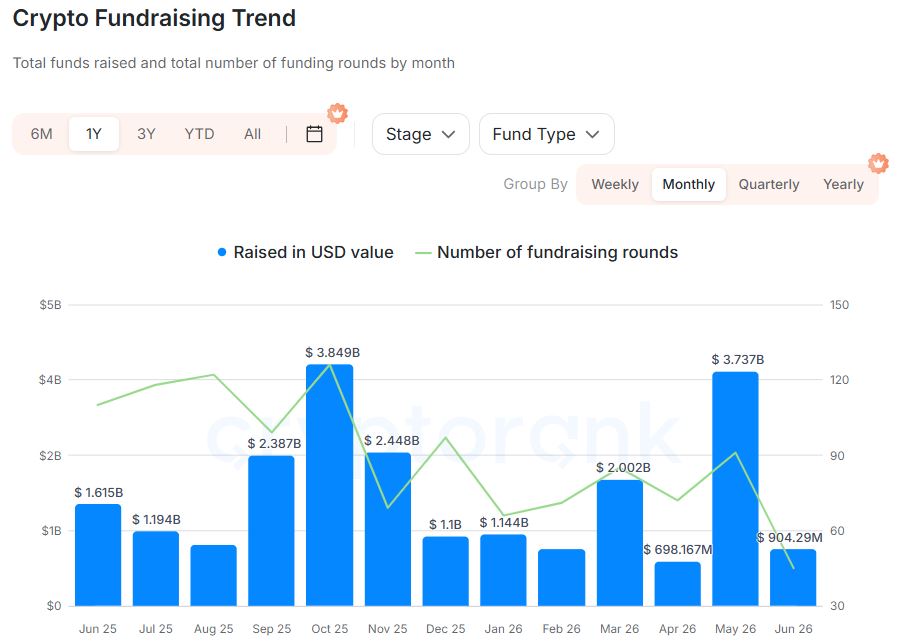
Crypto venture funding is showing clearer signs of cooling, but deal flow in June is still on track to be resilient by recent standards, with month-to-date financing topping $900 million and Carta emerging as the week’s biggest fundraise.
Data compiled by CryptoRank as of June 22 (UTC) shows 45 funding rounds completed so far this month, totaling approximately $904.29 million. That marks a sharp slowdown from the prior month’s $3.74 billion across 91 rounds, with both capital raised and the number of deals falling. Still, June’s dollar total is running ahead of April, when projects raised roughly $698.10 million across 72 rounds—suggesting that while activity has cooled, capital has not evaporated entirely.
The largest headline transaction over the past week was Carta’s $125 million in debt financing led by Community Investment Management, underscoring how some companies are turning to non-dilutive or structured capital as venture markets become more selective. Carta also logged a separate $15 million Series A round backed by Galaxy, according to the same dataset.
Other notable rounds during the June 15–18 window (UTC) included Trace Finance’s $32 million Series A led by CoinFund; Interchecks’ $50 million Series C backed by Commerce Ventures and others; Eldorado’s $9 million Series A co-led by Paradigm and additional investors; and Range’s $8.3 million Series A led by Maven 11 Capital. Coinbase Ventures also appeared in strategic activity during the period, including a strategic investment in Re Protocol.
Despite those larger tickets, broader momentum has softened. CryptoRank’s investment activity index over the past 30 days fell 26% month-over-month to a 'Low' reading, reflecting weaker 'risk appetite' and longer decision cycles. Over that same 30-day period, the dataset recorded 87 funding rounds—down 25.6% from the month prior—while total capital raised dropped to about $6.0 billion, a 33.5% decline.
Average round sizes were concentrated in the $3 million to $10 million range, pointing to a market leaning toward smaller, higher-conviction bets rather than aggressive, late-stage checks. By deal type, 'strategic investment' was the most active category, a pattern typically associated with ecosystem players prioritizing partnerships, distribution, and technical integration over purely financial exposure.
Sector allocation also highlighted where investors still see durable demand. Over the last six months, payments captured the largest share of funding at 31.07%, followed by API-focused projects at 19.9%, real-world assets (RWA) at 19.42%, decentralized exchanges (DEX) at 15.05%, and developer tools at 14.56%. CryptoRank’s data indicates API-related deals served as a central conduit for recent capital flows, reflecting continued interest in infrastructure that enables on-chain applications to plug into exchanges, wallets, identity layers, and compliance tooling.
On the investor side, Coinbase Ventures led in deal count with 30 participations over the referenced period, followed by Animoca Brands (19), Andreessen Horowitz’s a16z Crypto (18), Tether (17), GSR (12), Amber Group (11), and YZi Labs (9). The mix of corporate-linked investors, major market makers, and top-tier venture funds suggests that while the pace is slower, competition remains for projects viewed as essential infrastructure or clear revenue builders.
Overall, June’s figures reinforce a market transitioning from exuberant funding cycles to a more disciplined posture. If this trend persists, the next phase of crypto venture could be shaped less by headline valuations and more by 'capital efficiency', structured financing, and strategic partnerships that help projects reach sustainable adoption.
🔎 Market Interpretation
- Funding is cooling, not collapsing: June MTD funding reached $904.29M across 45 rounds (as of June 22 UTC), down sharply from May’s $3.74B and 91 rounds, but still ahead of April’s $698.10M.
- Risk appetite is fading: CryptoRank’s investment activity index dropped 26% MoM to “Low”, consistent with longer diligence cycles and tighter checks.
- Capital is shifting toward structure and selectivity: Carta’s $125M debt financing leads the week, signaling increased use of non-dilutive/structured capital as equity markets become more selective.
- Smaller rounds dominate: Average sizes cluster in the $3M–$10M band, implying a preference for higher-conviction, capital-efficient bets over aggressive late-stage deployment.
- Strategic deals are the most common: “Strategic investment” leads by deal type, highlighting ecosystem-driven objectives (distribution, integrations) over purely financial exposure.
- Where money still goes: Funding concentration over six months favors payments (31.07%), APIs (19.9%), RWA (19.42%), DEXs (15.05%), and developer tools (14.56%)—a signal that revenue-linked rails and infrastructure remain investable.
- Investor mix remains competitive: Active participation from Coinbase Ventures (30), Animoca (19), a16z Crypto (18), Tether (17), and market makers suggests continued competition for “must-have” infrastructure and clearer monetization plays.
💡 Strategic Points
- Optimize for capital efficiency: Build milestones that can be achieved within $3M–$10M tranches (ship product, prove unit economics, win distribution) to match prevailing check sizes.
- Consider structured financing early: Debt/structured capital (e.g., Carta’s $125M) can extend runway without immediate dilution—best suited for businesses with predictable cash flows or monetizable receivables.
- Prioritize strategic partners over valuation: With strategic investments leading, founders can trade some headline terms for integrations, customer access, liquidity support, or compliance rails that accelerate adoption.
- Align with funded sectors: Position offerings around investor “durable demand” themes—payments, API middleware, RWA enablement, DEX infrastructure, and dev tooling—especially where there is a direct path to fees.
- Expect longer decision cycles: Plan fundraising timelines with buffers (more data rooms, more reference checks, staged closes) as “risk appetite” weakens.
- Differentiate via distribution and compliance readiness: The strong API allocation implies demand for connective tissue to exchanges/wallets/identity/compliance—projects that reduce integration friction can win budgets even in a slowdown.
- Watch investor behavior for signals: High activity from corporate-linked investors and market makers can indicate where liquidity, listings, or ecosystem incentives may emerge—use this to target warm leads and non-financial value.
📘 Glossary
- Deal flow: The number and cadence of funding rounds being completed in a given period.
- Month-to-date (MTD): Cumulative totals measured from the start of the month up to the referenced date.
- Debt financing: Capital borrowed that must be repaid (often with interest); typically non-dilutive compared with equity rounds.
- Non-dilutive capital: Funding that does not immediately reduce existing shareholders’ ownership (e.g., debt, grants, revenue-based financing).
- Structured capital: Financing with customized terms (debt + covenants, convertibles, revenue-based structures) designed to fit risk and cash-flow profiles.
- Series A / C: Stages of venture funding; A is early growth after initial validation, C is later-stage scaling after stronger traction.
- Strategic investment: Investment made primarily to gain ecosystem benefits (integration, distribution, partnerships) rather than only financial return.
- RWA (Real-World Assets): Tokenized representations of off-chain assets (e.g., treasuries, real estate, credit) used in on-chain finance.
- DEX (Decentralized Exchange): On-chain exchange enabling peer-to-peer trading via smart contracts rather than a centralized intermediary.
- API-focused projects: Infrastructure products providing interfaces that let apps connect to exchanges, wallets, identity, compliance, and on-chain data/services.
- Capital efficiency: Ability to achieve growth/traction with less spend, improving runway and return on invested capital.



















Comment 0