

 News
News  Coin Information
  About us
  Customer Service


 Add as a preferred source on Google
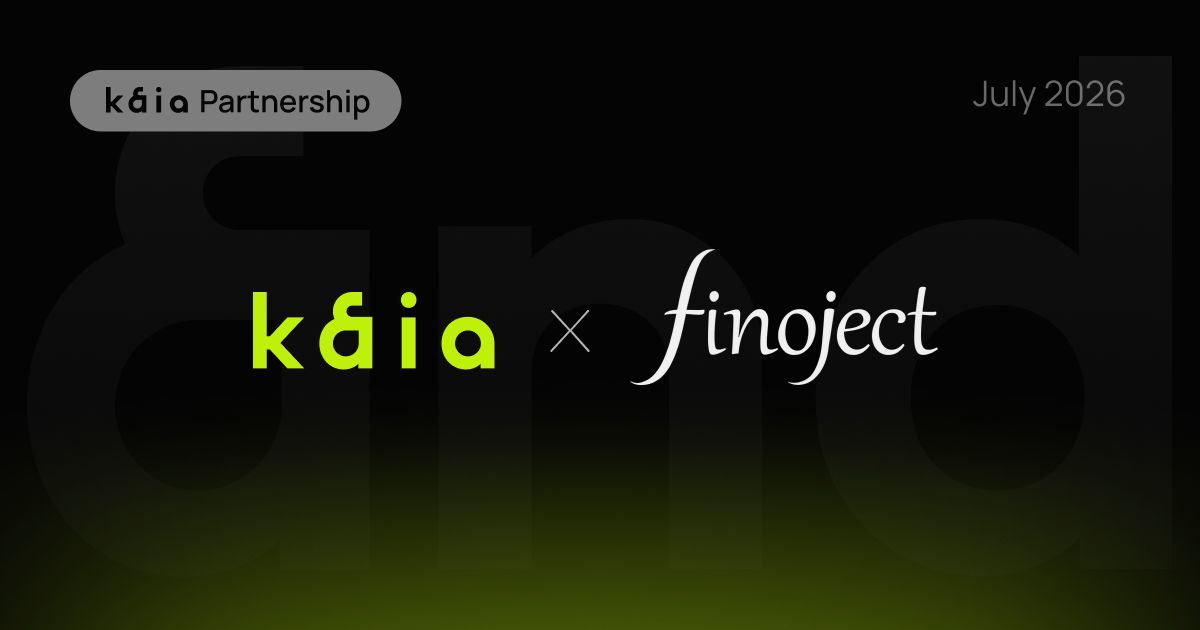
Kaia has signed a strategic partnership with Japanese Web3 and financial regulatory consulting firm Pinoject to accelerate stablecoin, tokenization, and broader digital-asset business opportunities in Japan—an increasingly pivotal market where compliance execution often determines whether products can launch at all.
The agreement positions Pinoject as Kaia’s on-the-ground partner for navigating Japan’s tightly structured regulatory environment, from licensing and compliance design to operational implementation. For Kaia, the move underscores a push to pair blockchain deployment with rigorous 'regulatory readiness' as Japan updates digital-asset rules and tax discussions continue to evolve.
Pinoject is a Japan-based consultancy specializing in financial regulation for Web3 businesses, known for supporting end-to-end delivery across licensing acquisition assistance, 'AML/CFT' (anti-money laundering and counter-terrorist financing) framework development, system buildout and operations, and even executive secondments. The firm highlights hands-on experience aligning with Japan’s Financial Services Agency (FSA) requirements and Financial Action Task Force (FATF) standards—capabilities increasingly sought by issuers and intermediaries exploring stablecoins and security tokens.
The consultancy’s client base spans major Japanese corporates and fintech startups, including Nomura Holdings and NTT Docomo, as well as Hitachi. In 2025, Pinoject also led what it described as Japan’s first cross-industry AML proof-of-concept initiative together with 12 companies including Hitachi and Nomura Holdings, underscoring its influence in practical compliance experimentation. That same year, it won the 'Best Transaction Monitoring Solution' category at the Regulation Asia Awards 2025.
Much of Pinoject’s profile reflects the career of its CEO, Kimihiro Mine, who previously served as CEO of one of Japan’s major crypto exchanges, bitFlyer, and later became the second chairman of the Japan Virtual and Crypto Assets Exchange Association (JVCEA). Mine’s background includes roles in traditional finance, such as the former Industrial Bank of Japan (now part of Mizuho Financial Group) and SBI Securities. He also sits as an outside director at JPYC, a Japanese yen-denominated stablecoin project, keeping him closely tied to Japan’s institutional stablecoin discussions.
Under the partnership, Pinoject will support Kaia’s Japan expansion while taking a proactive role in compliance planning and regulatory engagement. The two sides aim to combine Kaia’s blockchain infrastructure and prior deployments with Pinoject’s regulatory know-how and domestic network to speed up commercialization of Japan-focused stablecoin and tokenization initiatives.
Kaia said the timing is strategic, pointing to its position as the chain where Japanese yen stablecoin JPYC has seen its largest circulation. The company framed the alliance as a way to reinforce stable operations and build out 'onchain financial infrastructure' in Japan at a moment when market participants are reassessing interoperability between stablecoins and the design of compliant financial models amid shifting legal and tax considerations. Kaia Foundation representatives have previously participated in industry discussions related to tax reform proposals through the Japan Blockchain Association, signaling ongoing engagement with policy processes.
Kaia also plans to extend to Japan a set of banking-linked stablecoin experiments it has pursued in South Korea, including proof-of-concept work with KB Kookmin Bank and a local-currency stablecoin initiative with BNK Busan Bank. By bringing those frameworks into Japan with a dedicated compliance partner, Kaia appears to be betting that regulated pilots can be translated into scalable issuance and settlement use cases once licensing and monitoring requirements are addressed.
“Kaia is one of Asia’s representative public blockchains, rooted in two major platforms—LINE and Kakao—and it already has a track record implementing a Japanese yen stablecoin,” Mine said, adding that Pinoject intends to serve as a bridge between Kaia’s technology base and Japan’s emerging stablecoin and tokenization market.
Kaia Foundation Chair Sang-min Seo called Japan a key market both for its regulatory transparency and its scale, saying the foundation expects to work with Japanese industry players to develop new financial infrastructure supported by Pinoject’s expertise and network.
The partnership highlights a broader theme in Japan’s digital-asset sector: as stablecoins and tokenized instruments move from concept to deployment, competitive advantage is increasingly tied not only to throughput and developer tools, but also to governance structures, monitoring systems, and the ability to satisfy 'licensing-grade compliance' from day one.




















Comment 0