

 News
News  Coin Information
  About us
  Customer Service


 Add as a preferred source on Google
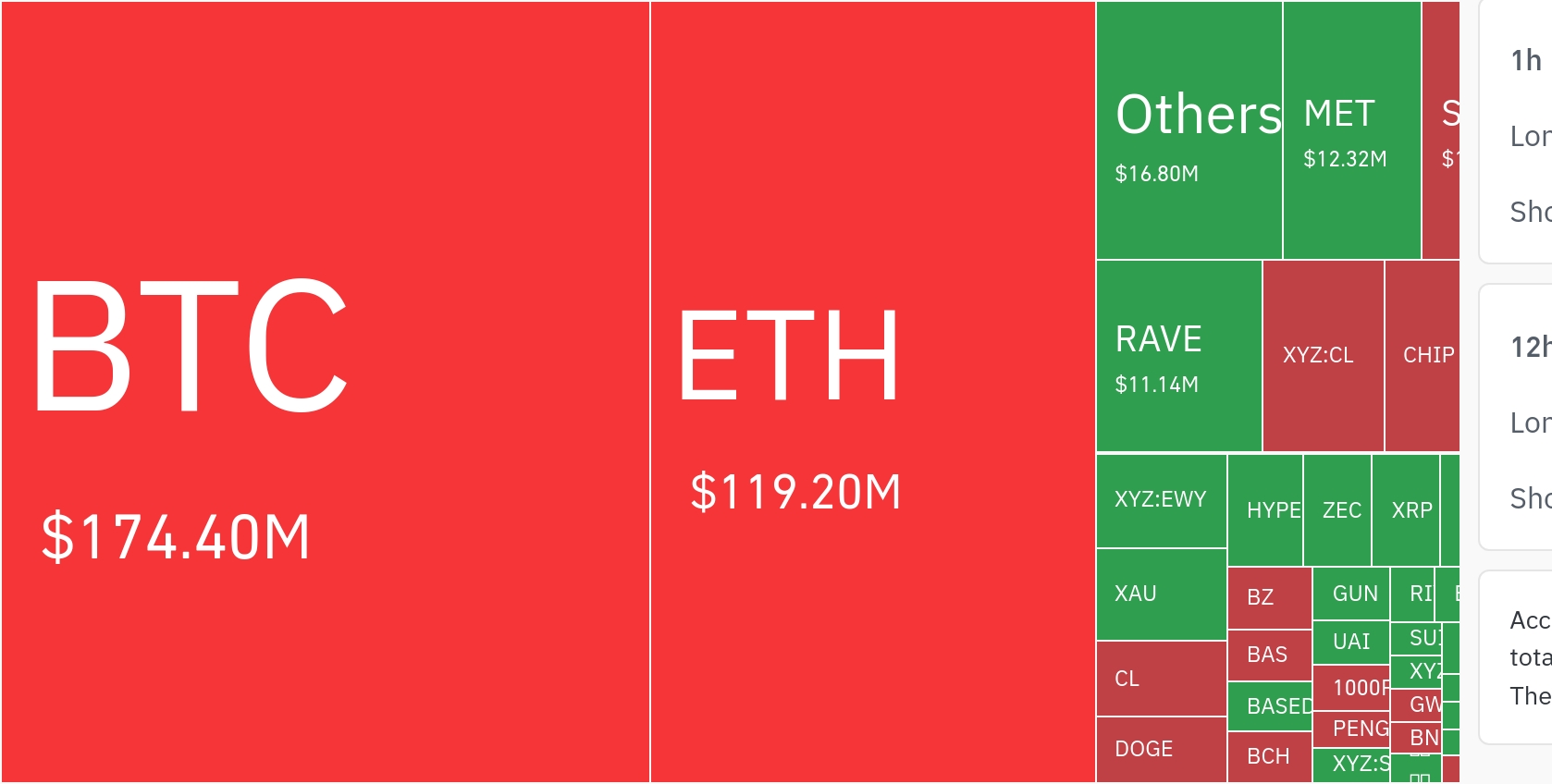
Crypto derivatives traders were hit by a sharp wave of forced deleveraging over the past day, with roughly $5.78 billion in leveraged positions liquidated across major tokens—an outsized flush that underscores how quickly risk can unwind when volatility returns.
Data compiled by CoinGlass shows long liquidations totaled about $3.34 billion, accounting for 57.8% of the 24-hour wipeout, while short liquidations reached roughly $2.44 billion, or 42.2%. While the broader day skewed toward long liquidations, the most recent four-hour window told a different story: shorts were closed out more aggressively, suggesting a short-term rebound pushed bearish positioning offside.
In the latest four hours, total liquidations across tracked venues came in at around $18.13 million, with shorts making up $12.75 million—70.35% of the total. Binance led the exchange breakdown with approximately $7.38 million in liquidations (40.69% share), where shorts represented $4.12 million, or 55.9% of Binance’s total. Hyperliquid followed with about $5.54 million, standing out for an extreme short skew: 99.89% of its liquidations were short positions. OKX recorded roughly $1.75 million, and was an exception among major venues, with long liquidations slightly dominant at 55.68%. Bybit ($1.24 million), Bitget (about $968,860), and Gate (about $844,980) rounded out the next tier. CoinEx posted liquidations entirely on the short side, while “Lighter” also showed a heavy short bias at 98.07%, consistent with broad short-covering during a quick intraday bounce.
By asset, XRP (XRP) saw the largest 24-hour liquidation total at roughly $2.34 billion, despite a comparatively modest 0.47% price increase on the day. CoinGlass data indicates both sides were heavily positioned, with about $1.25 billion in long liquidations and $1.09 billion in short liquidations—evidence of unusually concentrated leverage around the token. Ethereum (ETH) posted the second-largest liquidation figure at about $1.02 billion, alongside a 0.67% gain. Bitcoin (BTC) saw a comparatively smaller $83.95 million liquidated while rising 1.50% over the same period.
The mix—prices edging higher while sizable positions on both sides were forcibly closed—signals an environment where leverage, rather than direction, is driving near-term market structure. Even where short liquidations accumulated amid upward drift, meaningful long liquidations across the full 24-hour window point to choppy, two-way trading conditions and heightened sensitivity to rapid price swings.
Several major altcoins also recorded significant leverage washouts. Dogecoin (DOGE) drew attention with about $677.89 million in liquidations even as its price fell 1.21%, a combination that highlights how meme-coin trading often comes with elevated leverage and abrupt volatility. Elsewhere, BNB (BNB) saw about $275 million liquidated, Tron (TRX) roughly $156.05 million, Cardano (ADA) about $116.63 million, Avalanche (AVAX) approximately $66.78 million, and Polygon (MATIC) around $45.40 million. Solana (SOL) registered about $14.10 million, while Sui (SUI), Chainlink (LINK), Aave (AAVE), Litecoin (LTC), and Toncoin (TON) also experienced broadly distributed liquidations.
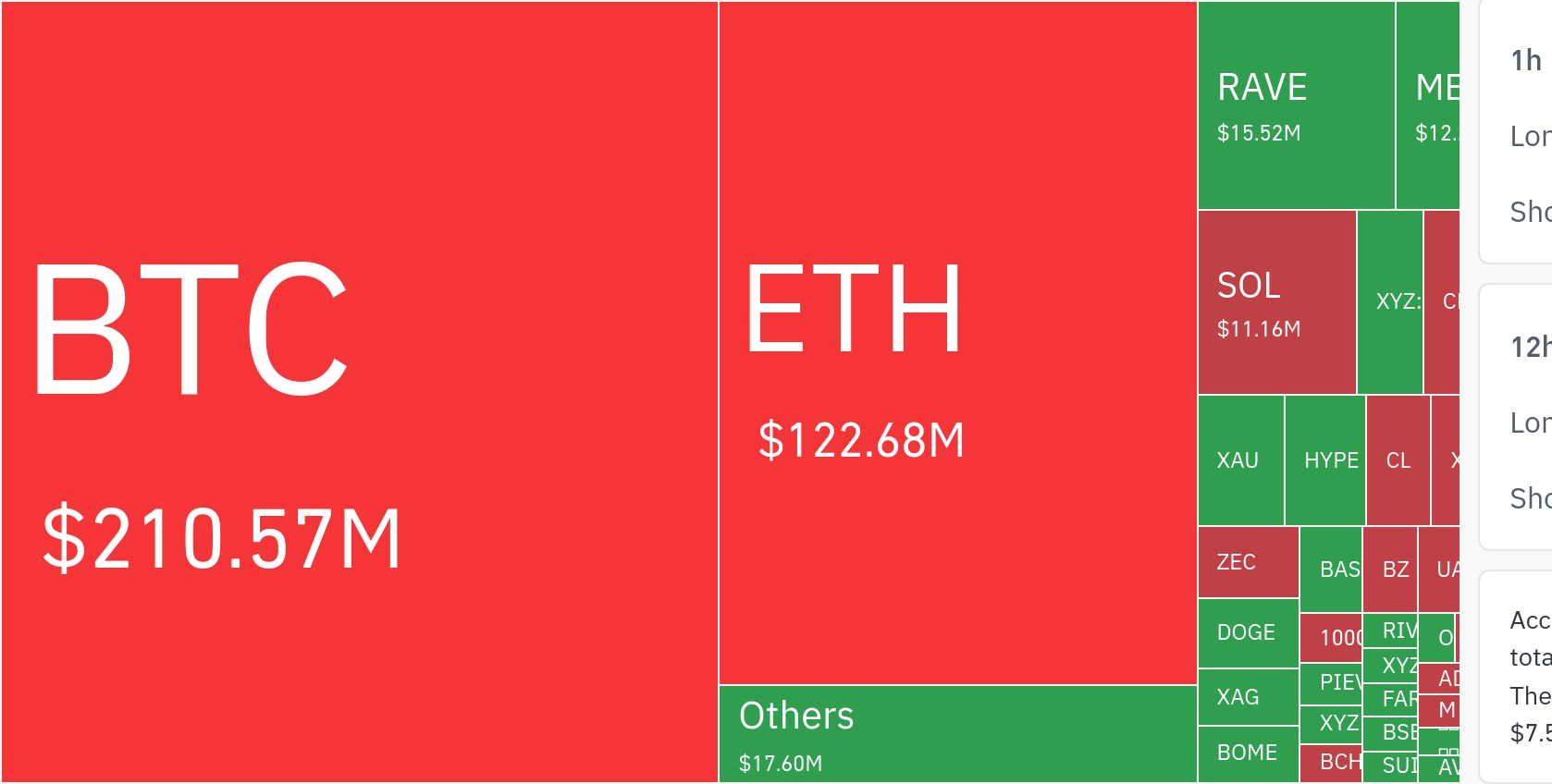
CoinGlass liquidation heatmaps additionally pointed to pockets of leverage concentration beyond the largest tokens, including around $12.32 million in MET and about $11.14 million in RAVE, reinforcing that crowded positioning is not limited to top-cap assets. Market watchers often read unusually skewed exchange-level liquidations—such as Hyperliquid’s near-total short wipeout over four hours—as a sign of a localized 'short squeeze' dynamic, where rising prices force short sellers to buy back, amplifying the move. In contrast, assets that weakened while seeing heavy liquidations—such as DOGE and MATIC—suggest long-side stress and more idiosyncratic, token-by-token positioning.
Liquidations occur when leveraged traders can no longer meet margin requirements and their positions are forcibly closed—often accelerating price moves as losses cascade. The latest figures suggest the market is still working through excess leverage, with rapid shifts in positioning increasing the probability of sudden, disorderly swings even when spot price changes appear relatively mild.
🔎 Market Interpretation
- Large-scale deleveraging: About $5.78B in crypto derivatives liquidations occurred in 24 hours, signaling a rapid unwind of leverage as volatility returned.
- Two-way squeeze conditions: Over 24h, long liquidations dominated ($3.34B, 57.8%), but in the most recent 4h window short liquidations dominated (70.35%), implying a quick rebound triggered aggressive short-covering.
- Leverage driving structure more than direction: Prices were only modestly higher (e.g., XRP +0.47%, ETH +0.67%, BTC +1.50%) despite outsized liquidations, indicating crowded leverage and tight liquidation thresholds rather than a clean trend.
- Concentration risk in specific tokens: XRP led liquidations (~$2.34B) with heavy losses on both sides (longs ~$1.25B; shorts ~$1.09B), pointing to unusually concentrated positioning.
- Altcoin/meme-coin fragility: DOGE saw ~$677.89M liquidated while falling (-1.21%), consistent with high-leverage participation and abrupt volatility in meme assets.
- Localized squeeze signals by venue: Hyperliquid showed an extreme short skew (99.89% shorts liquidated in 4h), consistent with a short-squeeze-like dynamic; other venues were mixed (e.g., OKX slightly long-dominant).
💡 Strategic Points
- Expect whipsaw risk: The mix of heavy liquidations and mild spot moves suggests a market prone to disorderly spikes when clustered stops/margins are hit.
- Watch liquidation composition by timeframe: 24h long-led flushing can coexist with 4h short-led squeezes; monitoring short vs. long dominance helps detect whether bounces are powered by short-covering (often less durable) versus new demand.
- Track exchange-level skew for microstructure clues: Extreme imbalances (e.g., near-total short wipes on a venue) can indicate venue-specific positioning and potential follow-through volatility if hedges shift elsewhere.
- Identify crowded tokens beyond majors: Heatmaps showing leverage pockets in smaller names (e.g., MET ~$12.32M, RAVE ~$11.14M) imply tail-risk can emerge outside top-cap assets during broad deleveraging.
- Risk management implications: In leverage-driven regimes, reduce effective leverage, widen liquidation buffers, and size positions assuming fast, multi-sigma intraday moves even when spot looks calm.
- Differentiate squeeze vs. stress: Tokens rising while shorts liquidate often reflect squeeze mechanics; tokens falling with heavy liquidations (e.g., DOGE, MATIC) suggest long-side stress and potentially weaker underlying bid support.
📘 Glossary
- Liquidation: Forced closure of a leveraged position when margin requirements are no longer met, often executed automatically by the exchange.
- Long / Short: Long bets on price increases; short bets on price declines (often by borrowing or using derivatives).
- Leverage: Borrowed exposure that amplifies gains and losses; higher leverage reduces the price move needed to trigger liquidation.
- Deleveraging: Broad reduction of leveraged exposure, frequently via liquidations, which can accelerate volatility.
- Short covering: Buying back to close short positions; can push prices higher quickly if many shorts exit at once.
- Short squeeze: A rapid price rise that forces short sellers to cover, creating feedback-driven upside acceleration.
- Liquidation heatmap: A visualization of where leveraged positions and potential liquidation levels are concentrated across prices or assets.
- Margin requirements: Collateral thresholds set by exchanges; breaching them triggers liquidation to prevent further losses.
- Two-way market: Choppy conditions where both longs and shorts get liquidated across different windows, often reflecting unstable positioning and rapid reversals.



















Comment 0