
Crypto Liquidations Hit $359 Million as Shorts Squeezed Across Exchanges
Crypto markets saw $359 million in liquidations led by Bitcoin and Ethereum, with short positions heavily squeezed across major exchanges.











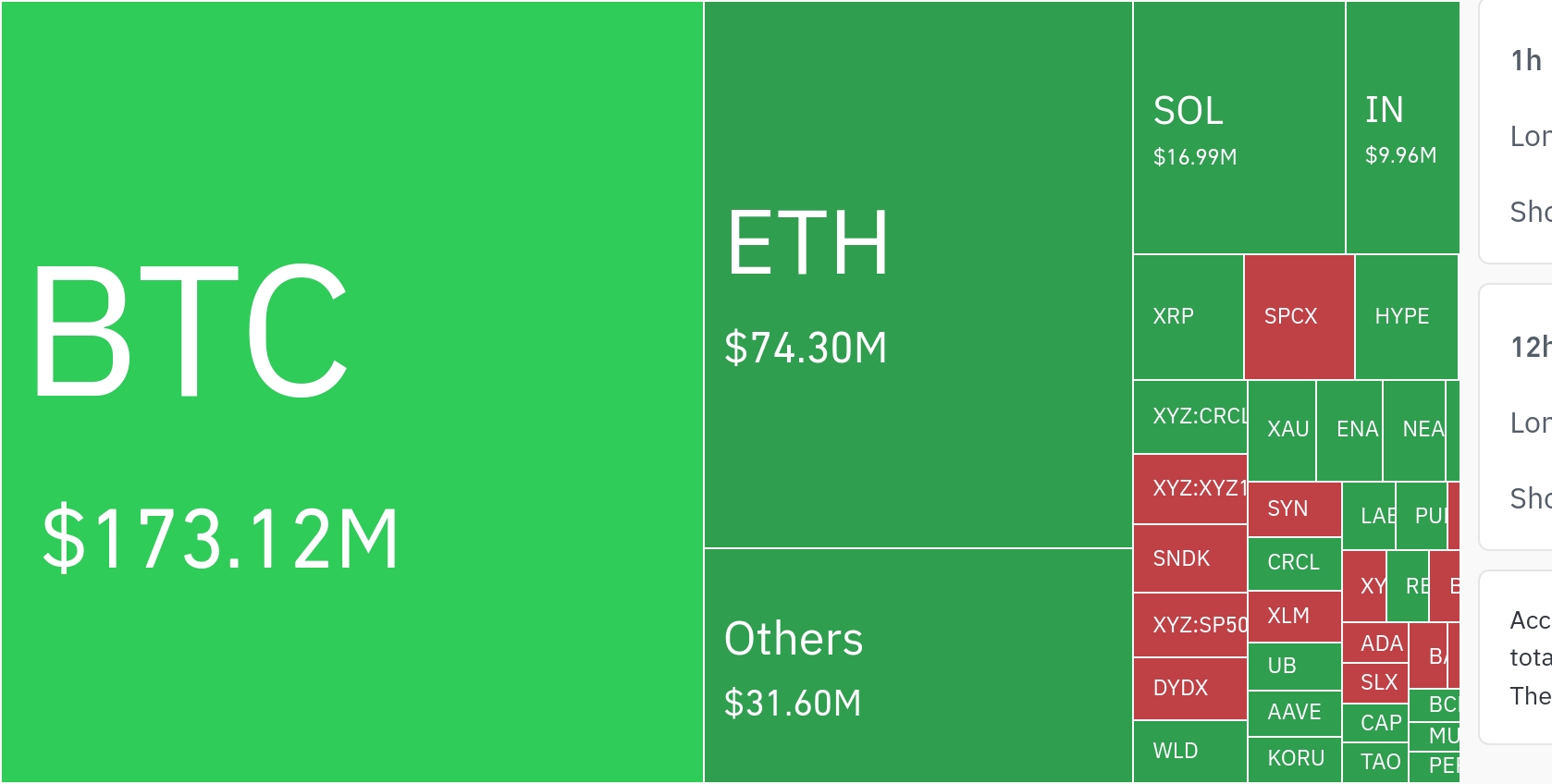
Crypto derivatives markets saw a fresh wave of forced liquidations over the past day, underscoring how quickly leverage can amplify volatility even when spot prices move modestly. Data tracked by CoinGlass showed roughly $359.27 million in leveraged positions were wiped out over the last 24 hours, with liquidation clusters heavily concentrated in Bitcoin (BTC) and Ethereum (ETH).
While the broader 24-hour tally reflected large liquidations on both sides of the market, short-term flow skewed toward shorts getting squeezed. In the most recent four-hour window, total exchange liquidations reached $43.66 million, of which short liquidations accounted for $26.22 million, or 60.06%, compared with $17.44 million in long liquidations.
Binance led all venues with $21.59 million in liquidations—about 49.45% of the total during the period—driven largely by shorts. On Binance, $14.03 million, or 65.01%, came from short positions being closed out. Gate followed with $7.04 million, with shorts representing 53.66%. By contrast, Bybit and OKX showed a different positioning mix: Bybit recorded $4.02 million in liquidations with a slight long bias (50.99%), while OKX posted $3.82 million with longs making up 59.61%—a sign that trader exposure and risk management differed meaningfully across venues. Bitget and Hyperliquid also printed pronounced short-heavy liquidation ratios at 69.07% and 72.36%, respectively, and USDT-margined derivatives on Aster showed an even sharper skew, with shorts representing 85.11%—patterns consistent with a rapid, exchange-specific 'short squeeze'.
On the asset level, Bitcoin (BTC) remained the primary driver of leverage flushes. BTC traded around $107,073, down 1.4% over 24 hours, yet still generated $54.32 million in liquidations—$27.06 million in longs and $27.26 million in shorts—highlighting two-way deleveraging rather than a clean directional unwind. The intraday turbulence was evident in the one-hour snapshot as well, with $6.64 million in long liquidations versus $9.39 million in shorts.
Ethereum (ETH) was not featured in some per-ticker breakdowns, but CoinGlass’ 24-hour liquidation heatmap placed ETH liquidations at roughly $74.30 million, second only to Bitcoin. Together, BTC and ETH accounted for the bulk of the market’s leverage reset, reinforcing a recurring dynamic in crypto: when volatility rises, the largest and most liquid assets often become the focal point for forced position closures.
Among major altcoins, XRP (XRP) stood out for liquidation intensity relative to price movement. XRP traded near $2.22, down 0.3% over 24 hours, yet saw about $100.27 million in total liquidations—$48.39 million in longs and $51.88 million in shorts. Over the last four hours alone, roughly $39.90 million was liquidated, making XRP one of the most aggressive deleveraging events among large-cap altcoins.
Dogecoin (DOGE) fell 4.7% to around $0.1544 and recorded $38.94 million in 24-hour liquidations. In the latest four-hour window, DOGE showed heavier long pain, with $9.37 million in long liquidations versus $4.59 million in shorts—suggesting leveraged dip-buying was punished during the downswing. Cardano (ADA) was a counterexample: ADA rose 0.3% to about $0.7057, but still logged larger short liquidations ($17.48 million) than long liquidations ($11.77 million), a typical signature of shorts being forced out during a grind higher.
Smaller tokens also contributed to the overall churn, though at a far lower scale. dogwifhat (WIF) slid 4.2% with roughly $427,920 liquidated, while Arbitrum (ARB) dropped 4.1% alongside about $94,840 in liquidations. Tron (TRX) gained 1.0% and saw approximately $1.19 million liquidated over 24 hours. Hedera (HBAR), Sui (SUI), and Chainlink (LINK) showed comparatively balanced long and short liquidations, while Pepe (PEPE) rose 0.4% with slightly more shorts liquidated than longs. Shiba Inu (SHIB) fell 2.6% but did not post an outsized liquidation print relative to bigger names.
The cross-exchange split—short liquidations dominating on Binance, Bitget, Hyperliquid, Aster, and others, versus long-heavy liquidations on Bybit and OKX—points to uneven positioning and liquidity conditions across derivative venues. In practical terms, it suggests that certain exchanges experienced sharper rebounds that forced shorts to cover, while others saw price action that trapped overleveraged longs.
Liquidations occur when leveraged traders can no longer meet margin requirements and exchanges forcibly close positions. With BTC and ETH dominating the heatmap—reported at roughly $173.12 million and $74.30 million in liquidations, respectively, in the 24-hour view—the latest episode signals that leverage was concentrated in the market’s largest assets and that deleveraging remains a central driver of near-term crypto volatility.
Article Summary by TokenPost.ai
🔎 Market Interpretation
Leverage-driven volatility resurfaced: About $359.27M in crypto derivatives positions were liquidated in 24 hours, showing how modest spot moves can trigger outsized forced selling/buying when leverage is crowded.
Short squeeze dynamics dominated the near-term tape: In the latest 4-hour window, liquidations totaled $43.66M, with short liquidations at 60.06% ($26.22M), indicating a rapid upward impulse (or rebound) that forced shorts to cover.
Exchange positioning was fragmented: Binance accounted for ~49.45% of 4-hour liquidations ($21.59M) and skewed strongly to shorts (65.01%), while Bybit and OKX showed comparatively long-heavy liquidation mixes—evidence that trader exposure and liquidity conditions differed materially across venues.
BTC/ETH remained the leverage epicenter: BTC and ETH led the liquidation heatmap (ETH ~$74.30M; BTC reported as major, with a separate figure also citing ~$173.12M for BTC in the 24-hour heatmap view), reinforcing that the most liquid large caps often absorb the bulk of forced deleveraging.
Two-way deleveraging in BTC: Despite BTC being down ~1.4% ($107,073 area), BTC liquidations were nearly balanced between longs and shorts (~$27.06M vs $27.26M), implying churn/whipsaw rather than a clean one-direction unwind.
Altcoin stress was selective: XRP saw an unusually large liquidation print (~$100.27M) despite only a ~0.3% price dip, signaling crowded leverage and tight risk buffers in that market.
💡 Strategic Points
Use liquidation skew as a regime signal: A rising share of short liquidations (as seen in the 4-hour window) often accompanies sharp rebounds; traders may treat it as a cue to reduce chase risk and expect mean-reversion/volatility after the squeeze.
Mind venue-specific risk: Divergent liquidation mixes (short-heavy on Binance/Bitget/Hyperliquid/Aster vs long-heavy on Bybit/OKX) imply exchange microstructure matters—slippage, funding, and liquidation cascades can differ even for the same asset.
Focus on “high liquidation vs low price move” setups: XRP’s pattern (large liquidations with small net move) can indicate range expansion risk—tight stops, reduced leverage, and staggered entries may be more appropriate than concentrated bets.
Expect BTC/ETH to transmit shocks: When BTC/ETH dominate liquidations, cross-margining and correlated positioning can spill volatility into majors and then to alts; risk controls should assume correlation spikes during deleveraging waves.
Interpret coin-specific liquidation balance:
Balanced liquidations (BTC example): suggests whipsaw conditions—consider smaller size and wider invalidation levels.
Long-heavy liquidations (DOGE in 4-hour): often reflects punished dip-buying—avoid aggressive leverage into downtrends.
Short-heavy liquidations (ADA): can reflect grind-up price action—shorts may be vulnerable to continued squeeze if trend persists.
Operational takeaway: Forced liquidations are not just a “price drop” phenomenon—both directions can cascade. Use conservative margin, monitor funding/open interest shifts, and avoid clustering stops near obvious liquidity pools.
📘 Glossary
Liquidation: Forced closing of a leveraged position by an exchange when margin requirements are no longer met.
Leverage: Borrowed exposure that magnifies gains and losses; increases liquidation risk during volatility.
Long / Short: Long profits if price rises; short profits if price falls.
Short squeeze: A rapid move up that forces short sellers to buy back (cover), accelerating the rally.
Deleveraging: Reduction of market leverage via position closures—voluntary or forced (liquidations).
Heatmap (liquidations): Visualization/aggregation showing where liquidation volume is concentrated by asset/time.
USDT-margined derivatives: Futures/perpetuals collateralized and settled in USDT, not the underlying coin.
Venue microstructure: Exchange-specific conditions (liquidity, fees, order book depth, liquidation engine) that affect execution and cascade risk.