
 Add as a preferred source on Google
Ethereum Options Signal Long-Term Bullish Bias as Short-Term Put Demand Rises
Ethereum options data shows call-heavy open interest alongside rising short-term put volume as traders hedge near-term volatility.


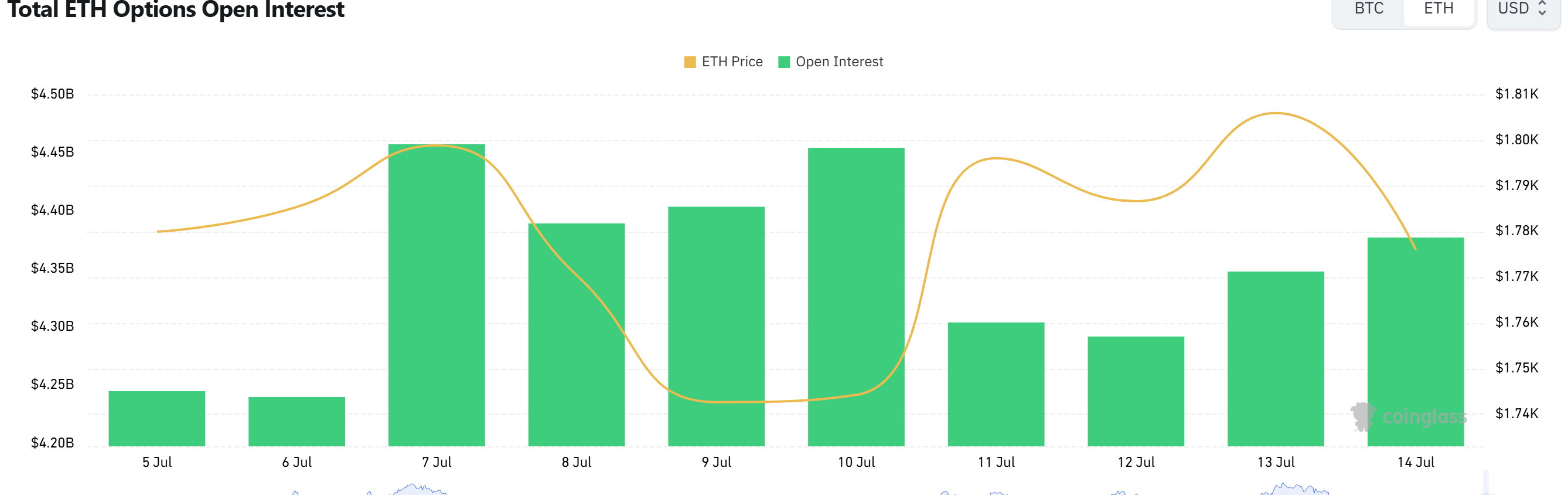
Ethereum (ETH) options positioning remained broadly risk-on in open interest, but short-dated trading over the past 24 hours leaned noticeably defensive as activity clustered in near-term put contracts around the $1,775 strike.
Data compiled by CoinGlass at 00:50 UTC on July 14 showed total Ethereum options open interest (OI) at $4.267 billion, down marginally by 0.03% from $4.269 billion a day earlier. Over the same window, aggregate options trading volume reached approximately $870.7 million, underscoring active repositioning despite the near-flat change in outstanding exposure.
The composition of outstanding positions continued to favor calls: call options accounted for 58.68% of OI versus 41.32% for puts. Volume was far more balanced, with calls representing 51.80% of the past 24 hours’ turnover and puts 48.20%. The divergence between OI and volume suggests that while the market’s medium-term structure still reflects a higher concentration of bullish positioning, short-term flows included meaningful 'hedging demand' via puts.
In open interest, the largest concentrations were anchored in longer-dated upside strikes on Deribit, led by the $3,200 call expiring Dec. 25, followed by the $2,200 call and the $3,500 call with the same expiry. The cluster of OI in high-strike calls typically points to sustained interest in upside participation or longer-horizon positioning, though it does not, by itself, indicate directional certainty.
By contrast, the most actively traded contracts over the past 24 hours were dominated by near-term downside protection on Bybit. The top contract by volume was the $1,775 put expiring July 14, followed by the $1,750 put expiring the same day, while the $1,800 call (also July 14 expiry) ranked third. A concentration of turnover in same-day or very short-dated options often reflects tactical positioning around intraday volatility, event risk, or a desire to fine-tune exposure without materially increasing longer-term commitments.
Options are derivatives that allow traders to either take leveraged views on price movement or hedge existing spot and futures positions. A 'call option' grants the right to buy at a preset price and is commonly associated with bullish positioning, while a 'put option' grants the right to sell and is often used for downside bets or protection. Open interest tracks the total number of outstanding contracts and is widely used as a gauge of accumulated positioning, while volume reflects the intensity of recent trading activity.
With calls still dominant in OI but short-dated put volume elevated, market signals point to a split between longer-horizon optimism and near-term caution—an indication that traders may be keeping upside exposure while paying for protection against further volatility in the immediate term.
Article Summary by TokenPost.ai
🔎 Market Interpretation
Positioning remains risk-on overall: Ethereum options open interest (OI) is still call-heavy (58.68% calls vs. 41.32% puts), indicating the broader positioning base is skewed toward upside exposure.
Near-term trading turned defensive: Despite bullish-leaning OI, the last 24 hours’ flows were much more balanced (51.80% call volume vs. 48.20% put volume) and concentrated in same-day puts, suggesting active short-term hedging.
Long-dated upside interest is pronounced: The largest OI clusters sit in higher-strike Dec. 25 calls on Deribit (notably $3,200, $2,200, and $3,500), pointing to sustained demand for longer-horizon upside participation.
Immediate-term risk management dominated activity: The highest volume contracts were Bybit’s July 14 expiry puts around $1,775 and $1,750, implying traders prioritized downside protection into near-term volatility or event-driven uncertainty.
Net signal: optimism with insurance: The market appears to be maintaining bullish longer-term structures while “buying protection” for the near term—consistent with caution around immediate price swings rather than a full sentiment reversal.
💡 Strategic Points
Read OI vs. volume as different time horizons: Call-dominant OI can reflect slower-moving, longer-dated positioning, while put-heavy (or put-surging) volume often reflects fast adjustments to near-term risk.
Watch the $1,775–$1,750 area as a key hedge zone: Heavy same-day put activity around these strikes can signal where traders are most actively insuring against near-term downside or where gamma-related effects may intensify intraday moves.
High-strike Dec. calls suggest asymmetric upside preference: Concentration at $3,200/$3,500 calls may be used for leveraged upside exposure or as part of structured trades (e.g., call spreads), which can coexist with short-term hedges.
Same-day expiries imply sensitivity to spot moves: Very short-dated options can amplify reaction to price changes; elevated turnover there typically aligns with tactical hedging, event risk positioning, or rapid exposure tuning.
Confirm with follow-through metrics: If put volume remains elevated while OI starts shifting toward puts, it may indicate broader de-risking; if put volume fades and call OI persists, it supports the “temporary hedging” interpretation.
📘 Glossary
Options: Derivative contracts giving the right (not obligation) to buy or sell an asset at a predetermined price before/at expiry.
Call option: Right to buy at the strike price; commonly used for bullish exposure.
Put option: Right to sell at the strike price; commonly used for bearish exposure or downside protection (hedging).
Strike price: The preset price at which the option can be exercised (e.g., $1,775).
Expiry (expiration): The date the option contract ends (e.g., July 14 for same-day/near-term contracts; Dec. 25 for longer-dated).
Open Interest (OI): Total number/value of outstanding option contracts that remain open; often used to gauge accumulated positioning.
Volume: The amount/value of contracts traded over a period; indicates recent trading intensity and short-term flow.
Hedging demand: Buying options (often puts) to reduce downside risk on spot/futures holdings.