
 Add as a preferred source on Google
US Spot Ethereum ETFs Extend Inflow Streak With $72 Million Daily Gain
US-listed spot Ethereum ETFs recorded $72.64 million in inflows led by BlackRock and Fidelity, extending a four-day streak and signaling sustained institutional demand.


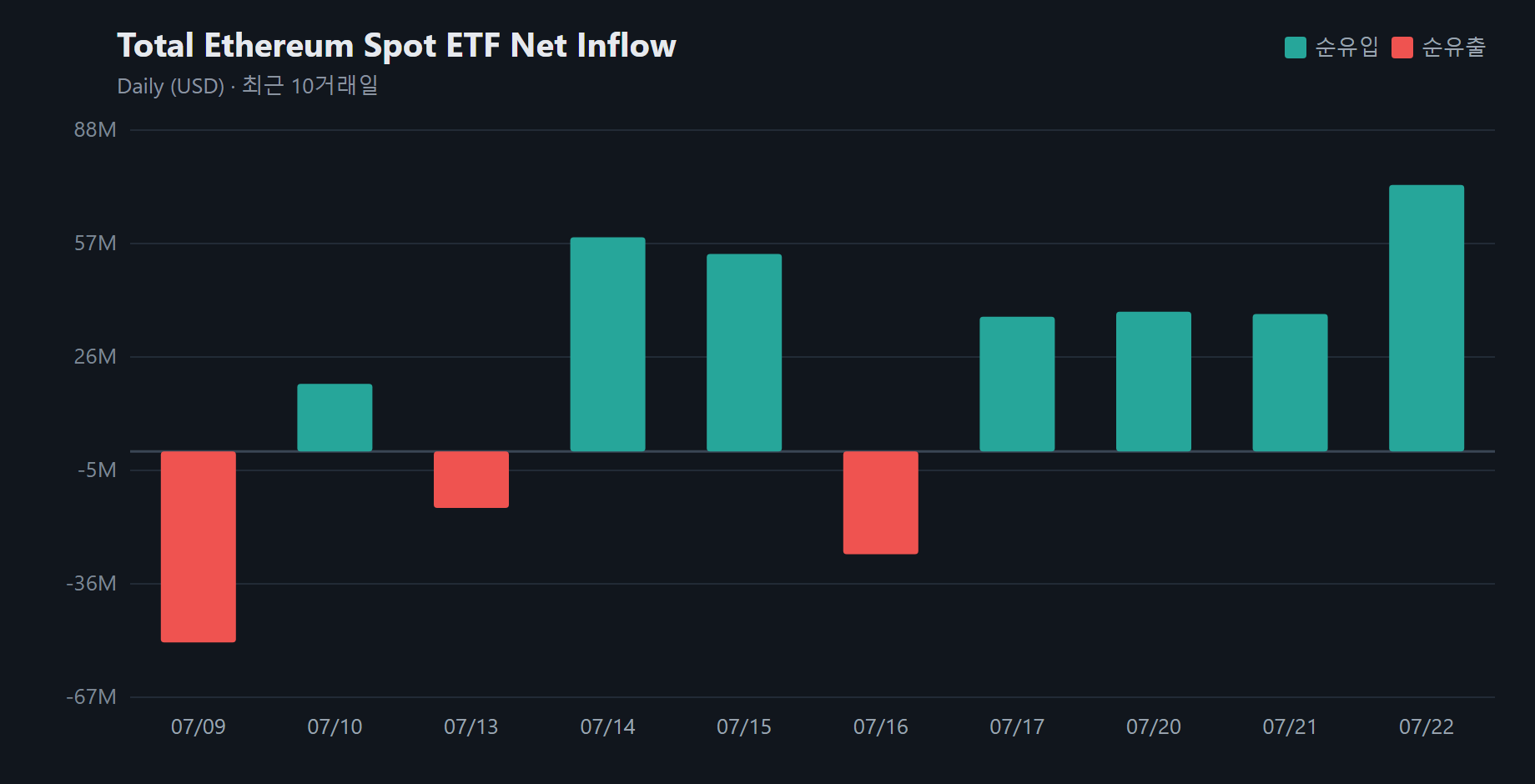
US spot Ethereum (ETH) exchange-traded funds extended their ‘net inflow’ streak to a fourth consecutive session on Tuesday ET, underscoring a renewed bid for regulated ETH exposure even as broader crypto markets remain sensitive to macro headlines and positioning.
According to data compiled by SosoValue, US-listed spot Ethereum ETFs recorded $72.64 million in net inflows on July 22 ET. The result marks four straight trading days of positive flows since July 17 ET and represents a sharp acceleration from the prior session’s $37.47 million—nearly doubling day over day. Cumulative net inflows across the category rose to approximately $11.227 billion.
In Tuesday’s tally, inflows were concentrated in just two products among the 10 spot Ethereum ETFs currently tracked. BlackRock’s iShares Ethereum Trust (ETHA) led with $53.47 million, while Fidelity’s Fidelity Ethereum Fund (FETH) added $19.18 million. The narrow distribution suggests ‘institutional demand’ remains selective, gravitating toward the most liquid, lowest-friction vehicles rather than spreading evenly across the full suite of issuers.
Trading activity also remained elevated. Total dollar turnover across spot Ethereum ETFs reached $597.49 million. ETHA accounted for the bulk of volume at $461.57 million, followed by Grayscale’s Ethereum Mini Trust (ETH) at $47.93 million and Fidelity’s FETH at $25.22 million—an indication that liquidity is consolidating around a handful of dominant tickers.
Total net assets across US spot Ethereum ETFs stood at $10.566 billion, equivalent to roughly 4.54% of Ethereum’s total market capitalization. By assets, ETHA remained the largest with $5.603 billion, followed by Grayscale’s ETH at $1.614 billion and Grayscale Ethereum Trust (ETHE) at $1.480 billion.
The persistence of inflows suggests investors are increasingly treating spot Ethereum ETFs as a core access point for ETH exposure, with daily flows and volume offering a near real-time read on risk appetite. If the current trend continues, the market will likely watch whether demand broadens beyond the top two issuers—an important signal for how durable the latest ‘liquidity inflow’ is across the ecosystem.
Article Summary by TokenPost.ai
🔎 Market Interpretation
Spot ETH ETF demand is strengthening: US spot Ethereum ETFs posted $72.64M net inflows on July 22 (ET), extending a 4-day inflow streak (since July 17) and nearly doubling the prior session’s $37.47M.
Institutional flow is highly concentrated: Only 2 of 10 tracked ETFs captured inflows—BlackRock ETHA (+$53.47M) and Fidelity FETH (+$19.18M)—signaling preference for the most liquid, operationally “simple” vehicles.
Liquidity is consolidating around leaders: Total ETF trading volume hit $597.49M, dominated by ETHA ($461.57M). This suggests market participants increasingly use a small set of tickers for scalable exposure and hedging.
ETH ETF footprint is now macro-relevant: Total net assets are $10.566B (~4.54% of ETH market cap), meaning ETF flows and positioning can increasingly influence near-term price behavior and sentiment.
Signal to watch: Continuation of inflows is constructive, but the next validation is whether buying broadens beyond ETHA/FETH; broad participation would imply deeper, more durable allocation rather than “winner-takes-most” flow.
💡 Strategic Points
Use flows as a real-time risk gauge: Consecutive net inflows and rising turnover often coincide with improving risk appetite; a reversal (outflows + falling volume) can flag cooling demand before price fully reflects it.
Track concentration risk: With flows and volume concentrated in ETHA (and to a lesser extent FETH), event risk (spreads, operational issues, fee changes) in a single product can disproportionately affect the “ETF narrative.”
Watch for “breadth expansion” catalysts: If additional issuers start seeing consistent inflows, it may indicate broader institutional onboarding, diversified execution channels, and greater durability of the trend.
Monitor AUM share vs ETH market cap: At ~4.54%, ETF ownership is large enough that sustained inflows could tighten available spot liquidity; conversely, coordinated outflows could amplify volatility during macro shocks.
Liquidity preference implies execution strategy: Traders and allocators seeking lower slippage may increasingly prefer the highest-volume tickers (e.g., ETHA). Smaller funds may lag in adoption despite being “spot ETH” exposure.
📘 Glossary
Spot Ethereum ETF: An exchange-traded fund designed to track Ethereum’s spot price by holding ETH directly (rather than futures contracts), providing regulated market access.
Net inflow / net outflow: The net value of capital entering or leaving a fund in a day (inflows minus outflows). Positive net inflow typically indicates demand for exposure.
Turnover (trading volume): The total dollar value traded in a given period; higher turnover typically signals stronger liquidity and market participation.
Net assets (AUM): The total market value of assets held by an ETF category or individual fund; used to gauge scale and potential market impact.
Liquidity inflow: A descriptive term for sustained capital entering a market/instrument, often associated with improving breadth, tighter spreads, and higher trading activity.
Institutional demand: Buying activity from professional allocators (e.g., asset managers, hedge funds, RIAs) that often favors high-liquidity, low-friction products.