

 News
News  Coin Information
  About us
  Customer Service


 Add as a preferred source on Google
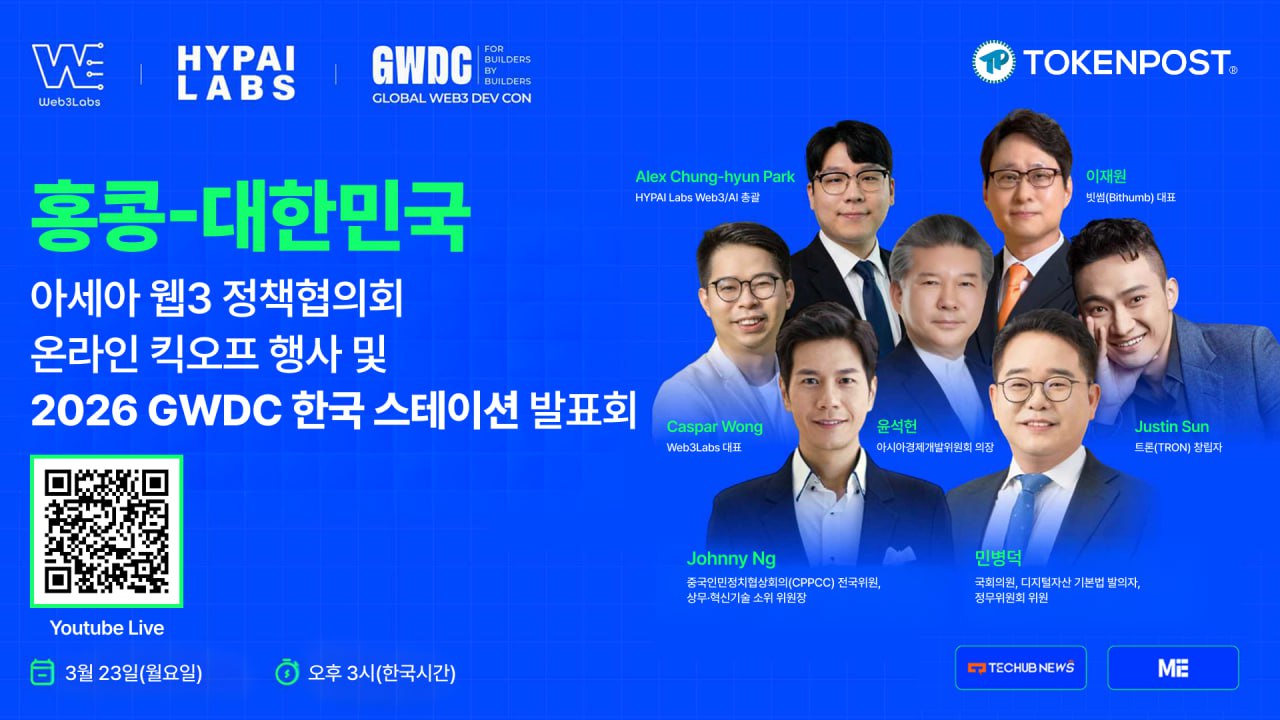
A new Hong Kong–Korea policy coordination network aimed at accelerating regional Web3 collaboration is set to formally launch on March 23, highlighting Asia’s growing push to align regulatory thinking with fast-moving blockchain innovation.
HYPAI Labs, WebGA, and the Global Web3 Developer Conference (GWDC) said on March 19 that they will host an online kickoff event on Monday, March 23 at 3:00 p.m. Korea time (2:00 a.m. ET / 6:00 a.m. UTC). The program—titled the “Asia Web3 Policy Council Online Kickoff & 2026 GWDC Korea Station Announcement”—will be livestreamed via TokenPost’s YouTube channel with Chinese and English subtitles, along with an on-demand replay.
The initiative, described as a multilateral policy cooperation body, brings together lawmakers, public-sector leaders, and blockchain and digital-asset specialists from both Hong Kong and South Korea. Organizers said the council’s broader ambition is to strengthen ties beyond Northeast Asia, building channels of cooperation with Web3-forward jurisdictions across Asia, the Middle East, and Africa—an implicit recognition that digital-asset markets are increasingly shaped by cross-border 'regulatory interoperability' rather than isolated national rulemaking.
Scheduled speakers include Johnny Ng, a national committee member of the Chinese People’s Political Consultative Conference (CPPCC) and chair of its commerce and innovation technology subcommittee; South Korean lawmaker Min Byung-deok, who is credited by organizers as having proposed a framework bill for digital assets; Suk-hun Yoon, chair of the Asia Economy Development Committee; WebGA CEO Caspar Wong; HYPAI Labs CEO Alex Chung-hyun Park; TRON founder Justin Sun; and Bithumb CEO Lee Jae-won.
The agenda runs until 4:20 p.m. Korea time (3:20 a.m. ET / 7:20 a.m. UTC), beginning with opening remarks and moving into Hong Kong–Korea policy cooperation statements from Ng and Min. That will be followed by a HYPAI Labs keynote, GWDC’s Korea launch presentation, a TRON network keynote, and a closing keynote from Bithumb.
The centerpiece announcement is the confirmation that GWDC will establish a “Korea Station” for its 2026 edition. GWDC positions itself as an international conference designed to connect Web3 developers and policymakers, and organizers argue that bringing a major node of the event to South Korea could help elevate the country’s profile as a regional hub for builders, capital, and policy dialogue. Market participants will be watching whether the initiative translates into concrete outcomes—such as clearer guidance on token issuance, exchange oversight, and custody standards—at a time when global firms are reassessing where to base operations and developer communities amid shifting enforcement and licensing regimes.
On the media side, TokenPost will serve as the exclusive domestic partner in South Korea, while Hong Kong-based Techub News will participate as a cooperating media outlet. The two organizations previously signed a strategic partnership following DePIN Expo 2025 held at Hong Kong’s Cyberport in August 2025, agreeing to collaborate on content exchange and co-hosted events.
The kickoff event will be broadcast live on TokenPost’s YouTube channel, offering a first look at how the new council plans to shape 'policy coordination' narratives between Hong Kong and Seoul—and whether it can turn high-level dialogue into a sustained pipeline of standards, pilot programs, and cross-border industry engagement.
🔎 Market Interpretation
- Asia is moving toward cross-border rule alignment: The Hong Kong–Korea “Asia Web3 Policy Council” signals growing emphasis on regulatory interoperability—making policy frameworks compatible across jurisdictions—rather than isolated national approaches.
- Policy signaling to attract builders and capital: Launching a formal coordination network and confirming “GWDC Korea Station” for 2026 is a reputational play aimed at positioning South Korea as a hub for Web3 development, investment, and compliant product launches.
- Regulatory clarity becomes a competitive variable: Markets will judge the council by whether it produces actionable guidance on token issuance, exchange oversight, and custody—areas that directly influence where global firms choose to base operations amid licensing and enforcement uncertainty.
- High-profile attendance increases narrative weight: Participation by policymakers and industry leaders (e.g., lawmakers, exchange executives, and protocol founders) increases perceived legitimacy, but also raises expectations for measurable follow-through.
- Media distribution expands regional reach: Livestreaming via TokenPost with multilingual subtitles and partnering with Hong Kong’s Techub News suggests a coordinated effort to shape public messaging and policy discourse across markets.
💡 Strategic Points
- Watch for concrete deliverables, not just dialogue: Key indicators include published joint statements, working groups, timelines for consultation, draft policy proposals, and announced pilot programs (e.g., compliant token offering processes or sandbox initiatives).
- Key policy topics to monitor post-kickoff:
- Token issuance standards: disclosure requirements, classification tests, and retail access rules.
- Exchange oversight: listing standards, market surveillance, stablecoin policies, and consumer protection mechanisms.
- Custody and asset segregation: proof-of-reserves expectations, third-party custody licensing, and insolvency protections.
- Cross-border compliance: harmonized KYC/AML expectations and shared approaches to licensing recognition.
- GWDC “Korea Station” is a talent-and-policy bridge: If executed well, it can serve as a recurring venue where developers, exchanges, protocols, and regulators converge—potentially accelerating standard-setting and ecosystem formation.
- For projects and firms: Consider aligning roadmap announcements (partnerships, pilots, compliance milestones) around the council/GWDC calendar to benefit from heightened policy attention—while ensuring jurisdiction-specific legal review.
- For investors: Track whether policy coordination reduces regulatory discount rates for regional exchanges, custodians, and infrastructure providers; lack of deliverables may limit near-term valuation impact.
- Event logistics and visibility: The March 23 online kickoff (TokenPost YouTube, multilingual subtitles, replay) makes it accessible for global stakeholders to benchmark the council’s tone, priorities, and seriousness.
📘 Glossary
- Web3: A broad term for blockchain-based internet services using tokens, smart contracts, and decentralized networks.
- Regulatory interoperability: The ability for different jurisdictions’ rules to work together, reducing friction for compliant cross-border operations.
- Digital-asset framework bill: A proposed comprehensive law that defines how cryptocurrencies/tokens and related businesses are regulated.
- Token issuance: The creation and distribution of a token (e.g., public sale, private sale, airdrop), often requiring disclosure and compliance considerations.
- Exchange oversight: Regulatory supervision of trading venues, including listing rules, custody practices, market manipulation controls, and consumer protections.
- Custody: The secure holding and management of digital assets on behalf of users or institutions, often requiring segregation and audit standards.
- Licensing regime: The set of legal approvals required to operate crypto-related services (exchange, brokerage, custody, payments) in a jurisdiction.
- GWDC (Global Web3 Developer Conference): An international event designed to connect Web3 developers with policymakers and industry participants.
- DePIN: Decentralized Physical Infrastructure Networks—blockchain-incentivized networks that coordinate real-world infrastructure (e.g., wireless, sensors, compute).















Comment 0