

 News
News  Coin Information
  About us
  Customer Service


 Add as a preferred source on Google

A widening wave of attacks targeting the Coldcard hardware wallet ecosystem is keeping the crypto security community on alert, with researchers warning that affected users could see funds drained if they delay protective steps. The reports come as major exchanges push deeper into traditional-asset derivatives, U.S. lawmakers face a narrowing window to advance a major crypto market-structure bill, and corporate Bitcoin treasuries grapple with drawdowns and liquidity decisions.
According to Chinese-language outlet BlockBeats, the Coldcard incident remains ongoing and is no longer limited to an original attacker set, with additional small-scale actors and copycats now believed to be participating. Details such as confirmed loss totals, precise attack vectors, and whether Coldcard’s maker has issued a formal incident response were not verified in the reports.
Still, the security warnings have grown more specific. Alex Thorn, head of research at Galaxy, reiterated concerns in a post cited by PANews on Aug. 2 UTC, arguing that certain Coldcard configurations face elevated risk and should be migrated immediately. Thorn singled out single-signature wallets using Coldcard firmware released after March 17, 2021 that did not harden seed generation via a 'dice roll' method and did not enable a 'passphrase'—an optional extra word layer that can protect a seed phrase if compromised.
Thorn added that while the risk set can be narrowed, users who did not create their seed with a high-entropy external source or sufficiently randomized dice-based entropy should consider exiting the Coldcard ecosystem entirely. He said attackers are continuing to scan for qualifying addresses and “empty” wallets that match the vulnerable conditions. Users with strong external randomness or robust dice-generated entropy may face comparatively lower risk, but Thorn urged those potentially affected not to wait for an attack before moving funds.
Separate reporting suggested the Coldcard warnings are spreading beyond the research community. U.Today said a contributor involved in Dogecoin (DOGE) development also urged Coldcard users to take urgent steps to protect funds, though the report did not specify the underlying risk details or the exact mitigation measures recommended.
In Washington, a claim circulating on X via Watcher.Guru said the U.S. Senate has five days left before the summer recess to pass the Crypto Clarity Act. The post did not provide bill text, a published voting calendar, or confirmation from congressional leadership, leaving the timetable uncertain. Even so, the chatter reflects the market’s sensitivity to U.S. legislative progress, particularly around jurisdictional lines between regulators and rules for spot market oversight.
On the corporate side, Trump Media & Technology Group ($DJT) drew attention after reports alleged it sold 2,628 Bitcoin (BTC), realizing an estimated $145 million loss, with proceeds tallied at about $165.07 million. AmbCrypto also cited broader data suggesting aggregate unrealized losses among corporate Bitcoin holders have reached roughly $49 billion from 2025 peak levels, underscoring how treasury strategies can magnify balance-sheet volatility when BTC retraces.
Cointelegraph separately reported that Trump Media conducted additional BTC sales via Crypto.com, reducing its Bitcoin holdings to 4,261 BTC. The outlet said the company has sold a cumulative 7,281 BTC over the past seven months, though the precise timing and motivations for the transactions were not confirmed in the summary reports.
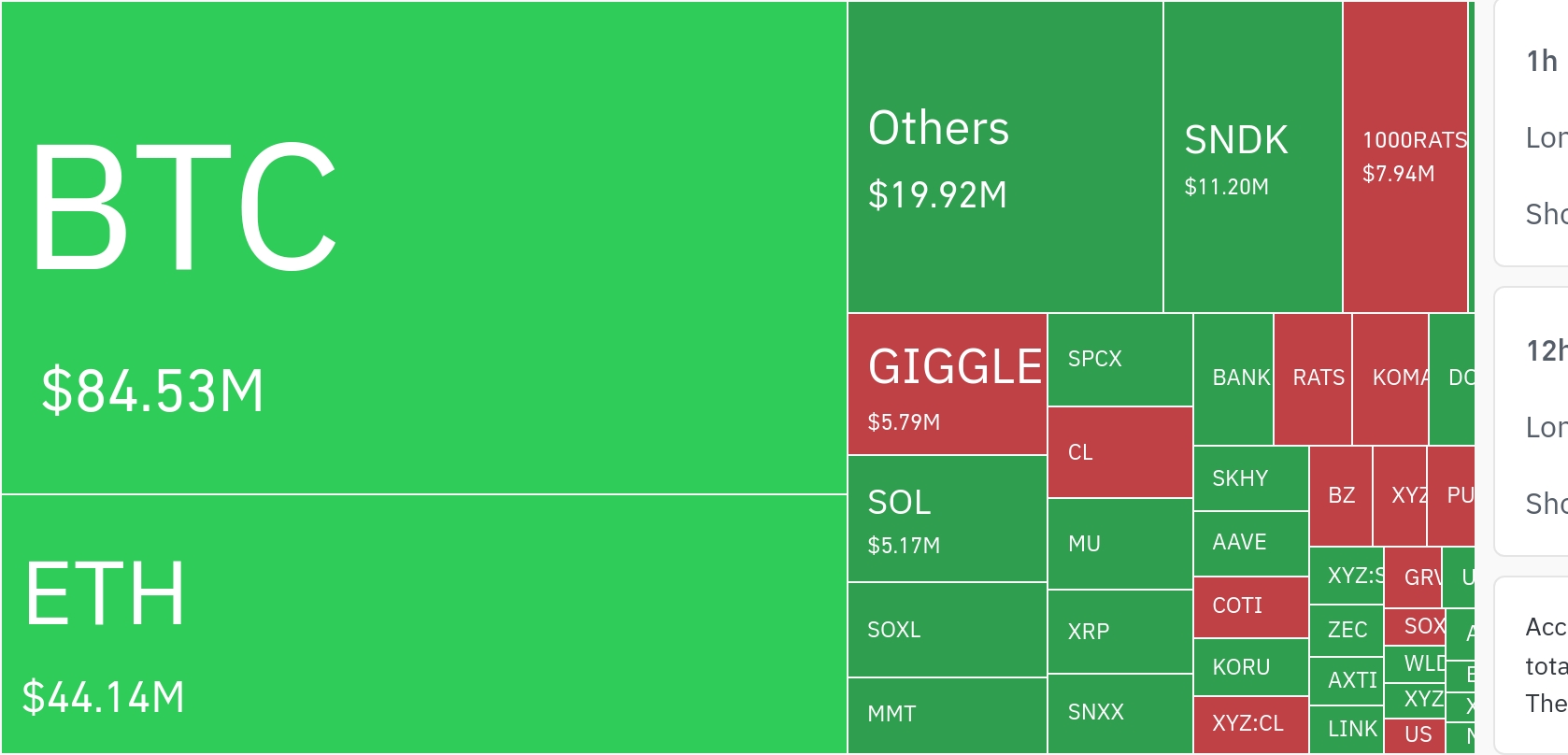
Market volatility also showed up in derivatives. Foresight News reported that roughly $330 million in crypto derivatives positions were liquidated over the past 24 hours, with long liquidations accounting for about $232 million—more than 70% of the total—while shorts made up the remaining roughly $98 million. Liquidations occur when exchanges forcibly close leveraged futures or margin positions due to insufficient collateral, often accelerating price moves during fast swings.
Meanwhile, CoinDesk highlighted the rapid expansion of non-crypto perpetual futures tied to traditional assets such as equities, equity indices, and commodities—products now being promoted by major crypto exchanges including Coinbase and Binance. Citing CoinGecko data, CoinDesk reported that trading volume in these traditional-asset-linked perpetuals reached about $1.32 trillion from January through May, already surpassing the full-year 2025 total of roughly $104.21 billion. Monthly volume, the report said, surged from about $230 million in January 2025 to about $347.17 billion by May 2026.
The trend is increasingly described as 'reverse bridging': while Wall Street capital previously entered crypto via ETFs, custody, and fund wrappers, crypto-native platforms are now pulling traditional market exposure into an around-the-clock, exchange-based derivatives format. CoinDesk said platforms are racing toward an 'everything exchange' model—integrating crypto, stocks, and derivatives within a single account structure, with some exploration of using tokenized stock positions as collateral. Large funds, however, remain cautious about relying on decentralized venues for this exposure.
In earnings, CryptoPotato reported that Strategy posted an $8.2 billion loss in the second quarter even as it continued increasing its Bitcoin holdings and reducing outstanding convertible debt. The same report noted Coinbase ($COIN) revenue fell 19%, reflecting a quarter where corporate treasury volatility and exchange-business cyclicality were both on display. The summaries did not provide full detail on the drivers behind Strategy’s quarterly loss or the specific mix shifts contributing to Coinbase’s revenue decline.
Across these developments, the common thread is risk management—whether it is operational security for self-custody, leverage discipline in derivatives markets, or governance and liquidity decisions for firms treating BTC as a treasury asset. With attackers reportedly persisting in targeting vulnerable wallet setups and exchanges blurring the lines between crypto and traditional markets, the industry’s next phase may be defined as much by infrastructure resilience as by price direction.
🔎 Market Interpretation
{
"market_interpretation": [
{
"theme": "Coldcard wallet-risk narrative is escalating",
"what_it_means": "Reports suggest attacks and copycats are actively targeting specific Coldcard setup patterns, shifting the story from theoretical vulnerability to ongoing adversarial scanning and potential real-time fund loss.",
"impact": "Heightened self-custody risk premium; users may rotate keys/devices, increasing on-chain movement and support burden across wallets/exchanges."
},
{
"theme": "Policy timing uncertainty still moves sentiment",
"what_it_means": "Unverified claims about a tight U.S. Senate window for a market-structure bill reflect how traders price regulatory momentum even without confirmed schedules.",
"impact": "Short-term volatility risk around headlines; longer-term focus remains on regulator jurisdiction and spot-market oversight rules."
},
{
"theme": "Corporate BTC treasuries face liquidity and drawdown stress",
"what_it_means": "Reported BTC sales and large unrealized losses highlight the tension between holding BTC for strategic exposure and managing cash needs, debt, and shareholder optics.",
"impact": "Potential incremental sell pressure during drawdowns; increased scrutiny of treasury leverage, custody, and liquidation planning."
},
{
"theme": "Leverage flushes remain a key volatility amplifier",
"what_it_means": "$330M in 24h liquidations (majority longs) suggests crowded positioning and fragile collateral buffers during fast price moves.",
"impact": "Cascade risk persists: liquidations can accelerate declines and widen spreads, especially when liquidity is thin."
},
{
"theme": "Exchanges are racing toward an 'everything exchange'",
"what_it_means": "Crypto venues are expanding perpetual futures into equities/indices/commodities ("reverse bridging"), importing traditional exposure into 24/7 derivatives infrastructure.",
"impact": "Competitive pressure on brokers and crypto peers; introduces new cross-market risk (correlation spikes, collateral policy, market-hours mismatch)."
}
]
}
💡 Strategic Points
{
"strategic_points": [
{
"audience": "Coldcard / self-custody users",
"priority": "Immediate",
"actions": [
"Identify whether you used a single-signature Coldcard wallet with firmware released after 2021-03-17.",
"If your seed was not generated with strong external entropy (e.g., robust dice-roll process) and you did not enable a BIP39 passphrase, treat the setup as high-risk and migrate funds.",
"Move funds to a newly generated seed created with verifiable high entropy; consider a fresh device/vendor and review the full setup process end-to-end.",
"Do not wait for proof of compromise—attackers are reportedly scanning for addresses that match vulnerable conditions.",
"After migration, rotate addresses and review any watch-only or exported xpub/xprv handling that could have widened exposure."
],
"risk_note": "The article cites third-party reporting with unverified totals/vectors; the recommended posture is precautionary key rotation for potentially affected configurations."
},
{
"audience": "Traders / risk managers",
"priority": "Near-term",
"actions": [
"De-lever or tighten margin buffers during high liquidation regimes; assume liquidation cascades can extend beyond initial triggers.",
"Stress test positions for gap moves and slippage (especially weekends/low-liquidity periods).",
"Monitor long/short liquidation imbalance as a sentiment and positioning indicator rather than a standalone signal."
]
},
{
"audience": "Corporate treasuries holding BTC",
"priority": "Ongoing",
"actions": [
"Formalize liquidity ladders: define what must be sold, when, and under what drawdown thresholds.",
"Separate strategic BTC allocation from operational cash needs; avoid forced selling driven by short-term liabilities.",
"Disclose custody, execution venues, and authorization controls clearly to reduce governance uncertainty.",
"Model balance-sheet volatility under multiple BTC retracement scenarios; align debt policy (e.g., convertibles) with downside tolerance."
]
},
{
"audience": "Exchange and product strategists",
"priority": "Mid-term",
"actions": [
"If offering traditional-asset perpetuals, strengthen risk controls: index integrity, funding-rate design, and market-disruption rules.",
"Define collateral policy carefully if tokenized stocks are used as margin (haircuts, liquidity, correlation, redemption risk).",
"Plan for regulatory fragmentation: traditional-asset derivatives may pull in additional licensing, surveillance, and reporting expectations."
]
},
{
"audience": "Policy watchers / investors",
"priority": "Event-driven",
"actions": [
"Treat viral legislative countdown claims as unconfirmed until supported by official calendars and bill text.",
"Track the substance: regulator jurisdiction boundaries and spot market oversight mechanisms tend to be more price-relevant than timing rumors."
]
}
]
}
📘 Glossary
{
"glossary": [
{
"term": "Coldcard",
"definition": "A popular Bitcoin-focused hardware wallet; here, referenced in connection with reports of ongoing attacker activity targeting certain user configurations."
},
{
"term": "Single-signature (singlesig) wallet",
"definition": "A wallet where one private key can authorize spending; simpler but offers less redundancy than multisig."
},
{
"term": "Seed phrase (BIP39 seed)",
"definition": "A set of words that encodes the master secret for generating wallet keys; whoever has it can control the funds."
},
{
"term": "Entropy",
"definition": "Randomness used during seed generation; higher entropy reduces brute-force or prediction risk."
},
{
"term": "Dice-roll seed generation",
"definition": "A method of adding user-generated randomness (e.g., rolling dice) to improve entropy during seed creation."
},
{
"term": "Passphrase (BIP39 passphrase)",
"definition": "An optional extra secret appended to a seed phrase that creates a different wallet; can protect funds even if the seed words are exposed."
},
{
"term": "Address scanning",
"definition": "An attacker technique of monitoring blockchain addresses for patterns or conditions that suggest vulnerability, then attempting to exploit them."
},
{
"term": "Perpetual futures (perps)",
"definition": "A derivative contract with no expiry date that uses funding payments to keep its price near the underlying reference index."
},
{
"term": "Liquidation",
"definition": "Forced closure of a leveraged position when collateral is insufficient, often accelerating market moves during volatility."
},
{
"term": "Reverse bridging",
"definition": "A trend where crypto platforms bring traditional-asset exposure (stocks/indices/commodities) onto crypto-style 24/7 derivatives venues."
},
{
"term": "Everything exchange",
"definition": "A platform strategy aiming to offer multiple asset classes (crypto + traditional assets) and derivatives within a unified account and collateral system."
},
{
"term": "Corporate Bitcoin treasury",
"definition": "A corporate strategy of holding BTC on the balance sheet as a reserve or investment, introducing material volatility to financial statements."
}
]
}


















Comment 0