

 News
News  Coin Information
  About us
  Customer Service


 Add as a preferred source on Google
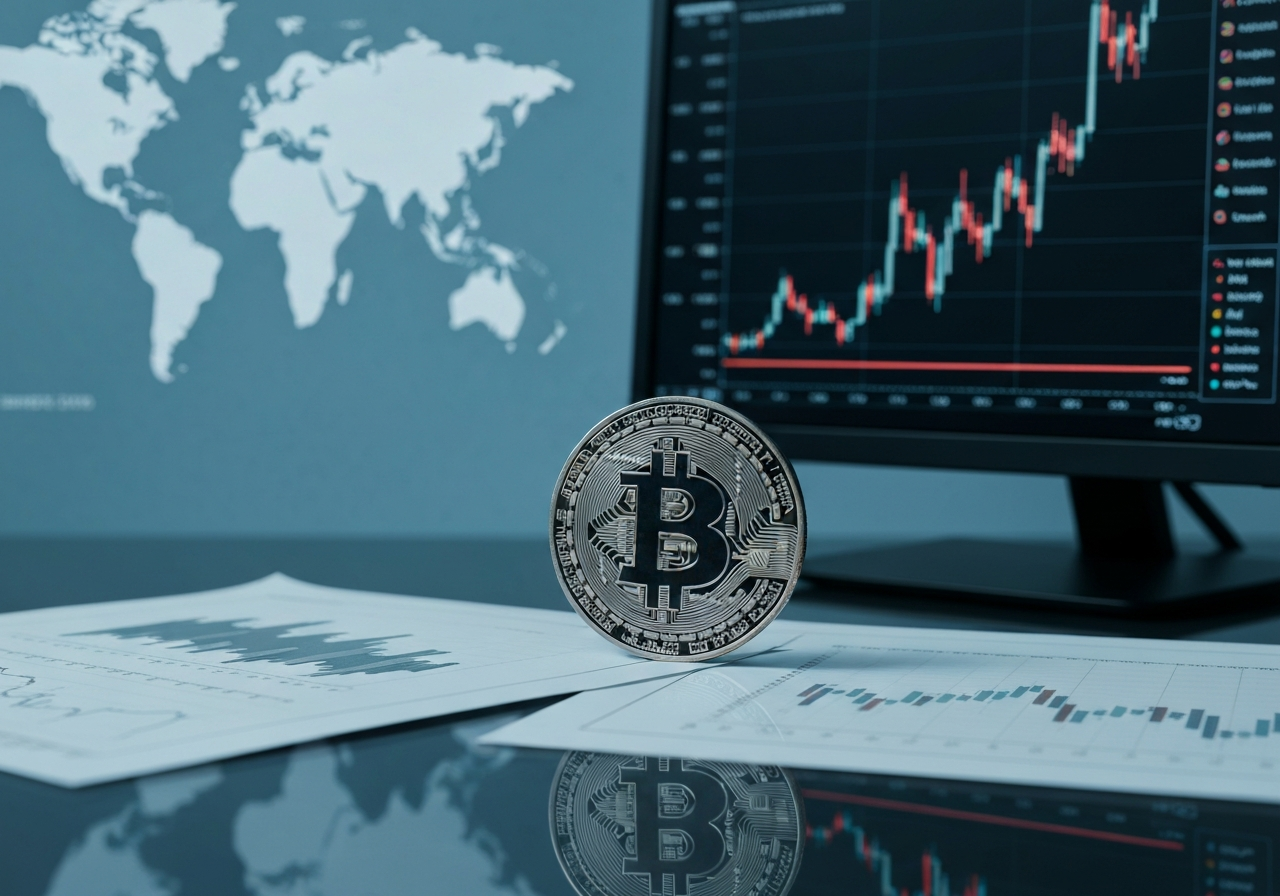
Global markets in 2026 are being driven less by any single theme—interest rates, oil, or artificial intelligence—and more by one pervasive condition: 'uncertainty'. For investors across equities, bonds, commodities, and crypto, the challenge is no longer predicting the next headline, but building the resilience to withstand a steady sequence of shocks.
The list of market-moving variables has become unusually long and unusually intertwined. Traders are juggling the path of U.S. monetary policy, Middle East tensions and security around the Strait of Hormuz, tariff disputes, volatile energy pricing, an AI investment boom, rising cyber risk, and climate-related disruptions. Before markets can fully digest one catalyst, another arrives—creating an environment where whipsaw price action is increasingly routine.
Recent moves in U.S. Treasury yields illustrate the feedback loop. Yields climbed as investors revisited the possibility that inflation could re-accelerate and force the Federal Reserve to maintain tight conditions for longer. Yet the rise in market rates is not a straightforward 'hawkish signal'. If financial conditions tighten through higher yields and a stronger dollar, the Fed may feel less pressure to raise policy rates further. Expectations are moving markets, and markets are reshaping expectations—leaving investors less confident about direction than about the path and volatility along the way.
Energy markets remain similarly fragile. Even if crude prices ease temporarily on signs of negotiation over shipping conditions near the Strait of Hormuz, the underlying risk premium has not disappeared. Analysts increasingly focus not only on benchmark crude but on 'real-economy supply chains' tied to diesel, marine fuel, and natural gas—inputs that transmit quickly into transportation costs, industrial production, and consumer inflation.
With refined product constraints still a concern and Europe facing seasonal demand swings, renewed inflation pressure cannot be ruled out. That matters because it directly narrows central banks’ room to cut. The mechanism is familiar but newly sensitive: geopolitical flare-ups lift energy prices, energy feeds inflation, and inflation reverberates through rates, FX, equities, and ultimately risk assets—including crypto.
South Korean equities have also reflected this global cross-current, with sharp swings driven less by sudden changes in corporate fundamentals and more by shifts in global capital. Moves in U.S. yields, AI investment expectations, semiconductor sentiment, and foreign inflows have combined to amplify volatility, underscoring how quickly confidence and positioning can dominate short-term pricing.
In the crypto market, these dynamics often play out faster. Bitcoin (BTC) and major digital assets are not insulated from global 'liquidity conditions', U.S. Treasury yields, or the dollar’s trend. While crypto narratives can be idiosyncratic, the asset class still trades as part of a broader risk complex whenever macro uncertainty rises.
What matters most, however, is not the daily percentage change in asset prices but the growing reality that uncertainty itself is now a macro force. When companies cannot forecast demand or policy direction, they delay investment. When households feel insecurity around jobs and income, they pull back on spending. When volatility increases, investors lean toward cash and short-duration positioning. Research from the European Central Bank has repeatedly found that uncertainty shocks can depress corporate capex and durable goods consumption—channels that ultimately feed back into growth and earnings expectations.
Markets do adapt. Repeated cycles of conflict headlines, tariff threats, and financial volatility tend to dull the initial fear response. Risk assets sell off on a geopolitical jolt, then rebound when the situation fails to deteriorate further. Trade tensions escalate in rhetoric, then expectations of talks revive dip-buying. This pattern has become familiar enough to shape behavior, sometimes to the point of complacency.
That adaptation carries its own danger: the assumption that the next episode will end like the last one. The fact that a previous conflict did not broaden does not guarantee the next won’t. The fact that a past tariff dispute cooled through negotiation does not ensure the same resolution ahead. Even AI investment—widely framed as a productivity revolution—could still produce bouts of overcapacity, misallocation, and the hangover of elevated asset prices if expectations outrun real economic gains.
Against that backdrop, both fear and unearned optimism can be destabilizing. A surge in sentiment can lift consumption and risk-taking in the short run, but positive vibes cannot substitute for productivity or competitive strength. High valuations do not automatically translate into industrial resilience.
The editorial conclusion is a call to return to fundamentals: improve productivity, stabilize energy and logistics, and convert innovation into durable competitiveness. Just as importantly, policymakers must strengthen 'predictability' so businesses can plan long-term investment with fewer sudden rule changes.
The crypto industry should be evaluated by the same standard. Rising Bitcoin prices or expanding token market capitalization may signal growth, but they are incomplete metrics for the sector’s underlying 'stamina'. Without real-world usage, defensible technology, sustainable business models, and institutional trust—particularly in regulation, custody, and market infrastructure—price gains alone cannot prove that the industry is becoming structurally stronger.
For market observers, the implication is to look beyond performance tables and ask deeper questions: why global capital is moving, where risks are accumulating, and through what channels shifts in rates, energy, geopolitics, and AI investment flow into Korean markets and crypto. In an era when traditional finance and digital assets increasingly trade on shared macro drivers, it is harder—and less useful—to analyze them in isolation.
Ultimately, the goal is not to eliminate uncertainty, but to build systems that can endure it. Governments are urged to prioritize industrial competitiveness, energy and supply-chain stability, and policy credibility over short-term stimulus or sentiment management. Companies should stress-test their assumptions, focusing on productivity, cash flow, and supply-chain durability rather than counting on prolonged easy money. And investors should be cautious about relying solely on the well-worn belief that 'it will bounce back again'.
If uncertainty is the new normal, the definition of competitiveness changes. What matters is not how quickly assets rise in favorable conditions, but how well economies, industries, and portfolios hold up when the next shock arrives. Market prices can move fast on expectations; economic and industrial resilience takes far longer to build.
🔎 Market Interpretation
- Uncertainty becomes the primary macro driver (2026): Markets are reacting less to one dominant theme (rates, oil, AI) and more to a persistent, overlapping set of shocks—making volatility itself the defining condition across equities, bonds, commodities, and crypto.
- Reflexive loop between rates and expectations: Rising U.S. Treasury yields reflect renewed inflation fears, but tighter financial conditions (higher yields/stronger USD) can reduce the Fed’s need to hike further. Outcomes are increasingly shaped by market expectations → financial conditions → policy expectations.
- Energy risk premium is “sticky”: Even if oil dips on temporary de-escalation near the Strait of Hormuz, supply-chain-sensitive inputs (diesel, marine fuel, natural gas) can quickly transmit into transportation costs and headline inflation, limiting central banks’ room to cut.
- Cross-asset contagion is faster and broader: Korean equities and crypto are portrayed as downstream receivers of global macro impulses—U.S. yields, USD strength, AI/semiconductor sentiment, geopolitics, and foreign flows—leading to sharp swings not fully explained by domestic fundamentals.
- Crypto remains a “risk-complex” asset under stress: Despite idiosyncratic narratives, Bitcoin and major digital assets tend to trade with global liquidity conditions; when macro uncertainty rises, correlations with broader risk assets reappear.
- Real-economy uncertainty shock channel: Uncertainty depresses corporate capex and durable goods consumption (citing ECB research), which then feeds back into growth, earnings expectations, and risk appetite—turning uncertainty into a self-reinforcing macro force.
- Adaptation can drift into complacency: Repeated cycles of selloff-then-rebound have trained markets to “buy the dip,” but the article warns that assuming every shock resolves like the last one increases tail-risk exposure.
💡 Strategic Points
- Shift from forecasting to resilience building: Prioritize portfolio and business structures that can withstand frequent shocks (rates, energy, geopolitics, cyber, climate) rather than relying on correct headline prediction.
- Watch the transmission channels, not single indicators: Track how energy → inflation → rates/FX → equities/credit → crypto propagates. The key is the sequence and speed of spillovers, not any one asset’s move.
- Manage duration and liquidity explicitly: In whipsaw conditions, cash buffers and short-duration exposure can reduce forced selling risk when yields spike and liquidity tightens.
- Treat “risk premium” as persistent in geopolitically sensitive assets: Temporary easing in headlines (e.g., shipping lanes) may not erase embedded premiums in refined products and logistics-linked costs; incorporate scenarios where inflation re-accelerates.
- Interpret AI as both growth driver and valuation risk: AI investment can lift productivity expectations, but the article flags the possibility of overcapacity/misallocation and a valuation “hangover” if expectations outrun realized gains.
- For Korea-focused investors: Separate fundamental earnings from flow-driven volatility; monitor foreign inflows, U.S. yield levels, and semiconductor/A I sentiment as primary short-term price engines.
- For crypto allocation decisions: Evaluate “stamina,” not just price—look for real-world usage, defensible tech, sustainable business models, and institutional trust (regulation, custody, market infrastructure). Bull markets alone are not proof of structural strengthening.
- Policy implication highlighted by the editorial: Competitiveness improves via productivity, stable energy/logistics, and policy predictability—reducing uncertainty shocks that deter long-term investment.
- Risk discipline: Avoid strategies built on the assumption “it will bounce back again.” Stress-test for non-linear outcomes: broader conflict, persistent inflation, tighter liquidity, or abrupt regime shifts in trade policy.
📘 Glossary
- Uncertainty shock: A rise in unpredictability about policy, geopolitics, or demand that causes firms to delay investment and households to reduce spending, weighing on growth.
- Financial conditions: The effective tightness/looseness of money in the economy, influenced by yields, credit spreads, equity prices, and the dollar—not just the policy rate.
- Risk premium: Extra return demanded by investors to hold an asset exposed to heightened risk (e.g., geopolitical supply disruption in oil).
- Refined products: Fuels like diesel and marine fuel derived from crude oil; often more directly tied to real-economy costs than headline crude benchmarks.
- Strait of Hormuz: A critical shipping chokepoint for global oil flows; disruptions can quickly affect energy prices and inflation expectations.
- Whipsaw: Rapid reversals in price direction that can cause losses for trend-following or over-leveraged positioning.
- Duration (bond duration): Sensitivity of bond prices to interest rate changes; higher duration means larger price moves when yields change.
- Liquidity conditions: The ease with which capital flows and trades clear; often tightens when yields rise, the dollar strengthens, or risk aversion increases—impacting crypto and equities.
- Capex: Corporate capital expenditures on long-lived assets (plants, equipment, software); tends to fall when uncertainty rises.
- Macro drivers: Economy-wide forces (rates, inflation, FX, energy, geopolitics) that shape multiple asset classes simultaneously.
- Institutional trust (crypto context): Confidence in regulation, custody, compliance, and market infrastructure that enables large-scale participation beyond speculative trading.













Comment 0