South Korea Shifts Crypto Policy Focus to Stablecoins and Tokenized Markets
South Korean lawmakers and industry leaders at a Seoul symposium highlighted stablecoins as core financial infrastructure while advancing plans for a Digital Asset Basic Act and tokenized markets.


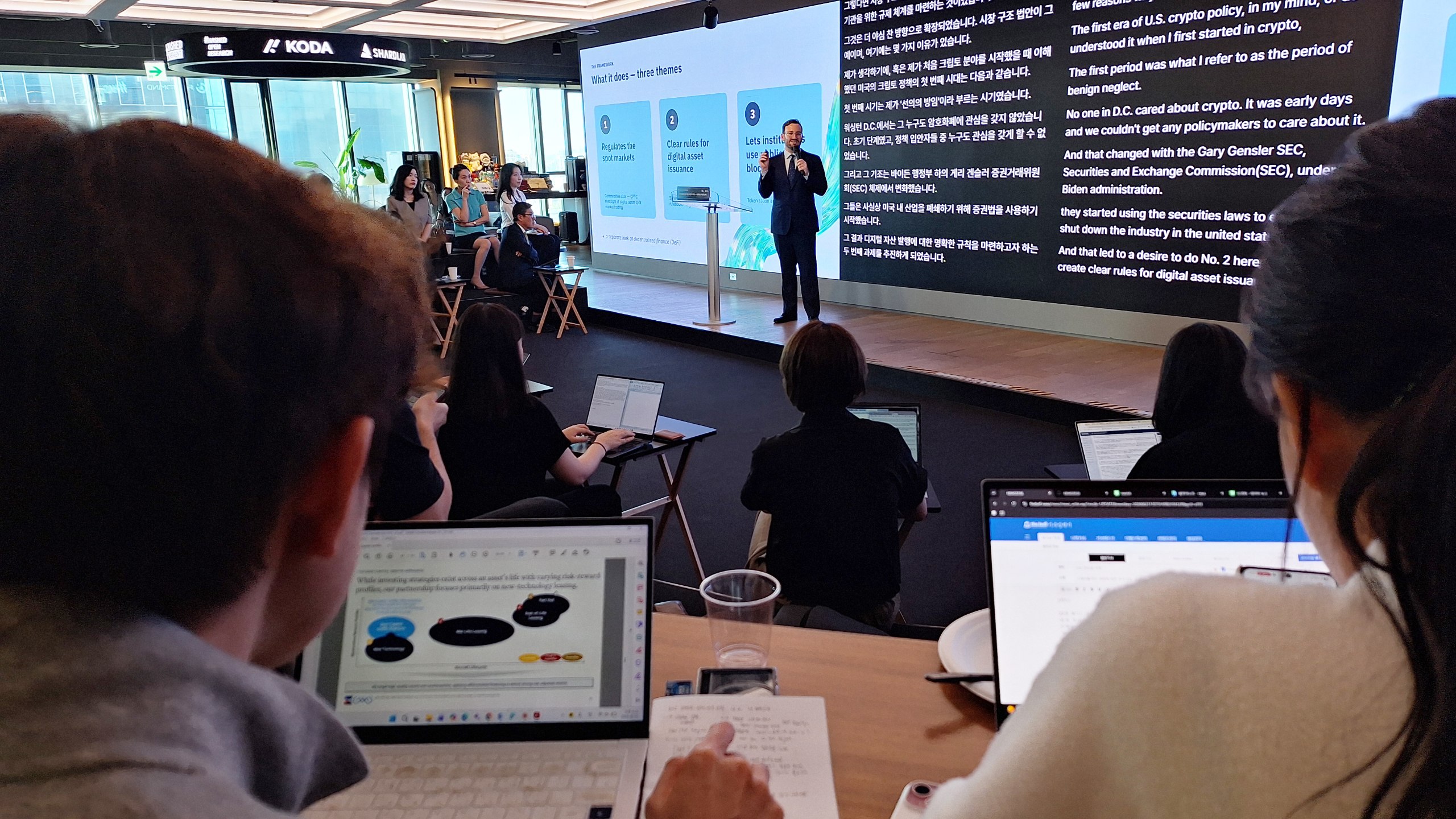
South Korea’s digital asset debate is no longer centered on how to fence off risk—it is increasingly about how to design the next financial infrastructure. At a policy symposium in Seoul on Monday ET, lawmakers, exchange executives, blockchain builders, legal experts, and regulators converged around a shared premise: 'stablecoins' may be the entry point, but the real contest is over who builds the rails for tokenized capital markets and an AI-driven economy.
The event, titled “Policy Symposium Toward Korea as a Digital G2: The Future of Digital Assets and Capital Markets—Choices of the U.S. and Korea,” was held in Seoul’s Yeoksam district at Hashed Lounge, a venue closely associated with Korea’s crypto venture ecosystem. While the agenda included familiar topics—stablecoin regulation and a comprehensive Digital Asset Basic Act—the conversation repeatedly moved upstream into larger questions: the architecture of redemption and reserve custody, how real-world asset tokenization (RWA) and tokenized securities (STO) will connect to existing market plumbing, and what happens when AI agents become economic actors that transact and settle around the clock.
Just a few years ago, the policy soundtrack in Seoul was dominated by 'containment' and 'investor protection'—a predictable response to the Terra–Luna collapse and the FTX failure. Those priorities remain, but speakers and attendees framed them less as a brake on innovation and more as a baseline requirement for opening new markets. The practical questions have changed: Who is permitted to issue? What qualifies as reserves? How is par redemption enforced, even in insolvency? And who can legally offer payment and settlement services when banking, securities, e-money, and virtual-asset rules overlap?
At the center of the day’s political messaging was Rep. Ahn Do-geol of the Democratic Party, who argued that stablecoins should be treated as 'monetary infrastructure' rather than a niche investment product. In his remarks, Ahn positioned stablecoins as an engine for future finance and the real economy—citing potential use cases ranging from cross-border remittances and migrant worker transfers to payments tied to Korea’s global content exports, tourism spending, and corporate settlement.
The pitch was not simply faster transfers. Ahn emphasized the broader shift enabled by blockchain-based value transfer: payments, clearing, FX conversion, and even changes in ownership can be linked within a single digital network capable of continuous operation. In that framing, stablecoins are not an add-on service atop legacy rails; they are a bid to redraw the rails themselves.
Ahn also tied the debate to what several speakers described as an emerging 'AI agent economy'—a world in which software agents gather information, compare products, negotiate terms, and execute contracts and payments with limited human involvement. Unlike traditional finance, which is shaped by operating hours, intermediaries, and layered identity verification, AI-driven commerce is expected to be high-frequency, cross-border, and often low-value per transaction. That environment, proponents argued, increases demand for programmable money that can settle 24/7—boosting the strategic significance of stablecoins as machine-to-machine payment instruments.
Legislatively, Ahn said the Democratic Party’s digital asset task force has largely completed work to consolidate related bills, underscoring a push to pass a Digital Asset Basic Act in the second half of 2026. He also signaled willingness to break political gridlock to keep the legislative calendar moving—an indication that the party views the framework not as a conceptual debate but as flagship industrial legislation.
Policy discussions also surfaced more concrete design parameters for a won-pegged stablecoin regime. One idea raised at the symposium was to set a minimum issuer capital threshold around 5 billion won (roughly $3.6 million) and require reserves proportional to the amount issued. Beyond capital, however, multiple speakers stressed that market confidence will hinge on the details of reserve composition, segregation, and enforceable redemption rights—questions that will determine whether a stablecoin functions as credible cash-equivalent infrastructure or merely a token with marketing.
In one proposed compromise model, banks would shoulder reserve custody and safety-net functions while fintech firms drive product design and service innovation. A notable concept discussed was ensuring fintech participation through equity and governance rights—potentially including a stake large enough to provide a blocking position on special resolutions—reflecting an effort to avoid a system that is bank-only by default.
Yet the symposium’s most pointed warnings focused on the mechanics of failure, not just success. Participants highlighted the need to specify whether reserves consist of cash, bank deposits, or short-term government securities; how reserves are legally separated from the issuer’s own assets; who receives reserve yield; and how users’ claims are handled if an issuer becomes insolvent. Several speakers argued that stablecoin trust cannot be manufactured by blockchain alone—it requires legal constraints that prevent misuse of reserves and guarantee redemption at par under clearly defined conditions.
Underlying the won-stablecoin push is a broader sovereignty concern. If dollar-based stablecoins become the default medium for domestic digital payments, crypto trading, and online consumption—particularly in content—Korea could find its digital economy increasingly routed through dollar settlement networks. In that context, a won-based stablecoin is being framed as both an industrial opportunity and a defensive tool to preserve and extend the won’s role in digital commerce.
Hashed Open Research researcher Esther Kim widened the lens further, arguing that national competitiveness in the digital era depends less on territory or population and more on whether a country becomes a platform chosen by global capital and talent. Pointing to Singapore and the United Arab Emirates, Kim said clear rules, workable licensing, predictable taxation, and talent-friendly policies can matter more than domestic market size. In her telling, “law and regulation” function as a platform’s operating system—countries with ambiguity and slow approvals risk pushing entrepreneurs offshore.
Kim argued Korea already has ingredients that many jurisdictions lack at the same time: advanced manufacturing, world-class connectivity, and globally exportable IP via K-content and gaming. The strategic opportunity, she suggested, is to connect AI agents, robotics and 'physical AI', cultural exports, and digital assets into a reinforcing loop—one that could support a “Digital G2” narrative if executed with speed and clarity. Notably, she presented digital assets less as a standalone sector and more as a liquidity layer connecting industries—where tokenized rights and assets are settled via stablecoins across borders.
A U.S. perspective came from Miller Whitehouse-Levine, head of the Solana Policy Institute, who contrasted American regulatory debates with Korea’s historically more liability-first approach. He pointed to two bills discussed in Washington—the CLARITY Act and the GENIUS Act—as signals that the U.S. is attempting to map which assets and networks belong under securities, commodities, or payment rules, rather than treating all crypto as a single category to be constrained.
Whitehouse-Levine emphasized a theme familiar in U.S. policy circles: early-stage projects with concentrated control may warrant heavier disclosure and investor protections, while networks that become sufficiently decentralized could see regulatory burdens adjust accordingly. He cited criteria lawmakers and regulators have explored for assessing decentralization—openness, permissionlessness, distribution of control, autonomy, and economic independence—aimed at transforming decentralization from a slogan into testable standards. The practical question, he argued, is not what a project calls itself, but who actually holds the power to halt transactions, change the ledger, or run the protocol via privileged keys.
That framework also spilled into DeFi: if a protocol does not custody customer assets or exercise discretionary control like an intermediary, what is the appropriate regulatory treatment? Speakers acknowledged the flip side: “decentralized” branding cannot be a shield if control remains centralized in practice.
For market participants, however, the most urgent issue was simpler: what will they be allowed to do after the law passes? Attorney Hyo-bong Kim, a partner at Bae, Kim & Lee, argued that Korea’s legislative success will ultimately be measured by licensing clarity—defining which entities can issue, broker, custody, transfer, and settle digital assets, and under what combinations.
The problem is structural. Digital asset businesses often bundle activities—issuance, exchange, brokerage, custody, transfer, and payments—into a single user experience. Korea’s existing financial statutes, by contrast, divide permissions across banking, investment, e-money, and virtual-asset service provider regimes. That mismatch creates uncertainty over whether firms will need one license, multiple approvals, or consortia with incumbent financial groups.
Stablecoin payments could become the clearest example of a 'dual license' dilemma: processing a payment request may fall under e-finance rules, but holding, transferring, or exchanging stablecoins in settlement could trigger digital-asset business regulations. Without detailed enforcement decrees and supervisory standards—covering reserve eligibility, segregation requirements, audit rules, and licensing criteria—companies may struggle to finalize budgets, staffing, and go-to-market plans for 2027, participants warned.
Debate over STOs sharpened the same point: tokenization’s value is not guaranteed by putting new, illiquid assets on-chain. Kim criticized Korea’s tendency to prioritize fractionalized exposures to art, cattle, real estate, and IP-linked contracts—assets that may still suffer from limited demand and hard-to-verify pricing even after tokenization. By contrast, the more transformational use case seen in parts of the U.S. and Europe is bringing 'standardized securities'—stocks, bonds, funds, money-market funds, and government debt—onto blockchain rails to expand trading hours, shorten settlement cycles, automate corporate actions, and improve collateral mobility.
In that view, the core competitive battleground is not the token itself but the 'distribution rail': the integrated system spanning issuance, disclosure, valuation, custody, trading venues, settlement, and redemption. Tokenized markets will only scale if investors can reliably verify underlying assets and enforce legal rights—while also accessing deep secondary liquidity.
By the end of the symposium, “stablecoin” was the most repeated word. But the theme that lingered was 'design'. Korea’s policy debate appears to be moving from whether to permit digital assets to how to allocate responsibility, define rules, and build infrastructure that can support both safety and innovation. Speakers repeatedly warned against two extremes: an overly closed issuance model that entrenches bank-led oligopoly, and an overly permissive regime that invites weak reserves and redemption failures that would ultimately be borne by users.
The broader implication is that Korea’s next steps will influence where value is created in the digital economy. If regulation and infrastructure arrive too slowly, capital, builders, and IP could migrate to jurisdictions with clearer pathways—while dollar stablecoins and foreign platforms become default standards in payments and tokenized finance. If the framework is built well, proponents argued, stablecoins, RWA, STOs, and AI-agent commerce could become a new growth axis that complements Korea’s strengths in manufacturing and content exports.
What the symposium made clear is that the policy clock is already ticking. The question for Korea is not whether digital assets will reshape finance, but whether the country will help write the rules and build the rails—or operate primarily on systems designed elsewhere.
Article Summary by TokenPost.ai
🔎 Market Interpretation
Korea’s crypto policy is shifting from “risk containment” to “infrastructure design.” Stablecoins are discussed less as speculative assets and more as foundational rails for payments, settlement, FX, and tokenized capital markets.
Won-pegged stablecoins are framed as financial sovereignty tools. Policymakers warn that if dollar stablecoins dominate domestic digital commerce (payments, trading, content), Korea’s digital economy could default to dollar settlement networks.
Stablecoins are positioned as the transaction layer for an “AI agent economy.” Always-on, cross-border, low-ticket machine-to-machine commerce increases demand for programmable money with 24/7 settlement.
Regulatory competitiveness is treated as a platform strategy. Clear licensing, predictable tax, and fast approvals are portrayed as decisive for attracting global capital/talent—rather than domestic market size.
Real competition extends beyond tokens to “distribution rails.” Scalable tokenized markets require integrated issuance, disclosure, valuation, custody, trading, settlement, and enforceable legal rights—plus deep secondary liquidity.
💡 Strategic Points
Legislative timeline signal: Ahn Do-geol indicates consolidation work is largely complete, targeting passage of a Digital Asset Basic Act in H2 2026; firms should plan now for 2027 commercialization scenarios (budgets, staffing, partnerships).
Issuer entry conditions under debate: A proposed won-stablecoin model includes a minimum capital threshold (~5B won) and reserves proportional to issuance; the market’s trust will hinge on reserve quality and enforceable redemption, not just capital.
Reserve and redemption mechanics are the key risk controls: Policy design focuses on (1) eligible reserve assets (cash/deposits/T-bills), (2) legal segregation from issuer assets, (3) audit/attestation requirements, (4) par redemption enforceability, and (5) insolvency treatment (priority of user claims).
Bank–fintech compromise model: Banks may provide custody/safety-net functions while fintechs drive product innovation; proposals include equity and governance rights for fintechs (even potential blocking rights) to avoid a bank-only structure.
Licensing clarity becomes the success metric: Korea’s current regime splits permissions across banking/securities/e-money/VASP rules, while digital-asset products bundle issuance, exchange, brokerage, custody, transfer, and payments. The law must specify which activities require single vs multiple licenses and what combinations are allowed.
“Dual-license” stablecoin payments dilemma: Payment processing may fall under e-finance rules, but holding/transferring/exchanging stablecoins for settlement can trigger digital-asset business regulation—raising compliance cost and go-to-market uncertainty without detailed decrees.
STO/RWA focus: move from exotic fractional assets to standardized securities. The article criticizes tokenizing illiquid assets (art/cattle/real estate fragments) with weak price discovery; higher-impact tokenization targets stocks, bonds, funds, MMFs, and government debt to extend trading hours, shorten settlement, automate corporate actions, and improve collateral mobility.
Decentralization as a testable standard (U.S. lens): Referencing U.S. bills (CLARITY, GENIUS), speakers highlight criteria like openness, permissionlessness, distribution of control, autonomy, and economic independence—plus the practical question of who holds “keys” to halt/change the protocol.
Avoid two failure modes: (1) overly closed issuance → bank-led oligopoly and slow innovation; (2) overly permissive issuance → weak reserves, redemption failures, and consumer harm that backfires politically.
📘 Glossary
Stablecoin: A digital token designed to maintain a stable value (often pegged 1:1 to a fiat currency) through reserves and redemption mechanisms.
Won-pegged stablecoin: A stablecoin targeted to track the Korean won, intended for domestic digital payments/settlement and to reduce reliance on USD stablecoins.
Par redemption: The right to redeem a stablecoin for fiat at face value (e.g., 1 token = 1 won), including under stress events.
Reserve composition: The assets backing a stablecoin (cash, bank deposits, short-term government securities, etc.). Reserve quality determines liquidity and safety.
Reserve segregation: Legal/operational separation of reserve assets from the issuer’s own assets to protect users in bankruptcy.
Custody: Safekeeping and control of assets (reserves or user tokens), often with strict compliance and operational controls.
RWA (Real-World Asset) tokenization: Putting claims on physical or traditional financial assets on-chain to enable digital issuance, transfer, and settlement.
STO (Security Token Offering) / tokenized securities: Blockchain-based securities that represent regulated financial instruments (equity, debt, funds) with investor rights enforced by law.
Distribution rail: The end-to-end market infrastructure—issuance, disclosure, valuation, custody, trading venue, settlement, and redemption—that determines scalability and liquidity.
DeFi (Decentralized Finance): Financial services delivered via smart contracts; regulatory questions often hinge on whether a protocol has custody or discretionary control.
AI agent economy: A commerce model where software agents autonomously search, negotiate, contract, and pay—driving demand for programmable, always-on settlement.
Digital Asset Basic Act: Proposed comprehensive Korean framework to define permissible digital-asset activities, licensing, and supervisory standards.
CLARITY Act / GENIUS Act: U.S. legislative efforts (as referenced) aiming to clarify regulatory classification and stablecoin/payment rules.