
South Korea Should Focus on AI Applications Over ChatGPT-Style Models: Lee Jun-seok
Reform Party leader Lee Jun-seok said at MetaCon 2026 that South Korea should prioritize AI applications and domain expertise over building large-scale models or GPU stockpiles.

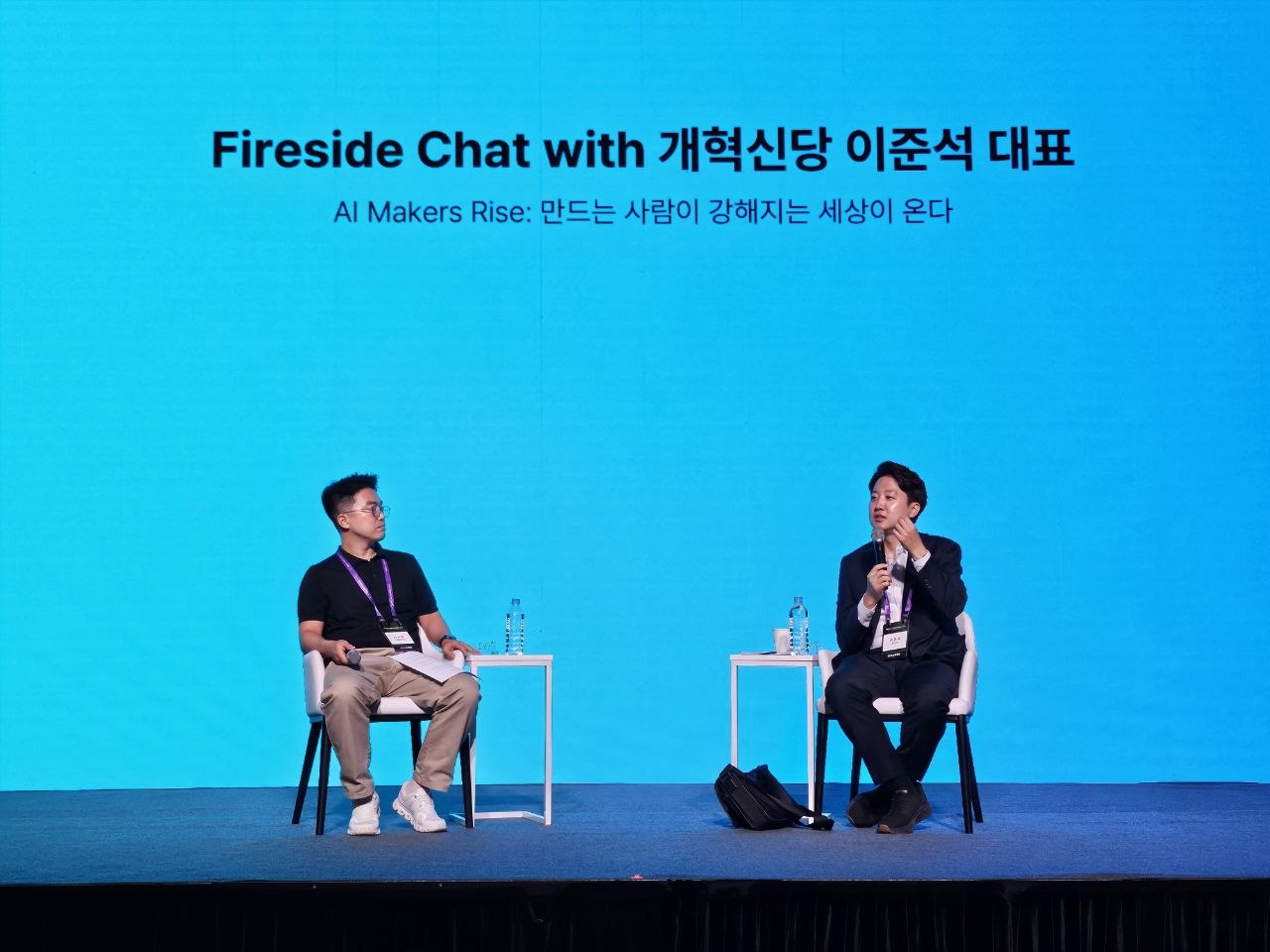
South Korea’s race to compete in artificial intelligence should not be framed as a head‑to‑head battle to “catch up with ChatGPT,” according to Lee Jun-seok, leader of the Reform Party. Speaking at MetaCon 2026 in Seoul, Lee argued that the country’s best chance is to build defensible advantages in domain expertise and application-layer products rather than pouring resources into GPU stockpiles and headline-grabbing foundation models.
Lee made the comments on Friday UTC (July 4), during a fireside chat with Na Seo-jeong, planning director of Seoul Meta Week, at MetaCon 2026—an AI conference hosted by TV Chosun and co-organized by TokenPost at COEX in Seoul. Under the session theme “AI Makers Rise: A World Where Builders Become Stronger,” Lee drew on his experience applying AI tools in political operations to outline what he sees as a more realistic playbook for Korean AI competitiveness.
One of Lee’s most pointed examples was how he has structured his own parliamentary office. “I may be one of the only lawmakers not to have an executive assistant,” he said, adding that he has instead hired two full-time developers to run ongoing projects. The shift reflects what he described as a broader change in how organizations adapt to AI: rather than leaning on systems integrators and external consultants, more teams are forming small in-house engineering groups capable of iterating quickly with modern AI-assisted development workflows.
Lee said his office has been building tools aimed at solving “political domain” problems—work that looks less like generic chatbot deployment and more like applied analytics and operations. He cited experiments analyzing voter bases in the Dongtan area using probabilistic methods and building an AI-driven interactive voice response polling system. According to Lee, the automated polling setup reduced costs from several million won to roughly 400,000–500,000 won (about $300–$370), illustrating how AI can compress operational budgets when paired with targeted software execution.
Beyond politics, Lee cautioned against an AI narrative dominated by hype and “AI FOMO.” He suggested that chat-style systems will eventually feel as ordinary as web search, recalling how universities initially resisted Wikipedia and Google, only to later teach students how to use search effectively. The urgent question, he said, is not whether AI will spread, but how individuals and organizations translate it into measurable productivity gains. “It’s not just a slightly more convenient search engine,” he noted, emphasizing that productivity improvements remain an “open question” that must be answered in each workplace and role.
On employment, Lee predicted significant disruption in parts of the software services market as development cycles collapse. He argued that systems that once cost tens of millions of won—such as ERP products—can increasingly be built in just a few days, putting pressure on traditional service providers and reshaping South Korea’s SaaS ecosystem centered around hubs like Pangyo. Still, he rejected the idea that people will simply “run out of work.” Instead, he framed coding as becoming “one of the languages,” less a high barrier and more a basic toolset—pushing domain specialists to take on more engineering-like responsibilities and potentially stabilizing employment by making expertise in real-world fields more valuable.
Lee also criticized the direction of government-backed AI industrial policy, particularly what he described as an overemphasis on GPU procurement. In his view, large-scale hardware allocation raises unresolved questions: by what criteria are GPUs distributed, and how should oversight work if firms choose revenue-generating activities that prioritize compute utilization over genuine R&D? He suggested that without a clear framework, subsidized infrastructure could be misallocated or fail to generate durable innovation.
He was equally skeptical about using national budgets to build foundation models “from scratch,” arguing that much of modern software innovation is built on open-source foundations. Lee said domestic model development has been constrained by political pressure to start from zero rather than leveraging existing architectures and ecosystems—an approach he implied is poorly matched to South Korea’s market reality.
In a global context, Lee pointed to the scale gap separating Korea’s AI sector from the front-runners. He noted that companies like OpenAI and Anthropic are discussed in terms of multi-trillion-won valuations, while China’s GLM is also assigned massive market value—advantages supported by large domestic markets and capital formation. South Korea, he argued, operates in a far more open arena where global AI models compete directly, making it difficult to replicate U.S. or China-style strategies with the same odds of success.
Even in “physical AI,” Lee urged selective prioritization. While South Korea is a world leader in industrial robot adoption, he said real-world demand often favors purpose-built robots over humanoids—raising doubts about whether humanoid-focused investment should be treated as the country’s top near-term bet.
As an alternative, Lee proposed a phased path: leverage South Korea’s comparatively deep developer base to win at the application layer first, then expand into specialized models anchored to a proven market. He pointed to the idea of capturing users through applications—citing Cursor as an example of an app-led approach—before building proprietary models tailored to specific verticals where Korean teams can demonstrate unmatched domain performance.
MetaCon 2026 ran July 3–4 in Seoul, convening builders and enterprise leaders to discuss AI technology, corporate transformation, marketing, and investment. Lee’s message, however, cut through the event’s broader programming with a clear strategic warning: in an era defined by scale economics and fast-moving global incumbents, Korea’s AI future may depend less on building the biggest models and more on producing the most effective tools in domains where it can genuinely lead.
Article Summary by TokenPost.ai
🔎 Market Interpretation
- South Korea’s most viable AI competitiveness path is positioned as application-layer and domain-expertise-led, not a direct “ChatGPT catch-up” race driven by foundation model headlines and GPU stockpiling.
- The market is shifting toward small, high-agency internal engineering teams using AI-assisted development to compress build cycles and costs, threatening traditional systems integrators and bespoke software services.
- GPU-first industrial policy introduces governance risk (allocation criteria, oversight, perverse incentives to maximize compute utilization over R&D), which could dilute national ROI and slow durable innovation.
- Scale economics favor U.S./China incumbents with capital formation and large domestic markets; Korea’s open-market exposure makes replication of their foundation-model strategies structurally harder.
- In robotics/“physical AI,” demand may skew toward task-specific robots rather than humanoids, suggesting near-term investment discipline is critical.
💡 Strategic Points
- Compete where defensibility exists: build products tightly coupled to Korean strengths in specific domains (regulated industries, language- and workflow-specific contexts, enterprise operations), rather than general-purpose chatbots.
- Start with applications to capture users and distribution, then graduate to specialized models once product-market fit is proven (app-led wedge → vertical model moat).
- Re-architect organizations for AI: replace consultant-heavy execution with compact in-house builder teams; iterate quickly using modern AI coding tools to reduce time-to-deploy.
- Measure AI by productivity outcomes, not novelty: treat chat interfaces as becoming “as ordinary as search,” and create role-by-role KPIs to validate real gains.
- Expect service-market disruption: ERP and similar systems can be built far faster/cheaper; SaaS ecosystems (e.g., Pangyo-centered vendors) should shift to differentiated workflows, data advantages, and ongoing iteration rather than one-off builds.
- Policy recommendation implied: prioritize clear governance for subsidized compute, incentives tied to measurable innovation and adoption, and pragmatic leverage of open-source foundations instead of “from scratch” mandates.
- Robotics investment triage: favor purpose-built industrial/service robots with near-term demand and deployability; scrutinize humanoid bets for timeline, cost, and actual customer pull.
📘 Glossary
- Foundation Model: A large general AI model trained on broad data used as a base for multiple applications (e.g., chat systems).
- Application Layer: User-facing products and workflows built on top of models (apps, copilots, enterprise tools) where distribution and domain fit create defensibility.
- Domain Expertise: Specialized knowledge (industry, operations, policy, language context) that improves problem selection, data labeling, evaluation, and product utility.
- GPU Procurement/Stockpiling: Government or enterprise purchasing of AI compute hardware; beneficial only when paired with strong allocation rules and outcomes.
- Systems Integrator (SI): A services firm that builds/implements IT systems for clients; vulnerable when AI reduces build complexity and time.
- ERP (Enterprise Resource Planning): Business software for core operations (finance, HR, supply chain); cited as becoming cheaper/faster to develop.
- SaaS Ecosystem: Network of software-as-a-service companies and customers; may be reshaped by rapid AI-assisted development cycles.
- AI FOMO: “Fear of missing out” driven adoption that prioritizes hype over measurable productivity.
- IVR (Interactive Voice Response) Polling: Automated phone system for surveys; example used to show large cost reductions via targeted AI-enabled tooling.
- Physical AI: AI embedded in real-world machines/robots; often constrained by reliability, cost, and deployment conditions.