Ethereum Leads Weekly Bridge Inflows as Arbitrum Posts $105 Million Outflow
Ethereum recorded the highest net bridge inflows while Arbitrum saw the largest outflows, highlighting ongoing liquidity rotation across major blockchain ecosystems.






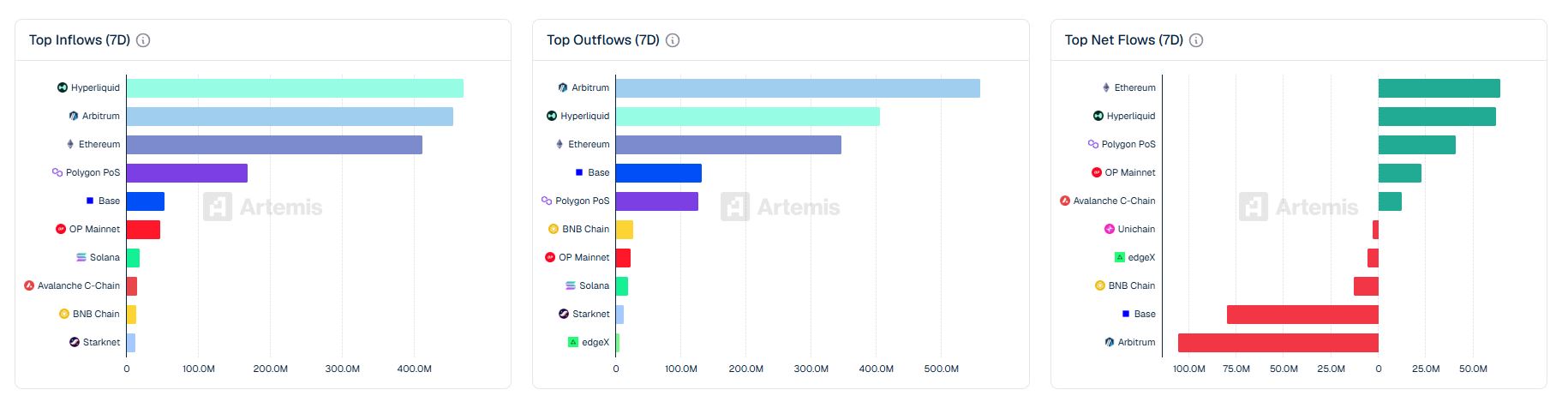
Ethereum (ETH) led weekly net bridge inflows among major blockchains, posting a $64.73 million net gain, even as Arbitrum recorded the largest net outflow at $105.48 million—signaling a fresh rotation of cross-chain liquidity rather than a one-way risk-on move.
According to data published by crypto analytics platform Artemis on June 24 UTC, bridge flows over the past week showed heavy two-way movement across several ecosystems. In gross inflows, Hyperliquid attracted the most bridged assets at $469.71 million, followed by Arbitrum at $454.92 million and Ethereum at $411.69 million. Polygon PoS brought in $168.73 million and Base added $53.24 million, while smaller but notable inflows were recorded on OP Mainnet ($47.14 million), Solana (SOL) ($19.07 million), Avalanche C-Chain (AVAX) ($15.76 million), BNB Chain ($14.70 million), and Starknet ($13.49 million).
On the outflow side, Arbitrum also saw the largest gross withdrawals at $560.40 million, underscoring its role as a high-velocity hub for bridging activity. Hyperliquid followed with $407.27 million in outflows, while Ethereum saw $346.96 million exit over the same period. Base recorded $132.72 million in outflows and Polygon PoS $127.71 million. Additional outflows were observed from BNB Chain ($27.46 million), OP Mainnet ($24.30 million), Solana ($19.63 million), Starknet ($13.44 million), and edgeX ($6.38 million).
Netting inflows against outflows, Ethereum emerged as the top destination for 'net liquidity inflow' with $64.73 million, edging out Hyperliquid at $62.43 million. Polygon PoS followed with a $41.02 million net inflow, while OP Mainnet added $22.85 million and Avalanche C-Chain gained $12.50 million.
Arbitrum posted the largest 'net liquidity outflow' at $105.48 million, suggesting capital may have been redeployed to other chains or temporarily moved off-bridge into alternative venues. Base recorded a $79.48 million net outflow, while BNB Chain saw $12.76 million. Smaller net outflows were also reported for edgeX ($5.47 million) and Unichain ($2.64 million).
Market observers often treat bridge flows as a proxy for where traders are positioning liquidity for on-chain activity—such as lending, perpetuals trading, or ecosystem-specific incentive programs—though the data can also reflect short-term arbitrage and operational rebalancing by large accounts. The latest figures point to continued fragmentation of on-chain liquidity, with Ethereum maintaining a net advantage as a settlement layer while high-throughput environments like Arbitrum and Base show signs of churn.
Overall, the week’s bridge activity highlights a market still actively reallocating capital across ecosystems. If net inflows into Ethereum persist, it could reinforce its role as the primary liquidity anchor, while sustained net outflows from certain Layer-2s may indicate shifting demand for specific trading venues, yields, or applications.
Article Summary by TokenPost.ai
🔎 Market Interpretation
Ethereum led net bridge inflows: ETH recorded +$64.73M net, narrowly ahead of Hyperliquid (+$62.43M), suggesting Ethereum remains a preferred settlement/liquidity destination despite large two-way flows.
Rotation, not pure risk-on: Arbitrum had the largest net outflow (-$105.48M) even while ranking near the top in gross inflows and outflows, indicating high churn and redistribution rather than a single-direction market bet.
Bridging hubs show velocity: Arbitrum’s $454.92M gross inflows and $560.40M gross outflows highlight its role as an active routing venue where liquidity frequently transits rather than accumulates.
Selective accumulation across chains: Polygon PoS (+$41.02M), OP Mainnet (+$22.85M), and Avalanche C-Chain (+$12.50M) posted positive net inflows, pointing to targeted deployments (apps, incentives, or positioning) beyond Ethereum alone.
Layer-2 churn signals venue switching: Base posted a sizable net outflow (-$79.48M), aligning with the article’s view that some high-throughput environments are seeing liquidity turnover as traders chase better yields, depth, or product fit.
Liquidity fragmentation persists: The distribution of inflows/outflows across many ecosystems supports a market structure where capital is continuously rebalanced across chains for tactics like arbitrage, lending, and perpetuals.
💡 Strategic Points
Track net flows, not just gross: High gross bridge activity can mask whether a chain is accumulating or merely routing liquidity. Net flow is the clearer signal for positioning.
Ethereum as “liquidity anchor” watch: If ETH maintains consistent net inflows, it may reinforce Ethereum’s role as the primary settlement layer where capital ultimately consolidates for safety, collateral usage, and deep DeFi liquidity.
Arbitrum/Base: interpret outflows carefully: Net outflows can reflect profit-taking, incentive cycling, venue migration, or operational rebalancing by large accounts—not necessarily bearish fundamentals.
Hyperliquid strength is two-sided: Leading gross inflows ($469.71M) alongside strong net inflow suggests durable demand, but large outflows imply tactical usage (e.g., perps/liquidity provisioning) that can reverse quickly.
Use flows to anticipate on-chain activity: Sustained net inflows often precede increased usage in lending, perps, and incentive programs; monitor whether net-positive chains see rising TVL/volume as follow-through confirmation.
Risk management: Rapid cross-chain rotations increase exposure to bridge risk, latency, and slippage. Favor robust routes, consider splitting transfers, and avoid bridging during volatility spikes.
📘 Glossary
Bridge flows: Movements of crypto assets between blockchains via bridges; used as a proxy for liquidity migration.
Gross inflow / gross outflow: Total value bridged into / out of a chain over a period, regardless of direction elsewhere.
Net flow (net inflow/outflow): Gross inflows minus gross outflows; indicates whether liquidity accumulated on a chain or left it.
Liquidity rotation: Capital moving among ecosystems to pursue better yields, incentives, liquidity depth, or trading opportunities.
Settlement layer: A base network where assets are ultimately held/settled, often due to perceived security and deep liquidity (e.g., Ethereum).
Layer-2 (L2): Scaling networks built on top of a Layer-1 (like Ethereum) to improve throughput and reduce fees (e.g., Arbitrum, Base, OP Mainnet).
Churn: High turnover of liquidity—large inflows and outflows with limited net change—often signaling short-term trading or routing behavior.
Arbitrage: Exploiting price differences across venues/chains; can generate bridge traffic without indicating long-term allocation.